Compact Fluorescent Lamps: Efficiency, Characteristics, and Evolution
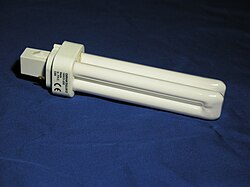
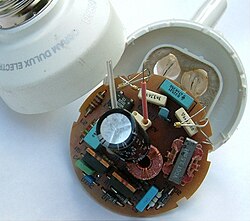
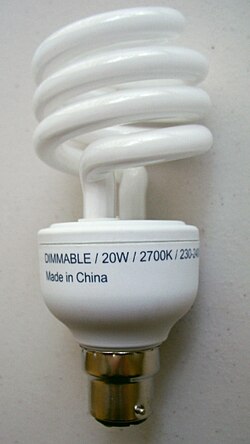
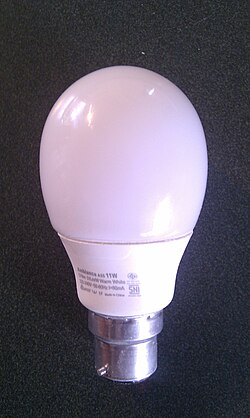
A Compact Fluorescent Lamp (CFL), often referred to as an energy-saving light or compact fluorescent tube, is a lighting technology designed to replace the traditional incandescent light bulb. By utilizing a fluorescent tube that is curved or folded to fit within a small space, and incorporating a compact electronic ballast in the base, CFLs provide a high-efficiency alternative for standard light fixtures.
While once the primary successor to incandescent lighting, the CFL has seen a commercial decline due to the rapid rise of Light Emitting Diode (LED) technology. By 2018, LEDs accounted for nearly 60% of the lighting market in India, and major manufacturers like General Electric began phasing out CFL production in early 2016.
Key Facts
- Lifespan: Rated between 6,000 and 15,000 hours, significantly longer than the 750–1,000 hours of standard incandescents.
- Efficiency: Typical luminous efficacy ranges from 50–70 lumens per watt (lm/W), compared to 10–17 lm/W for incandescents.
- Energy Use: CFLs generally use two-thirds to three-quarters less energy than equivalent incandescent bulbs.
- Composition: Contains a small amount of mercury and requires an electronic ballast to operate.
- Cost: While the initial purchase price is 3–10 times higher than incandescents, the long-term energy and replacement savings are substantial.
Technical Characteristics and Light Quality
The Spectrum of Light
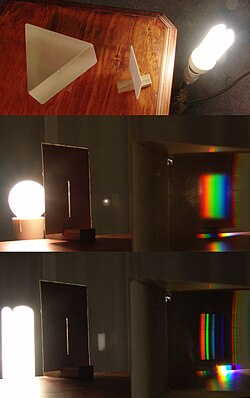
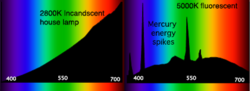
CFLs produce light differently than incandescent bulbs. While incandescents emit a continuous spectrum, CFLs have characteristic spectral power distributions (SPDs) with significant peaks, including some UV light that is not visible to the human eye.
Color Temperature
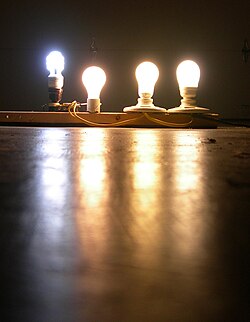
The appearance of light is measured by color temperature, expressed in Kelvin (K). This determines whether the light feels "warm" (yellowish) or "cool" (bluish).
| Name | Color Temperature (K) | Mired |
|---|---|---|
| Soft White | 2700 | 370 |
| Warm White | 3000 | 333 |
| Neutral White | 3500 | 286 |
| Cool White | 4000 — 4100 | 250 — 243 |
| Daylight | 5000 — 6500 | 200 — 154 |
Energy Efficiency and Performance
Luminous Efficacy
Lighting efficiency is measured in lumens (the power of light as perceived by the human eye) per watt of electricity. CFLs operate at a lighting efficiency of 7–10%, whereas incandescent lamps only reach 1.5–2.5%.
Power Consumption Comparison
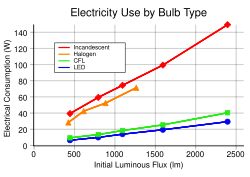
The following data illustrates the electric power use (in watts) required to achieve specific light outputs across different technologies:
- 450 Lumens: Incandescent (40W) | CFL (9–11W) | LED (6–8W)
- 800 Lumens: Incandescent (60W) | CFL (13–15W) | LED (9–12W)
- 1600 Lumens: Incandescent (100W) | CFL (23–28W) | LED (15–22W)
- 4000 Lumens: Incandescent (300W) | CFL (38W) | LED (Not listed)
Operational Considerations
Design and Versatility
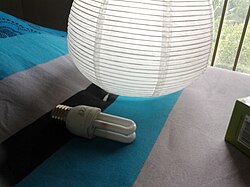
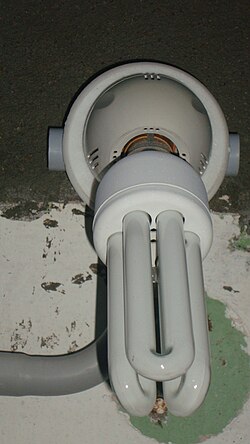
CFLs come in various forms, including tubular shapes popular in Europe and helical designs. Some are integrated with a permanently attached tube and ballast, while others use plug-in bases like the G24d.
Dimming and Power Factor
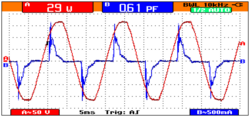
Standard CFLs are not naturally dimmable, though specific dimmable helical versions exist that can range from 2–100%. Additionally, CFLs can have a low power factor (e.g., 0.61) due to current distortion caused by the electronic ballast, meaning they may draw more volt-amperes than actual watts.
Environmental and Health Impact
CFLs contain mercury, which poses a risk if the bulb breaks or is disposed of improperly. EPA data suggests that approximately 14% of CFL mercury content escapes into the environment after landfill disposal.
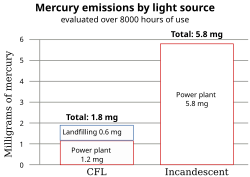
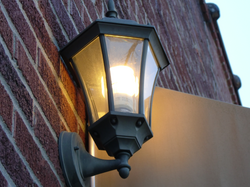
Interestingly, the impact of switching to CFLs can vary by region. In areas like Quebec and British Columbia, where electricity is primarily hydroelectric and heating is natural gas, the heat generated by incandescent bulbs may have actually reduced the need for gas heating. Some estimates suggested that a total switch to CFLs in Quebec could increase CO2 emissions by nearly 220,000 tonnes due to increased heating demands.
Frequently Asked Questions
Why do CFLs take time to reach full brightness?
CFLs often require a "warm-up" period to reach full luminosity. This effect is more pronounced in cold weather, where lamps may take several minutes to reach full brightness even with low-temperature ballasts.
Are CFLs more expensive than incandescent bulbs?
Yes, the initial purchase price is typically 3 to 10 times higher. However, because they last 8 to 15 times longer and use significantly less energy, they provide substantial long-term financial savings.
Can I use a CFL outdoors?
While some CFLs are designed for outdoor use, performance can be affected by ambient temperature, specifically regarding the starting time and brightness levels in cold environments.
How do CFLs compare to LEDs?
LEDs are generally more efficient, have longer lifespans, and do not contain mercury. This has led to a significant commercial decline in CFL production and sales globally.
What happens if a CFL breaks?
Because CFLs contain mercury, a broken bulb requires careful cleanup to avoid exposure to mercury vapor. Proper recycling is recommended over landfill disposal to prevent environmental contamination.