Communist Party of Belgium (CPB): The Rise and Fall of an Anti-Revisionist Splinter
The political landscape of mid-20th century Belgium was marked by ideological volatility, mirroring the global tensions of the Cold War. One of the most notable episodes of this era was the emergence of the Communist Party of Belgium (CPB), a party born from the depths of the Sino-Soviet split—the ideological break between the Soviet Union and the People's Republic of China.
The Origins of the CPB
The CPB began as a splinter group of the existing Communist Party of Belgium (KPB-PCB). By 1962, an anti-revisionist faction—those who opposed the perceived softening of Marxist-Leninist principles—began to gain traction within the KPB-PCB. This faction was led by Grippa, who was eventually expelled from the party after successfully promoting an anti-Soviet resolution during a local meeting in Brussels.
Following his expulsion, Grippa and his supporters launched a periodical titled La Voix du Peuple. By the third issue of this publication, the group's intentions were explicit: they aimed to organize a new, dedicated anti-revisionist party. This goal was realized in December 1963 at a national conference, where the CPB was officially founded on the basis of Marxism-Leninism.
Relations with China and the CCP
Grippa had cultivated relationships with the Chinese Communist Party (CCP) long before the CPB's inception, having visited Beijing in June 1956. He was viewed as a strategic asset by Kang Sheng for his ability to establish pro-Chinese influence within Belgium. Consequently, Grippa received high-level recognition, including personal meetings with Liu Shaoqi and Mao Zedong.
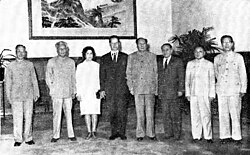
While the Chinese government provided initial material support, the relationship was fraught with tension. Grippa insisted on the CPB's independence, which eventually led him to criticize the official Chinese narrative regarding the Cultural Revolution (a socio-political movement intended to preserve Chinese Communism by purging remnants of capitalist and traditional elements). Specifically, Grippa condemned the attacks on Liu Shaoqi.
The Rittenberg Case and Diplomatic Decline
Grippa's defense of Liu sparked a public conflict known as the "Rittenberg case," after Sidney Rittenberg, a prominent Maoist, published a pamphlet censuring him. This dispute severely damaged Grippa's standing with both the Chinese government under Mao Zedong and the Albanian government under Enver Hoxha.
The breaking point occurred in the summer of 1966. During a visit to Beijing, Grippa was scolded by Kang Sheng for operating the party too independently from the CCP. By September 1966, China terminated its financial and material support, and Hoxha similarly withdrew his backing.
The Collapse of the Party
The loss of international support left the CPB vulnerable. In December 1967, Grippa was ousted from the party by an internal faction, a move potentially influenced by the Albanian government. By early 1968, the Chinese government shifted its support to a different entity, the Marxist–Leninist Communist Party of Belgium.
The CPB spent its final years plagued by internal factionalism, splitting into various smaller sub-groups. According to the Marxists Internet Archive, the party was officially dissolved in 1976.
Key Facts
- Founded: December 1963.
- Dissolved: 1976.
- Core Ideology: Anti-revisionist Marxism-Leninism.
- Key Leader: Grippa.
- Primary Catalyst: The Sino-Soviet split.
- Major Allies: Initially the CCP (China) and the Albanian government.
| Period | Status/Event | Key Outcome |
|---|---|---|
| 1962 | Schism in KPB-PCB | Expulsion of Grippa |
| 1963 | National Conference | Official founding of the CPB |
| 1966 | Rittenberg Case / Beijing Visit | Withdrawal of Chinese and Albanian support |
| 1967 | Internal Coup | Grippa ousted from leadership |
| 1976 | Final Dissolution | Party ceases to exist due to factionalism |
Frequently Asked Questions
Why was the Communist Party of Belgium (CPB) formed?
The CPB was formed as a splinter of the KPB-PCB due to the Sino-Soviet split. An anti-revisionist faction, led by Grippa, wanted a party that adhered more strictly to Marxism-Leninism and rejected Soviet influence.
Who was Grippa and what was his role?
Grippa was the leader of the anti-revisionist faction and the founder of the CPB. He established early ties with the Chinese Communist Party and was personally received by Mao Zedong and Liu Shaoqi.
What was the "Rittenberg case"?
The Rittenberg case was a political conflict that arose when Sidney Rittenberg, a Maoist, censured Grippa in a pamphlet for defending Liu Shaoqi during the Cultural Revolution.
Why did China stop supporting the CPB?
China ended its support in September 1966 because Grippa led the party too independently from the CCP and criticized the official narrative of the Cultural Revolution.
How did the CPB eventually end?
The party suffered from intense internal factionalism, leading to the creation of several divided sub-groups. It was officially dissolved in 1976.