Common Wall Lizard: A Study in Color, Survival, and Global Expansion
The common wall lizard (Podarcis muralis) is a small, agile reptile that has become a fascinating subject of evolutionary study. Known for its remarkable ability to adapt to diverse environments, this species is found throughout much of mainland Europe and has established successful introduced populations in North America. Whether scurrying through rocky crevices in the Mediterranean or navigating urban rubble in the United States, the common wall lizard demonstrates a high degree of biological resilience.
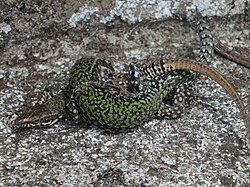
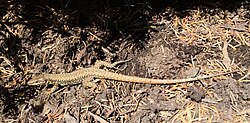
Reaching a total length of approximately 20 cm (7.9 in), these lizards are characterized by their thin bodies and highly variable coloration. While they are often brownish or greyish, some individuals display green tinges or intricate patterns of spots and reticulations. Their underbellies are particularly striking, featuring six rows of larger rectangular scales that range in color from reddish to orange or pink.
Key Facts
- Scientific Name: Podarcis muralis
- Total Length: Approximately 20 cm (7.9 in)
- Conservation Status: Least Concern (IUCN 3.1)
- Primary Habitat: Rocky environments, urban settings, and debris
- Key Feature: Six distinct color morphs based on throat and belly coloration
- Global Presence: Native to Europe and Turkey; introduced to North America and parts of Britain
Morphology and Color Polymorphism
One of the most scientifically significant aspects of P. muralis is its polymorphism—the occurrence of several different forms or phenotypes within a single species. The common wall lizard exhibits six distinct morphological forms, which are primarily identified by the color of their throat and underbelly. These include three pure morphs (white, red/orange, and yellow) and three combination morphs (white-yellow, white-red, and yellow-red).
These color variations are driven by specific pigments: carotenoids produce yellow hues, while pteridines are responsible for red and orange tones. This complexity suggests that genetic mechanisms such as multiple alleles or epistasis play a role in determining their appearance.
Sexual Dimorphism and Physical Traits
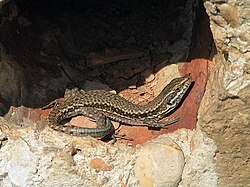
The species also exhibits sexual dimorphism, meaning males and females display different physical characteristics. While males show vibrant coloration on their underbellies, females typically have much less color in this region. Research has even identified differences in digit ratios; specifically, males tend to have larger 2D:4D and 2D:3D ratios on their paws compared to females.
Ecological Strategies and Evolutionary Trade-offs
The different color morphs are not merely aesthetic; they represent unique evolutionary trade-offs that allow the species to survive in varying conditions. These morphs differ in body size, immune competence, and reproductive strategies.
Survival and Immunity
There is a clear link between color morphs and resistance to the haemogregarine parasite. White morphs demonstrate the highest resistance, while red and yellow-red morphs are the most susceptible. This creates a biological balance: orange morphs tend to be larger to compete physically, but they face higher risks of infection, whereas white morphs invest more metabolic energy into a hardy immune system.
Reproductive Strategies: r vs. K Selection
Females of different morphs employ different reproductive methods to ensure offspring survival:
- r-strategists: Yellow females often produce many smaller eggs, a strategy suited for proliferating in populations with less competition.
- K-strategists: White females produce fewer, larger eggs, which increases the likelihood of offspring survival in harsh or highly competitive environments.
- Flexible strategies: Red females may act as either r or K strategists depending on their specific environment.
Communication and Chemical Signaling
Beyond visual cues, common wall lizards rely heavily on chemical communication. Males possess femoral glands that secrete waxy, proteinic, and lipophilic compounds. These secretions are used to mark territories and attract mates.
Interestingly, the chemical composition of these secretions varies by morph. For instance, red morphs produce higher concentrations of α-tocopherol, a molecule that prevents oxidation in humid environments. This allows their scent marks to persist longer, suggesting that red morphs are often more territorial and maintain their boundaries more effectively than other morphs.
Global Distribution and the "Lazarus Lizard"
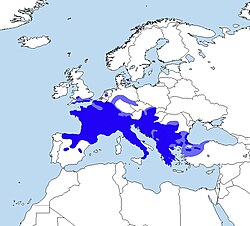
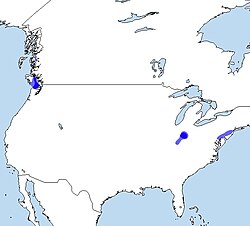
While native to mainland Europe and Turkey, the common wall lizard has successfully expanded its range through human activity. In southern Britain, populations have become well-established, particularly in seaside areas like the Isle of Wight.
The North American Introduction
In the United States, the species is famously known in the Cincinnati, Ohio, area as the "Lazarus lizard." This name stems from an introduction around 1950 by George Rau, who released approximately ten lizards near his home after a trip to Italy. Despite an extreme genetic bottleneck—where it is believed only three individuals survived to reproduce—the population has exploded.
Today, the species is considered a naturalized part of the ecosystem in southwest Ohio, Kentucky, and parts of Indiana. In Ohio, the lizard is protected under state law, making it illegal to harm or possess them without a license. Similarly, a population was established on Vancouver Island, Canada, in 1970 via a private zoo release.
Summary of Morphological and Ecological Traits
| Morph Type | Immune Resistance | Reproductive Strategy | Key Characteristic |
|---|---|---|---|
| White | Highest | K-strategist (fewer, larger eggs) | Metabolic focus on immunity |
| Yellow | Intermediate | r-strategist (many, smaller eggs) | High proliferation potential |
| Red/Orange | Lowest | Variable (r or K) | Larger body size; high territoriality |
Frequently Asked Questions
What is the difference between r and K strategists in lizards?
An r-strategist focuses on quantity, producing many small offspring to ensure at least some survive, while a K-strategist focuses on quality, producing fewer, larger, and more developed offspring to increase individual survival rates.
Why is the common wall lizard called the "Lazarus lizard" in Ohio?
It earned this nickname because the population in Cincinnati grew exponentially from a tiny group of survivors (as few as three) following an intentional release in the 1950s.
How do wall lizards communicate with each other?
They use a combination of visual signals and chemical signals. Males use femoral glands to release waxy secretions that convey social information, such as territory ownership and mating readiness.
Are common wall lizards considered an invasive species?
In North America, they are considered a naturalized species. In Ohio, they are specifically protected under state law, meaning they are a recognized and legal part of the local fauna.
What causes the different colors in wall lizards?
The colors come from different pigments: carotenoids create yellow colors, while pteridines create red and orange colors. The specific combination is determined by the lizard's genetics.