Common Eland: The Giant Antelope of Africa
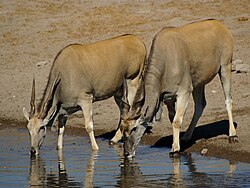
The common eland (Taurotragus oryx), also known as the southern eland or eland antelope, is one of the largest and most impressive antelope species found across the savannahs and plains of East and Southern Africa. First scientifically described by Peter Simon Pallas in 1766, this massive herbivore is renowned for its size, strength, and adaptability to diverse African landscapes.
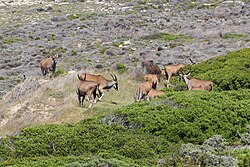
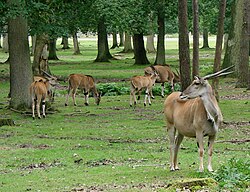
These animals are primarily grazers and browsers, feeding on a variety of grasses and leaves. They are highly social, often forming massive herds of up to 500 individuals, though they do not maintain fixed territories. Their preference for open woodlands, savannahs, and montane grasslands allows them to thrive in environments rich with flowering plants, though they instinctively avoid dense forests and swamps.
Key Facts
- Maximum Weight: Bulls can reach up to 942 kg (2,077 lb), with some reaching 1,000 kg.
- Conservation Status: Listed as Least Concern by the IUCN.
- Unique Ability: Capable of jumping up to 2.5 meters (8 ft 2 in) from a standing start.
- Diet: Primarily herbivorous, consuming grasses and leaves.
- Social Structure: Non-territorial, forming herds of up to 500 animals.
- Domestication: Successfully domesticated in Southern Africa for meat and high-fat milk.
Physical Characteristics and Biology
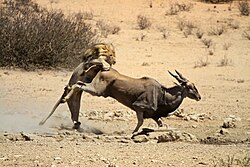
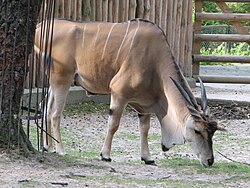
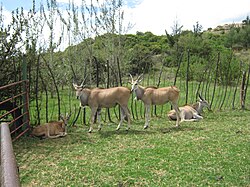
Common elands exhibit significant sexual dimorphism, meaning males and females differ noticeably in size and appearance. Adult males typically stand about 1.6 m (5.2 ft) tall at the shoulder and weigh between 500 and 600 kg, though exceptional bulls can exceed 900 kg. Females are smaller, averaging 1.4 m (4.6 ft) in height and weighing between 340 and 445 kg.
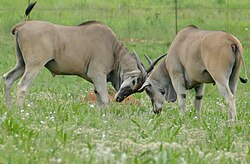
Both sexes possess spiral-horned ridges. While newborns have small horn buds, these grow rapidly during the first seven months. Male horns are generally thicker and shorter with a tighter spiral, used primarily for wrestling and butting during the rutting season. In contrast, females use their horns to protect their calves from predators.
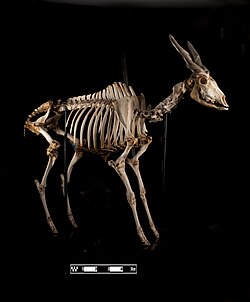
Despite their bulk, elands are agile jumpers. While they are the slowest of the antelopes—reaching a peak speed of 40 km/h (25 mph) before tiring—they can maintain a steady trot of 22 km/h (14 mph) indefinitely. Young elands are particularly athletic, capable of jumping up to 3 meters (9.8 ft) when startled.
Taxonomy and Subspecies
The common eland belongs to the family Bovidae and the subfamily Bovinae. While some molecular phylogenetic studies suggest they belong to the genus Tragelaphus, they are most commonly categorized under Taurotragus, sharing the genus with the giant eland (T. derbianus).
There are three recognized subspecies, though their classifications are sometimes debated:
- Cape Eland (T. o. oryx): Found in Southern and southwestern Africa; adults typically lose their stripes and have tawny fur.
- Livingstone's Eland (T. o. livingstonii): Native to the Central Zambezian miombo woodlands, featuring brown fur with up to 12 stripes.
- East African Eland (T. o. pattersonianus): Found in East Africa and also characterized by up to 12 stripes.
Behavior and Ecology
Elands are crepuscular, meaning they are most active during the dawn and dusk hours. They spend the hottest parts of the day resting in the shade and bask in the sun when temperatures drop. Communication is achieved through loud barks, postural movements, and the flehmen response (curling the upper lip to detect pheromones).
Their social structure is divided by age and sex. Males often form small bachelor groups or wander alone, while females and juveniles form larger herds. A complex linear hierarchy exists among females. Calves are born into a nursery group, staying there until approximately two years of age before joining the adult groups.
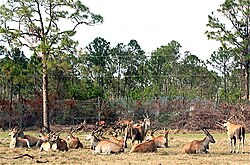
Mating typically occurs during the rainy season when lush grass is abundant. Females generally choose the most dominant and fit males, which often leads to competitive fighting between bulls.
Interaction with Humans and Conservation

The common eland is currently listed as Least Concern by the IUCN, with an estimated population of 90,000 to 110,000 mature individuals. Populations are stable or increasing in countries such as Namibia, Botswana, South Africa, and Tanzania. About half of the population lives in protected areas, while 30% reside on private land.
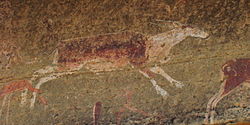
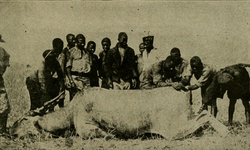
Humans have utilized elands for meat and leather for centuries. In Southern Africa, they have been domesticated as an alternative to cattle because they are better suited to the local climate. Eland milk is particularly prized for its high butterfat content (11-17%), which is significantly higher than that of cow's milk, and it can be stored for up to eight months if properly prepared.
| Feature | Male (Bull) | Female (Cow) |
|---|---|---|
| Average Height | 1.6 m (5.2 ft) | 1.4 m (4.6 ft) |
| Weight Range | 400–942 kg (882–2,077 lb) | 300–600 kg (660–1,320 lb) |
| Horn Length | 43–66 cm (17–26 in) | 51–69 cm (20–27 in) |
| Sexual Maturity | 4 to 5 years | 15 to 36 months |
Frequently Asked Questions
How does eland milk differ from cow's milk?
Eland milk is much richer, with a butterfat content of 11-17%, compared to the lower fat content of cow's milk. Additionally, when properly prepared, eland milk can be stored for up to eight months, whereas cow's milk lasts only a few days.
Why are elands considered the slowest antelopes?
While they can reach a peak speed of 40 km/h (25 mph), they tire very quickly at this pace. However, they compensate for this by being able to maintain a steady trot of 22 km/h (14 mph) indefinitely.
What is the conservation status of the common eland?
The common eland is classified as Least Concern by the IUCN. Its population is considered stable or increasing, with many individuals living in protected national parks and on private lands across Africa.
Can common elands be kept as livestock?
Yes, they have been successfully domesticated in South Africa and Russia for meat and milk. However, they are difficult to house because they can jump over fences up to 3 meters high or break through enclosures using their massive weight.