Common Carp: Biology, Domestication, and Global Impact
The common carp (*Cyprinus carpio*) is one of the most recognizable and widespread freshwater fish in the world. From its role as a vital food source in global aquaculture to its status as a highly sought-after ornamental variety, this robust species has left an indelible mark on human history and aquatic ecosystems alike.
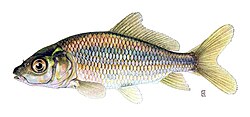
Whether appearing as the shimmering koi in a Japanese garden or as a massive specimen in a European fishery, the common carp is a master of adaptation. This article examines the fascinating biology, diverse varieties, and the complex ecological footprint of this resilient fish.
Key Facts
- Scientific Name: Cyprinus carpio
- Conservation Status: Least Concern (IUCN 3.1)
- Maximum Weight: Over 40 kg (88 lb) recorded in domesticated forms.
- Lifespan: Can live for decades; one wild-origin specimen reached 64 years.
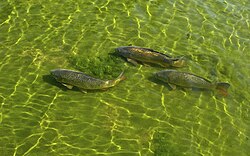
- Habitat: Prefers large, slow-moving or standing freshwater bodies.
- Dietary Adaptation: Capable of surviving in low-oxygen environments by gulping air at the surface.
Taxonomy and History of Domestication
The common carp belongs to the family Cyprinidae, a large group of freshwater fishes. Its history is deeply intertwined with human civilization. In Europe, the domestication of carp for food was significantly advanced by monks between the 13th and 16th centuries. Evidence suggests that wild forms had already reached the Rhine delta by the 12th century, likely aided by human movement.
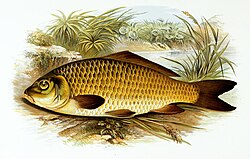
Diverse Varieties and Subspecies
Through centuries of selective breeding, several distinct varieties have emerged:
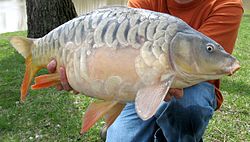
- Mirror Carp: Characterized by large, mirror-like scales. Some variants, known as linear mirror carp, are scaleless except for a single row of large scales along the lateral line.
- Leather Carp: These fish are virtually unscaled, except for areas near the dorsal fin.
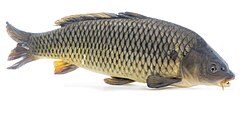
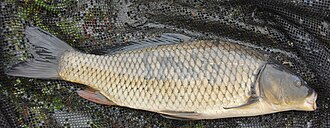
- Fully Scaled Carp: The traditional form covered in conspicuous, shiny scales.
- Koi Carp: These ornamental varieties originated in Japan's Niigata region in the 1820s. While often associated with the common carp, recent scientific consensus suggests they may originate from an East Asian species, possibly Cyprinus rubrofuscus.
![Koi feeding. The koi are ornamental varieties of domesticated carp and are kept in garden ponds. Although the koi's parent species has been considered the common carp, recent authorities believe it originates from an East Asian carp, possibly Cyprinus rubrofuscus.[1][6]](/images/7d/01/7d018907bab2a17ef237ae12b56a281798e0116dbc33b372223e3ead837e9cb0.jpg)
Physiology and Life History
The common carp possesses a robust build, often displaying a dark gold sheen, particularly on the head. Its anatomy includes large pectoral fins and a tapering dorsal fin that runs down the last two-thirds of its body. A defining feature is the downward-turned mouth, equipped with two pairs of barbels (sensory organs) located at the corners of the upper and lower lips.
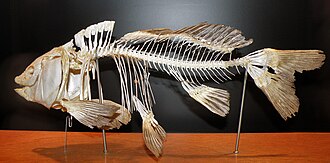
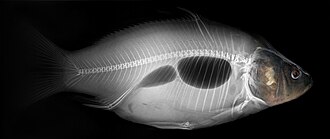
While wild carp tend to be slimmer, domesticated varieties are bred for size. Domesticated carp can reach a maximum length of 120 cm (47 in) and weights exceeding 40 kg. In contrast, the average common carp typically measures between 40–80 cm and weighs between 2–14 kg.
Habitat and Environmental Tolerance
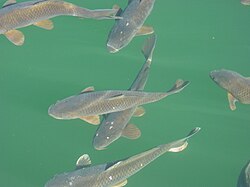
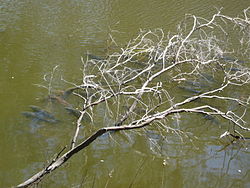
Carp are highly tolerant of varying conditions, thriving in temperate climates with water temperatures ranging from 3 to 35 °C (37–95 °F). Their ideal temperature range is 23 to 30 °C (73–86 °F). They prefer slow-moving or standing water with soft, vegetative sediments and can tolerate salinity levels up to 0.5%.
Global Aquaculture and Economic Importance
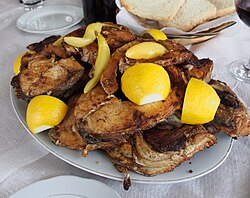
Common carp is a major player in the global food industry. In the 2015–2016 period, carp contributed approximately 4.67 million tons to global aquaculture, representing about 7.4% of total global inland fisheries production.
![Global aquaculture production of common carp (Cyprinus carpio) in million tonnes from 1950 to 2022, as reported by the FAO[66]](/images/54/7e/547e17fc373db279e10423f1550de2d4dba55823c797392507f6231455c7a92a.webp)
In Europe, production is concentrated in central and eastern countries. The Russian Federation, Poland, the Czech Republic, Hungary, and Ukraine account for roughly 70% of European carp production. While carp farming is a vital economic driver for land-locked central European countries, it is sometimes scrutinized regarding its potential contribution to eutrophication—the enrichment of water with nutrients that can lead to oxygen depletion.
Ecological Impact and Invasive Status
While beneficial in controlled aquaculture, the common carp can become a significant problem when introduced to non-native habitats. In Australia, carp were introduced over 150 years ago and have since established themselves in every state and territory except the Northern Territory. In Victoria, they are classified as a noxious species.
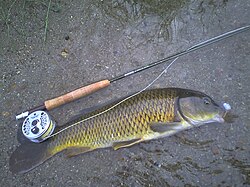
In these environments, they can disrupt local ecosystems. Management strategies vary by region; for example, in South Australia, it is an offense to release carp back into the wild, while in other areas, they are even utilized to produce plant fertilizer.
Summary of Common Carp Characteristics
| Feature | Details |
|---|---|
| Preferred Water Type | Fresh or slightly brackish; slow-moving or standing. |
| Ideal Temperature | 23 to 30 °C (73–86 °F). |
| Key Physical Traits | Downward mouth, two pairs of barbels, large scales. |
| Major Varieties | Mirror, Leather, Fully Scaled, and Koi. |
| Global Role | Major aquaculture species and potential invasive pest. |
Frequently Asked Questions
What is the difference between a common carp and a koi?
Koi are domesticated ornamental varieties of carp bred for color and pattern. While they were traditionally thought to be a variety of the common carp, many authorities now believe they originate from an East Asian species, possibly Cyprinus rubrofuscus.
How large can a common carp grow?
Domesticated carp can grow significantly larger than wild ones, reaching lengths of up to 120 cm (47 in) and weights exceeding 40 kg (88 lb).
Can carp survive in frozen ponds?
Yes. Common carp can survive winter in a frozen-over pond as long as there is some free water remaining beneath the ice.
Why are carp considered invasive in some regions?
In areas where they are not native, such as parts of Australia, they can establish massive populations that disrupt local ecosystems and compete with native species.
What are the different scale patterns in carp?
Carp can be fully scaled, mirror carp (large scales along the lateral line), or leather carp (virtually scaleless).