Common Brushtail Possum: Biology, Habitat, and Human Interaction
The common brushtail possum (Trichosurus vulpecula) is one of Australia's most recognizable and widespread marsupials. Known for its distinctive tail and nocturnal lifestyle, this semiarboreal mammal—meaning it spends much of its time in trees—has become a fixture in both wild landscapes and urban environments. While it is a native resident of Australia, its history and impact in New Zealand tell a very different story of ecological adaptation and challenge.
Key Facts
- Scientific Name: Trichosurus vulpecula
- Status: Least Concern (IUCN 3.1)
- Diet: Primarily a folivore (leaf-eater), often consuming eucalyptus leaves.
- Lifestyle: Nocturnal and largely solitary.
- Native Range: Australia, Tasmania, and various offshore islands.
- Invasive Range: New Zealand (introduced in the 1850s).
Physical Characteristics and Classification
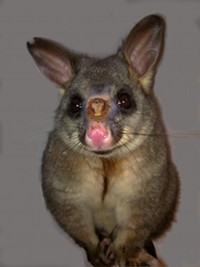
Belonging to the family Phalangeridae, the common brushtail possum is the second-largest of the Australasian possums. Its name is derived from the Greek for "furry tailed" and the Latin for "little fox." Physically, these animals are quite varied, with coat colors ranging from silver-grey and brown to black and gold.
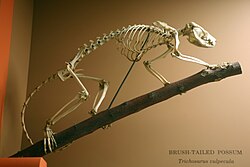
An adult typically weighs between 1.2 and 4.5 kg, with a head and body length of 32–58 cm. They are characterized by a prehensile tail—a tail capable of grasping—which is naked on its lower underside. Both males and females possess a scent gland on the chest that emits a reddish secretion used for territorial marking. Males are generally larger than females and often exhibit reddish fur at the shoulders.
Subspecies Variations
The species is divided into several subspecies across different geographic regions:
- T. v. vulpecula (South-eastern and central)
- T. v. arnhemensis (Northern)
- T. v. eburacensis (Cape York)
- T. v. johnsoni (Coppery)
- T. v. fuliginosus (Tasmanian)
- T. v. hypoleucus (South-western or Koomal)
Biology and Ecology
As nocturnal creatures, brushtail possums are most active during the night. They are primarily folivores, meaning their diet consists mainly of leaves, particularly eucalyptus. However, they are opportunistic and have been known to consume small mammals like rats and various fruits.
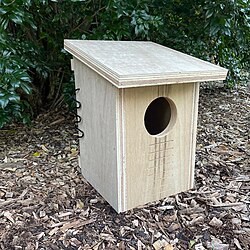
In terms of social structure, they are mostly solitary. They maintain distance from one another through scent marking (urinating) and various vocalizations, including clicks, grunts, hisses, and even guttural coughs. While they often sleep in separate dens, they may occasionally share spaces. Common den sites include natural tree hollows, caves, and even the roof spaces of human homes.

Reproduction and Life Cycle
Brushtail possums can breed year-round, though peaks often occur in spring (September to November) and autumn (March to May). The reproductive process is a classic example of marsupial biology:
- Gestation: The female has a gestation period of 16–18 days.
- Birth: A single newborn, weighing only about 2g and measuring 1.5 cm, climbs into the female's pouch.
- Pouch Development: The young remains in the pouch for 4–5 months, receiving immunological protection through specialized milk secretions.
- Independence: Once older, the young may ride on the mother's back until they are 7–9 months old.
Range and Habitat Distribution
The species is incredibly adaptable, found in forests, semi-arid areas, and urban environments. In Australia, they are found across the eastern and northern parts of the continent, Tasmania, and islands like Kangaroo Island. In Western Australia, local populations are known by various indigenous names, such as nunguin in the Kimberley and bilda on the Nullarbor Plain.
In New Zealand, the situation is different. Introduced in the 1850s for the fur industry, the lack of natural predators allowed them to thrive, making them a major agricultural and conservation pest. While Australian populations face threats from predators like tiger quolls, foxes, and owls, New Zealand populations are primarily managed due to their impact on native forests and birds.
| Feature | Australia | New Zealand |
|---|---|---|
| Status | Native | Invasive |
| Population Trend | Decreasing in some regions | Managed/Stable (after peak) |
| Primary Threats | Habitat loss, predators (cats, foxes, owls) | Human control measures |
| Disease Concerns | Bovine tuberculosis eradicated | Host for bovine tuberculosis |
Relationship with Humans
The relationship between humans and the brushtail possum is complex. In urban areas, they are often viewed as pests because they can damage fruit trees, vegetable gardens, and buildings. However, they are also highly tolerant of human presence.
In Australia, they are largely protected, though regulations vary by state. For example, in South Australia, they are fully protected, whereas in other states, specific permits are required for trapping or relocation. In New Zealand, they are actively controlled via aerial baiting to protect native ecosystems.
Frequently Asked Questions
Are brushtail possums dangerous to humans?
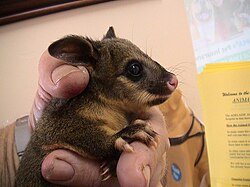
While they are generally not aggressive, they can be defensive if cornered. They have very sharp claws that can cause scratches, which may lead to infection or the transmission of disease.
Why are they considered a pest in New Zealand?
Because they were introduced without natural predators, their population exploded. They cause significant damage to native forests and are a host for bovine tuberculosis, which threatens local ecosystems.
What do brushtail possums eat?
They are primarily folivores, meaning they eat leaves (especially eucalyptus), but they are also known to eat fruit, vegetables, and occasionally small mammals like rats.
How long do they live in the wild?
In their natural habitat, common brushtail possums can live for up to 13 years.
Can they live in residential areas?
Yes, they are highly adaptable and are one of the few possum species that thrive in cities, often using house roofs as dens.