Command and Staff College Quetta
The Command and Staff College Quetta is a premier staff college of the Pakistan Armed Forces. Located in the scenic landscape of Quetta, Balochistan, it serves as a critical center for advanced military education, shaping the strategic and tactical capabilities of senior officers. Affiliated with the National Defence University, the college is renowned for its rigorous academic standards and its role in fostering professional military leadership.
Key Facts
- Established: 1905 (originally as Staff College, Deolali).
- Location: Quetta, Balochistan, Pakistan.
- Current Commandant: Maj-Gen. Naseem Anwer.
- Student Body: Approximately 400 officers, including international students from over 23 nations.
- Faculty-to-Student Ratio: Approximately 1:8.
- Core Publication: The Citadel.
Historical Evolution
The institution was founded in 1905 as the Staff College, Deolali, to eliminate the need for British Indian Army officers to travel to the Staff College, Camberley in Great Britain for graduate studies. This initiative was championed by Field Marshal Lord Kitchener, the then Commander-in-Chief, India, who sought to expand staff appointments through a localized curriculum.
In 1907, the college moved to its current location in Quetta, where new academic centers and dormitories were constructed. It was officially opened on June 1, 1907, by Major General Horace Smith-Dorrien. While the college briefly closed during World War I (1915–1919) to serve as a Cadet College, it resumed its primary function shortly thereafter.
Following the Partition of British India in August 1947, the institution transitioned into its role within the newly formed state of Pakistan. A significant piece of its early history remains visible today in the Staff College monument, the only original structure still standing after a devastating earthquake in 1935 necessitated extensive reconstruction.
Location and Geography
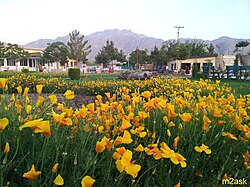
Situated in the Quetta Cantonment at the entrance to the Urak Valley, the college is surrounded by the Takatu, Murdarghar, and Chiltan mountain ranges, which reach heights between 930 and 1,020 meters. A notable local landmark is the "Sleeping Beauty" mountain, named for its resemblance to a reclining woman, which is particularly striking during the winter snowfall.
Motto and Symbolism
The college's identity has evolved to reflect its cultural and national context. Until 1950, it utilized the Latin motto "Tam Marte Quam Minerva" (By the pen as much as by the sword), accompanied by an emblem featuring an owl, the symbol of wisdom.
In 1979, the emblem was updated to include the word Iqra (Read!), a reference to the 96th surah of the Qur'an. The current Persian motto, "Pir Sho Biyamooz – Saadi," translates to "Grow old learning," quoting the famous poet Saadi to emphasize the importance of lifelong acquisition of knowledge.
Organizational Structure
The college is led by a Commandant (Major General) and divided into two primary wings:
- Instructional Wing: The core of the college, headed by a Chief Instructor (Brigadier). It consists of four instructional divisions and the Faculty of Research and Doctrinal Studies (FORADS), which manages research and IT/media wings.
- Headquarters Wing: Provides the necessary administrative support to ensure the smooth operation of the Instructional Wing.
The college maintains a cosmopolitan atmosphere, hosting approximately 30 officers from over 23 allied nations, which enhances the diversity of perspectives in military discourse.
Academic Objectives and Criteria
The primary goal of the college is to produce graduates capable of handling complex operational and administrative staff functions. Key objectives include:
- Developing insight into tactical operations within battlefield environments.
- Integrating tactical plans into broader operational strategies and joint services warfare.
- Applying leadership and management skills within socio-religious settings.
- Analyzing international and regional political orders.
- Conducting professional research and resolving complex military problems.
Admission Requirements
While predominantly for Army officers, admission is open to Navy and Air Force officers, as well as interagency federal officials focused on national security. Pakistani military applicants typically require the rank of OF-4 with 8–12 years of service, a Bachelor's degree, and completion of mid-career leadership examinations. Civilian applicants with a Bachelor's degree may qualify for a Master of Science in Art and Science of Warfare from the National Defence University, Islamabad.
Campus Life and Facilities
The campus is designed to support both professional growth and personal well-being. It features a Main Library for professional research and a Fiction Library for leisure reading, as well as a museum inaugurated in 1979 that preserves the college's history.
Social and recreational life is centered around several clubs:
- Saddle Club: Offers equestrian activities with 30 ponies.
- Shikar Club: Dedicated to shooting sports.
- Polo: A popular seasonal sport played from April to November.
- Al-Nisa Club: An active club for the spouses of officers.
- Allied Officers Cell: Ensures the welfare and integration of international students.
For families, the college provides the Iqra Army Public School and College. Additionally, Barki Park offers a recreational retreat featuring live Rabab music, a skating arena, zip lining, and rock climbing.
Professional Publications
Since 1984, the college has published The Citadel, a professional magazine focused on doctrinal issues, national security, and conceptual military thought. This replaced earlier year-books such as Owl Pie, The Owl, and The Review.
Summary of Institution Details
| Category | Details |
|---|---|
| Type | Staff College |
| Affiliation | Pakistan Armed Forces / National Defence University |
| Student Capacity | ~400 Officers |
| Faculty Size | ~55 Members |
| Official Colors | Grey and Maroon |
| Website | cscquetta.gov.pk |
Frequently Asked Questions
What is the primary purpose of the Command and Staff College Quetta?
The college serves as a post-graduate military institution that trains senior officers in the art and science of warfare, focusing on tactical operations, operational strategy, and administrative staff functions.
Who is eligible to attend the college?
Admission is primarily for Army officers (typically rank OF-4 with 8–12 years of service), but it is also open to Navy and Air Force officers, as well as specific federal civilians involved in national security.
What is the significance of the motto "Pir Sho Biyamooz"?
Attributed to the poet Saadi, the Persian phrase means "Grow old learning," reflecting the institution's commitment to continuous professional development and lifelong learning.
Does the college accept international students?
Yes, the college hosts approximately 30 officers from over 23 allied nations, contributing to a cosmopolitan learning environment.
What is "The Citadel"?
The Citadel is the college's official professional publication, established in 1984 to provide a forum for discussing military doctrine and national security issues.