Columbia University School of Library Service
Established in 1926, the Columbia University School of Library Service stood for decades as a cornerstone of professional librarian training in the United States. Formed by merging the New York State Library School in Albany and the training school of the New York Public Library, the institution was launched with a grant from the Carnegie Corporation of New York. This merger brought significant resources to the university, including a foundational collection of 6,000 books from the Albany school.
Under the leadership of its first director, Charles C. Williamson, the school transitioned from a purely vocational approach to one incorporating more theoretical educational materials. Initially operating out of East Hall and the Business Building (later Dodge Hall), the school expanded its reach in 1928 by absorbing the American Correspondence School of Librarianship from Syracuse, New York.
The Golden Era of Expansion
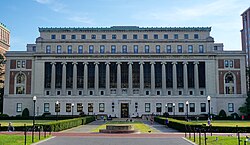
By the early 1930s, Columbia had cemented its status as one of the five premier library schools in the nation. A pivotal moment occurred in 1934–35 with the opening of South Hall, which was later renamed Butler Library. Moving the school into the university's main library provided students with what Dean Williamson described as a "laboratory" for their studies.
This move coincided with a period of unprecedented growth. The school's curriculum was revised to support advanced study and to reposition the public library as a hub for adult community learning. Enrollment peaked during the 1938–39 academic year with 1,071 students, making it the largest library school in the country at the time.
Global Influence and Leadership
The school's impact extended far beyond New York. Its model was used to establish international training centers, such as the library school at the University of Cape Town, founded by a 1938 Columbia graduate. Leadership transitioned from Charles C. Williamson to Carl M. White in 1943, ensuring the school's continued academic rigor.
Academic Evolution and Specializations
In 1948, the school overhauled its degree programs. It replaced the "fifth-year" bachelor's degree with a one-year post-bachelor's master's degree and launched a doctoral program. This PhD track became one of the most active in the U.S., eventually awarding 166 doctoral degrees, with a peak of eleven granted in a single year.
Diverse Curricula and Expert Faculty
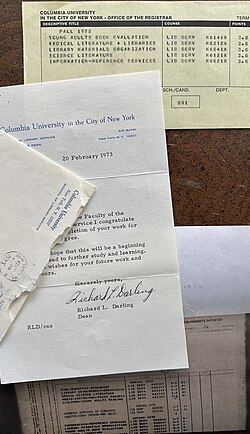
By the 1970s, the school offered approximately 60 courses. The Master of Library Science could be completed in a single year (including a summer session) for full-time students or over three years for those working. Graduates typically found employment in academic libraries, followed by public, special, and school libraries.
The faculty included renowned experts such as Frances E. Henne, an authority on children's and school libraries, and Maurice Tauber, a specialist in cataloging and classification. Additionally, Theodore C. Hines contributed significant research on computer-based indexing for library catalogs.
Pioneering Rare Books and Conservation
The school was home to a world-leading collection of 110,000 volumes on librarianship. In 1972, Terry Belanger developed a master's program for rare book and special collections librarians, which included the Book Arts Press. This evolved into the Rare Book School in 1983, which offered non-credit courses on the history of books and manuscripts.
Furthermore, in 1981, Paul N. Banks created the Conservation Education Program, the only program of its kind globally dedicated to paper preservation. Students could earn an Endorsement of Specialization in Administration of Preservation Programs in Libraries and Archives.
Key Facts
- Founded: 1926 via a Carnegie Corporation grant.
- Peak Enrollment: 1,071 students in the 1938–39 academic year.
- Academic Milestone: Launched its doctoral program in 1948.
- Specializations: Home to the world's only paper preservation program and a renowned Rare Book School.
- Collection: Maintained a library of 110,000 volumes, considered the most extensive of its kind globally.
- Closure Date: June 30, 1992.
The Decline and Closure
Enrollment began to decline between the mid-1970s and mid-1980s, dropping to around 250 students. Despite efforts by Dean Robert Wedgeworth (appointed 1985) to modernize technology and information services, the school faced severe headwinds. By 1990, it was the smallest school on Columbia's main campus.
The university, facing financial pressure and planning renovations for Butler Library, announced the school's closure in June 1990. The decision sparked debate over whether professional education belonged in a high-research institution and reflected a broader trend of library schools moving from private to public universities.
The school officially closed on June 30, 1992. While a planned move to the City University of New York fell through, two specialized programs survived: the Rare Book School moved to the University of Virginia, and the Conservation Education Program moved to the University of Texas at Austin (where it operated until 2009).
| Category | Details |
|---|---|
| Founding Components | NY State Library School (Albany) & NY Public Library training school |
| Primary Location | Butler Library (formerly South Hall) |
| Key Degrees | Master of Library Science, PhD |
| Notable Programs | Rare Book School, Conservation Education Program |
| Total PhDs Awarded | 166 |
Frequently Asked Questions
Why was the School of Library Service created?
It was created in 1926 as a professional school to centralize library training, incorporating existing schools from Albany and the New York Public Library with funding from the Carnegie Corporation of New York.
What made the school's location in Butler Library unique?
Housing the school within the university's main library allowed students to use the library as a "laboratory," providing immediate, practical access to the tools and environments of their profession.
What were the school's most unique academic offerings?
The school hosted the only program in the world for paper preservation (the Conservation Education Program) and a specialized Rare Book School focusing on the history of books and printing.
Why did Columbia University decide to close the school?
The closure was driven by substantial financial pressure, the need for Butler Library renovations, and an institutional debate regarding the role of professional education within a high-research university.
What happened to the school's resources after it closed?
The Rare Book School moved to the University of Virginia, and the Conservation Education Program moved to the University of Texas at Austin. In 2002, Columbia began digitizing the school's historic library collection.