Colorado Hairstreak: The Unique Montane Butterfly of the Southwest
In the rugged oak scrublands of the southwestern United States and northern Mexico lives a specialized resident known as the Colorado hairstreak (*Hypaurotis crysalus*). This montane butterfly—a species adapted to mountain environments—holds a special place in regional heritage, having been designated as the official state insect of Colorado in 1996. As the sole member of its genus, *Hypaurotis*, it represents a unique lineage within the butterfly world.
Physical Characteristics and Identification
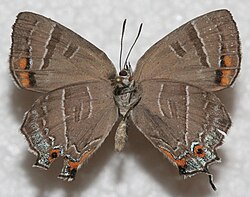
The Colorado hairstreak is a relatively small butterfly, boasting a wingspan typically ranging between 3.1 and 3.8 cm (1.2 to 1.5 inches). Its appearance is defined by a striking contrast between the upper and lower surfaces of its wings.
Wing Patterns
The upperside of the wings features a deep purple hue, framed by a broad black or dark border. Adding a splash of color to this dark palette are orange spots located at the lower outer edge of each wing. On the underside, the pattern shifts to a palette of pale to dark gray decorated with intricate white and dark markings. Notable features on the underside include an orange patch on the margin of each forewing and a distinct orange spot with a black center located on the hindwing near the tail.
The butterfly derives its common name from the thin, hair-like tails that extend from its rear wings. These delicate structures are a hallmark of many species in the Lycaenidae family (commonly known as gossamer-winged butterflies).
Habitat and Life Cycle
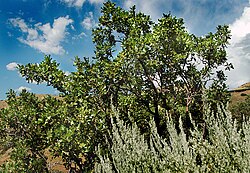
The survival of the Colorado hairstreak is intimately tied to a specific botanical host: the Gambel oak (*Quercus gambelii*). This plant serves a dual purpose, acting as the primary food source for caterpillars and the preferred roosting site for adults.
The life cycle follows a seasonal rhythm tailored to the montane environment:
- Egg Laying: In late summer, females lay eggs singly on the twigs of Gambel oaks or other related oak species.
- Larval Stage: The caterpillars emerge in the spring, feeding on the fresh, young leaves of the oak.
- Adult Feeding: Unlike many butterflies that frequent flowers for nectar, adults primarily feed on tree sap and likely consume honeydew—a sugary substance secreted by other insects.
- Flight Period: The species typically exhibits a single flight period each year, occurring between mid-June and August.
Distribution and Conservation
While its primary range covers the Colorado Plateau states—including Utah, Colorado, Arizona, and New Mexico—the Colorado hairstreak can also be found in smaller populations in Nevada, Wyoming, and Durango, Mexico. Currently, the species is classified as Secure according to NatureServe.
Key Facts
- Scientific Name: Hypaurotis crysalus
- State Status: Official state insect of Colorado (since 1996).
- Primary Host: Gambel oak (*Quercus gambelii*).
- Wingspan: 3.1–3.8 cm (1.2–1.5 in).
- Diet: Tree sap and potentially honeydew.
- Conservation Status: Secure.
Summary of Classification and Biology
| Category | Details |
|---|---|
| Kingdom | Animalia |
| Order | Lepidoptera |
| Family | Lycaenidae |
| Genus | Hypaurotis |
| Primary Habitat | Oak scrubland |
| Flight Season | Mid-June to August |
Frequently Asked Questions
What does the name "hairstreak" refer to?
The name refers to the thin, hair-like tails that extend from the rear of the butterfly's hindwings.
What do Colorado hairstreak caterpillars eat?
The caterpillars feed on the young leaves of the Gambel oak and other oak species.
Do these butterflies visit flowers?
Adults are more likely to feed on tree sap and honeydew secreted by insects rather than on flower nectar.
Where is the best place to find this butterfly?
They are most commonly found in the oak scrublands of the Colorado Plateau, specifically in Colorado, Utah, Arizona, and New Mexico.
Is the Colorado hairstreak endangered?
No, the species is currently listed as Secure.