Colorado General Assembly: An Overview of the State Legislature
The Colorado General Assembly serves as the legislative branch of the State of Colorado, exercising the power to create and amend laws as established by the 1876 state constitution. Operating under a bicameral system—meaning it is composed of two distinct chambers—the General Assembly is responsible for shaping the state's statutes, which are codified in the Colorado Revised Statutes (C.R.S.).
Located at the Colorado State Capitol in Denver, the legislature functions through a separation of powers, ensuring that legislative authority remains distinct from the executive and judicial branches. Notably, unlike many other states, Colorado's lieutenant governor holds no legislative authority and does not possess a tie-breaking vote in either chamber.
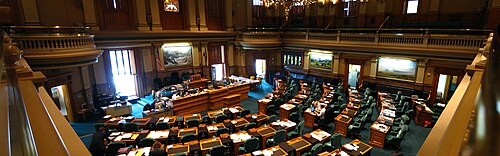
Key Facts
- Structure: Bicameral (Senate and House of Representatives).
- Total Seats: 100 (35 Senators and 65 Representatives).
- Leadership: Senate President James Coleman and House Speaker Julie McCluskie.
- Session Timing: Regular annual sessions begin no later than the second Wednesday in January.
- Term Limits: House members are limited to four consecutive terms; Senators are limited to two.
- Meeting Place: Colorado State Capitol, Denver.
Legislative Structure and Composition
The General Assembly is divided into two houses, each with specific roles and membership counts. The Senate consists of 35 members, while the House of Representatives consists of 65 members.
The Senate
Senators are elected to four-year terms. To ensure continuity, they are elected in two classes so that approximately half of the Senate is up for election every two years. As of the current session, the Senate is composed of 23 Democrats and 12 Republicans.
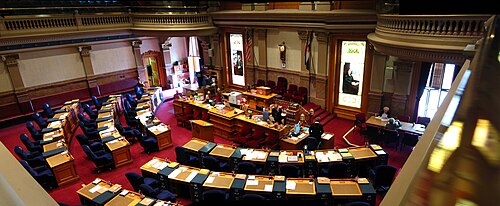
The House of Representatives
Members of the House serve two-year terms, with the entire body up for election during every general election cycle. The House currently maintains a Democratic majority with 43 Democrats and 22 Republicans.
History and Evolution
The Colorado General Assembly held its first meeting from November 1, 1876, to March 20, 1877. While the legislature originally met every two years, it transitioned to an annual meeting schedule in 1950.
A significant constitutional change occurred in 1974. Previously, the lieutenant governor served as the Senate President. However, an amendment to Article V, Section 10 of the state constitution granted the Senate the right to elect one of its own members to the position of Senate President.
The legislature also holds a place of historical significance regarding gender equality. Colorado was a pioneer in this regard, being the first state legislature to welcome women as elected members in 1894 (Clara Cressingham, Carrie C. Holly, and Frances S. Klock). In 1922, the 74th session marked a historic milestone as women held the majority of seats in the General Assembly for the first time.
The Lawmaking Process
Creating a law in Colorado involves a structured sequence of drafting and review. Most policy proposals begin with external advocates or subject-matter experts who identify a need for change. A legislator, acting as the prime sponsor, then works with the Office of Legislative Legal Services (OLLS).
The OLLS is a non-partisan body of staff attorneys who formalize the proposal, ensuring the text conforms to the Colorado Revised Statutes and constitutional requirements. Once the text is finalized, co-sponsors may join the bill to signal support.
Summary of Legislative Roles
| Entity | Role in Process | Contribution to Bill Text |
|---|---|---|
| External Originator | Identifies need for change | Prepares initial working draft |
| Prime Sponsor | Manages legislative progress | Provides draft to OLLS |
| OLLS | Non-partisan legal counsel | Writes/rewrites text for legal conformity |
| Co-sponsor | Signals legislative support | Joins after text is formalized |
Budgeting and Fiscal Oversight
Each year, the Governor submits a proposed budget to the Joint Budget Committee. The Colorado fiscal year runs from July 1 to June 30. The resulting comprehensive appropriations bill is known as the "Long Bill."
The General Assembly maintains strict fiscal oversight. All introduced bills are evaluated by non-partisan services for their fiscal impact. Furthermore, the legislature is constitutionally required to obtain voter approval for significant actions, such as incurring major debt or raising taxes.
Frequently Asked Questions
How long are terms for Colorado legislators?
Members of the House of Representatives serve two-year terms, while members of the Senate serve four-year terms.
What are the term limits for state legislators?
House members are limited to four consecutive terms in office, and state senators are limited to two consecutive terms. Former members may run again after a four-year break.
Does the Lieutenant Governor preside over the Senate?
No. Since a 1974 constitutional amendment, the Senate elects its own President from among its members. The lieutenant governor does not have legislative authority or tie-breaking powers.
What is a "safety clause" in a bill?
A safety clause is a legislative declaration that a bill concerns an urgent matter. Bills with a safety clause typically take effect on July 1 following the legislative session.
How are vacancies in the legislature filled?
Vacancies are generally filled by political party vacancy committees rather than through special elections.