Collegiate Gothic Architecture: The Legacy of Academic Design
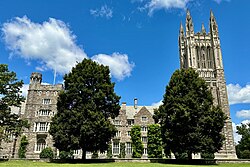
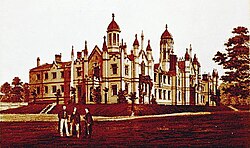
Collegiate Gothic is a specialized subgenre of Gothic Revival architecture that defined the visual identity of educational institutions across the United States, Canada, and parts of Europe during the late 19th and early 20th centuries. As a form of historicist architecture—a style that draws inspiration from previous historical periods—it specifically emulated the English Tudor and Gothic buildings of the Middle Ages.
The appeal of this style was not merely aesthetic. Ralph Adams Cram, a preeminent Gothic Revival architect and theorist, argued in his work The Gothic Quest that architecture possesses a unique power to influence and sway people, suggesting that the style served a higher duty in spreading truth through its physical presence.
Key Facts
- Origins: Emerged as a subset of Gothic Revival, heavily inspired by the universities of Oxford and Cambridge.
- Core Influence: Based on English Tudor and Gothic forms, emphasizing a sense of history and academic prestige.
- Peak Popularity: Late 19th century through the early 20th century.
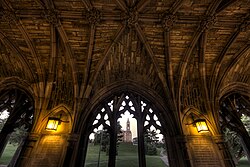
- Defining Features: Pointed arches, limestone cladding, ornate carvings, and often a dominant central tower.
- Geographic Reach: Primarily found in North American colleges and high schools, with some presence in Europe and Turkey.
The Evolution of the Style
Early Beginnings
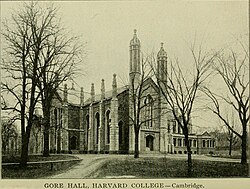
Gothic Revival elements appeared on American campuses as early as 1829 with "Old Kenyon" at Kenyon College in Ohio. Other early milestones include Alexander Jackson Davis's University Hall at New York University (1833–1837) and Richard Bond's Gore Hall at Harvard College (1837–1841), the latter of which served as a blueprint for future academic libraries.
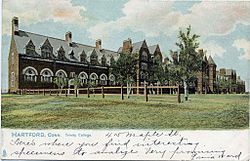
Following the American Civil War, campuses saw an influx of High Victorian Gothic buildings. These were often more idiosyncratic, such as the work of William Burges at Trinity College in Connecticut (1878) and various structures at Yale and Cornell.
The Rise of the Collegiate Movement
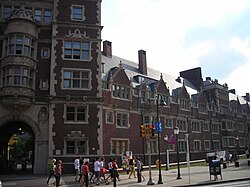
The transition from general Gothic Revival to a distinct "Collegiate Gothic" movement began in the late 1880s. Philadelphia architects Walter Cope and John Stewardson were pivotal, introducing an understated English Gothic style at Bryn Mawr College. Unlike literal copyists, Cope and Stewardson focused on site sensitivity and materials, drawing inspiration from the "Oxbridge" (Oxford and Cambridge) tradition.
Their influence spread rapidly through major commissions at the University of Pennsylvania, Princeton University, and Washington University in St. Louis.
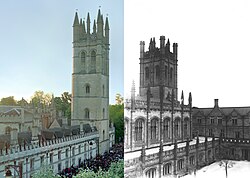
By 1901, the firm Shepley, Rutan & Coolidge implemented a master plan for the University of Chicago. Some of their designs, such as the Mitchell Tower, were near-literal reproductions of historic English landmarks.
Expansion and Criticism
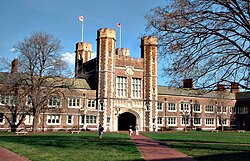
The style gained massive public exposure during the 1904 Louisiana Purchase Exposition in St. Louis, hosted on the newly built campus of Washington University.
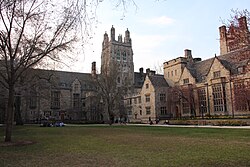
Architects like Ralph Adams Cram and James Gamble Rogers further refined the style. Cram's work at Princeton's Graduate College and Rogers' extensive developments at Yale created sophisticated, atmospheric campuses. However, Rogers' lavish use of ornament, particularly in the Sterling Memorial Library, drew criticism from the emerging Modernist movement, which viewed such ecclesiastical imagery as excessive.
High-Rise Gothic and Modern Adaptations
While most Collegiate Gothic complexes were horizontal, the 1920s saw the style ascend vertically. Following the success of the neo-Gothic Tribune Tower in Chicago, architects began applying these motifs to skyscrapers.
The most prominent example is the Cathedral of Learning at the University of Pittsburgh (1926–1937), designed by Charles Klauder. This 42-story steel-frame structure, clad in limestone, is the world's second-tallest university building and is considered the literal culmination of late Gothic Revival architecture.
Summary of Notable Collegiate Gothic Examples
| Institution | Building/Complex | Architect | Date |
|---|---|---|---|
| University of Chicago | Mitchell Tower | Shepley, Rutan & Coolidge | 1901–1908 |
| Princeton University | Graduate College | Ralph Adams Cram | 1913 |
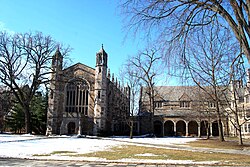
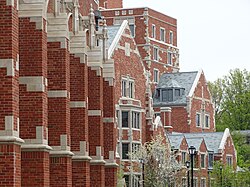
| University of Michigan | Law Quadrangle | York and Sawyer | 1923–1933 |
| University of Pittsburgh | Cathedral of Learning | Charles Klauder | 1926–1937 |
| Yale University | Memorial Quadrangle | James Gamble Rogers | 1917–1921 |
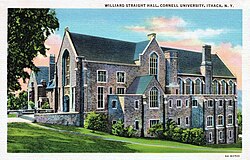
| Cornell University | Willard Straight Hall | William Adams Delano | 1925 |
Frequently Asked Questions
What is the difference between Gothic Revival and Collegiate Gothic?
Gothic Revival is a broad architectural movement that sought to revive medieval Gothic forms. Collegiate Gothic is a specific subgenre of that movement tailored for educational institutions, drawing specifically from the English Tudor and university styles of Oxford and Cambridge.
Who coined the term "Collegiate Gothic"?
The term is generally credited to American architect Alexander Jackson Davis, who used it in a handwritten description of an "English Collegiate Gothic Mansion" in 1853.
Why was this style chosen for universities?
The style was intended to evoke the prestige, tradition, and intellectual history of ancient European universities, creating an atmosphere of academic seriousness and permanence.
Is the Cathedral of Learning a true Gothic building?
While it looks Gothic, it is a modern hybrid. It uses a steel frame and limestone cladding to achieve the height of a skyscraper while maintaining the aesthetic of a Gothic spire.
Which architects were most influential in this movement?
Key figures include Walter Cope and John Stewardson, who established the movement's sensitivity to materials; Ralph Adams Cram, a leading theorist; and James Gamble Rogers, known for his work at Yale.