College Towns: The Social and Economic Dynamics of University Cities
A college town (or university town) is a community whose identity, economy, and social structure are dominated by the presence of a college or university. While these towns vary in size and location, they are typically characterized by a student population that makes up at least 20 percent of the total community. Unlike student quarters—which are specific neighborhoods within larger metropolitan areas—true college towns are distinct entities where the educational institution pervades nearly every aspect of local life.
In these environments, the university often serves as the primary employer and the central driver of economic activity. Local businesses frequently pivot to cater specifically to students and faculty, and in some cases, the transient student population may even outnumber the permanent residents.
Key Facts
- Definition: A town where the character is dominated by a university, often with students comprising 20% or more of the population.
- Economic Impact: The university is frequently the largest employer and the primary catalyst for local business growth.
- Cultural Influence: These towns often exhibit high tolerance for unconventional lifestyles and active arts and music scenes.
- Innovation Hubs: Many college towns evolve into centers for technological research and startup incubators.
- Studentification: The process where residential neighborhoods are transformed into high-density student housing.
Regional Variations: Europe vs. North America
The development and layout of university towns differ significantly between Europe and the United States, reflecting different historical trajectories.
European University Towns
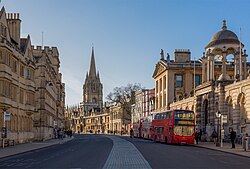
In Europe, university towns are generally characterized by the presence of ancient institutions. The city's history is often inextricably linked with the university's growth. In cities like Oxford, Cambridge, St Andrews, and Durham, the university dominates the town center both physically and functionally. In some instances, such as Durham, the university has effectively "colonized" the town center over time.
The economy in these towns is supported by a broad university structure, including clinics, libraries, business incubators, and student unions. Because many of these institutions grew within existing urban areas, university buildings are often scattered across multiple sites throughout the city center.
North American College Towns
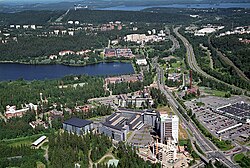
In the United States, the development of the university often preceded the growth of the town. Many land-grant universities—institutions mandated to provide agricultural education and research—were intentionally sited away from major cities. This led to the creation of a distinct campus, a concentrated area of university buildings separated from the city's main commercial district.
These towns often foster a powerful sense of "school pride." Residents frequently display loyalty to the institution through school colors and attendance at massive sporting events, such as American college football games that can attract crowds exceeding 100,000 people. Examples include Athens, Georgia (University of Georgia) and State College, Pennsylvania (Penn State).
Comparative Case Studies: Ithaca and Durham
Academic studies of Ithaca, New York, and Durham, England, reveal how different origins shape the modern college town. Both cities have similar populations (between 50,000 and 60,000 as of 2021) and student populations exceeding 20,000.
Ithaca, New York
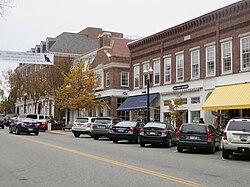
Ithaca's growth was driven by the development of Cornell University. Because the university was built on a campus east of the city center, student housing developed in separate districts like Collegetown and the Greek housing district. Collegetown evolved as a response to student demand, transitioning from cheap rooming houses in the late 19th century to larger apartment blocks by the 1980s.
Durham, England
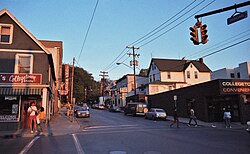
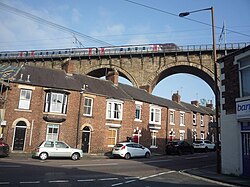
Durham is an ancient cathedral city established in the 10th century, with its university founded in 1832. Unlike Ithaca, Durham University was based in the city center. As the university expanded after the 1980s, students began renting privately in established residential areas, such as the Viaduct area. This led to the conversion of over 1,800 family homes into student rentals over a 30-year period ending in 2022.
Studentification and Town-Gown Relations
The term studentification, coined by Darren Smith in 2002, describes the process where neighborhoods become dominated by high concentrations of students. This often involves converting family homes into Houses of Multiple Occupation (HMOs)—residential properties shared by several unrelated people.
While studentification can boost local economies through increased spending and project a cosmopolitan image, it often creates tension in "town and gown" relations (the relationship between the townspeople and the university). Common points of conflict include:
- Housing Availability: The conversion of family homes to HMOs can reduce the supply of affordable housing for non-students.
- Cost of Living: High spending power from the university and students can inflate local prices.
- Social Friction: Differences in socio-economic class and the transient nature of the student population can lead to cultural clashes.
- Infrastructure: Rapid growth can lead to school closures or strained local services.
Summary of College Town Characteristics
| Feature | European Model (e.g., Oxford, Durham) | US Model (e.g., Ithaca, State College) |
|---|---|---|
| Spatial Layout | Buildings scattered throughout city center | Concentrated on a distinct campus |
| Historical Origin | Often grew within or around old urban centers | University often preceded urban growth |
| Housing Trend | Conversion of existing historic housing to student use | Development of dedicated student districts (e.g., Collegetown) |
| Community Focus | Deeply intertwined historical and political influence | Strong tradition of "school pride" and athletics |
Frequently Asked Questions
What is the difference between a college town and a student quarter?
A college town is an entire community whose character and economy are dominated by a university. A student quarter is a specific neighborhood or district within a larger city that houses a high concentration of students.
What does "studentification" mean?
Studentification is the social, cultural, and physical transformation of a neighborhood as it becomes dominated by a student population, typically resulting in the conversion of family homes into Houses of Multiple Occupation (HMOs).
Why do US college towns often have a separate campus?
Historically, many US universities, particularly land-grant institutions, were established away from major cities to provide agricultural research and education, leading to the development of a self-contained campus separate from the town center.
What are "town and gown" relations?
This term refers to the relationship between the residents of a university town (the "town") and the students and faculty of the university (the "gown"). These relations can be harmonious or tense due to differences in demographics and economic pressures.
How do college towns impact the local economy?
Universities often act as the largest employer in the community. While student spending boosts local businesses and fosters innovation through startups, it can also inflate the local cost of living and reduce the availability of affordable family housing.