College Street Baptist Church: A History of Faith and Transformation
The story of the College Street Baptist Church is a reflection of the evolving urban landscape of Toronto, Ontario. Born from a collaborative effort to expand mission work and establish self-sustaining congregations, the church served as a spiritual hub for decades before transitioning into a residential landmark.
The Origins of the Congregation
The church was established through the efforts of the Union, an organization within the Baptist denomination in Ontario designed to foster mission work in eligible city areas. This initiative was primarily sponsored by three established congregations: Bond Street Baptist Church, Alexander Street Baptist Church, and Yorkville Baptist Church (now known as Yorkminster Park Baptist Church).
On December 15, 1872, the College Street Baptist Church was officially organized, appointing Hoyes Lloyd as its first pastor.
Growth and Relocation
The congregation's first physical presence was a small building located at the corner of College Street and Lippincott. As the community evolved, the church sought a more permanent and suitable location. In 1888, the original property was sold to facilitate the construction of a new sanctuary.
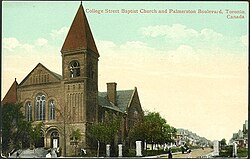
The new building was erected at the intersection of College Street and Palmerston Boulevard, where the congregation held its first service in September 1889.
Leadership and Prosperity
Throughout its early years, the church was guided by several notable pastors, including S. A. Dykes and Robert Holmes. A significant turning point occurred in February 1886 when Stuart S. Bates assumed the pastorate. Under the leadership of Bates, the church experienced a period of renewed growth and prosperity.
The Transition and Legacy
By approximately 1960, the congregation had seen a decline in membership, consisting primarily of elderly members. Facing these demographic shifts, the decision was made to close the church and encourage the remaining members to join neighboring congregations.
Following the closure, the building entered a new chapter when it was sold to the Portuguese Seventh-day Adventist Church (Toronto). The structure continued to serve a religious purpose until 2007, when it was purchased by developer Matthew Kosoy. Kosoy transformed the historic College Street landmark into four large, multi-level luxury freehold homes, preserving the site's presence in the neighborhood while changing its function.
Key Facts
- Founded: December 15, 1872.
- First Pastor: Hoyes Lloyd.
- Original Location: College Street and Lippincott.
- Second Location: College Street and Palmerston Boulevard (opened September 1889).
- Sponsoring Churches: Bond Street, Alexander Street, and Yorkville Baptist Churches.
- Final Use: Converted into luxury residential homes in 2007.
| Year | Event |
|---|---|
| 1872 | Church organized with Hoyes Lloyd as pastor |
| 1886 | Stuart S. Bates becomes pastor, leading a period of growth |
| 1888 | Sale of the original Lippincott property |
| 1889 | First service held at the Palmerston Boulevard location |
| c. 1960 | Church closes; building sold to Portuguese Seventh-day Adventist Church |
| 2007 | Building sold to Matthew Kosoy for residential conversion |
Frequently Asked Questions
What was the purpose of the "Union" in the Baptist denomination?
The Union was an organization in Ontario used to carry forward mission work in specific city areas with the goal of developing self-sustaining congregations.
Who were the primary sponsors of the College Street Baptist Church?
The church was sponsored mostly by the congregations at Bond Street Baptist Church, Alexander Street Baptist Church, and Yorkville Baptist Church.
When did the church move to Palmerston Boulevard?
The property at College Street and Palmerston Boulevard was constructed after the sale of the original site in 1888, with the first service held there in September 1889.
Why did the College Street Baptist Church eventually close?
Around 1960, the congregation had dwindled to a small number of mostly elderly members, leading to the decision to close and merge with neighboring churches.
What happened to the church building after 2007?
Developer Matthew Kosoy purchased the building and converted the landmark into four large multi-level luxury freehold homes.