Coach Buses: The Standard for Long-Distance Travel
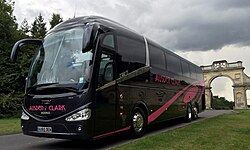
A coach, also referred to as a motorcoach or coach bus, is a specialized vehicle designed for long-distance service. Unlike transit buses, which are built for short journeys and frequent stops within a single metropolitan area, coaches are engineered for touring, intercity travel, and international routes. They are also widely used for private charters to transport groups over significant distances.
The modern coach is characterized by its high-floor design, which allows for a separate luggage hold located beneath the passenger compartment. To maximize comfort for long-haul trips, coaches typically feature forward-facing seats and do not provide standing room for passengers.
Terminology for these vehicles varies by region. In the United States, they are officially designated as motorcoaches. In the United Kingdom, Ireland, and Australia, the term coach is standard. In Japan, they are known as highway buses, while those specifically serving airports are called limousine buses or airport limousines.
Key Facts
- Purpose: Designed for long-distance, intercity, and international travel.
- Design: High-floor construction with underfloor luggage compartments.
- Seating: Forward-facing seats with no provision for standing passengers.
- Amenities: Often include onboard restrooms, climate control, and entertainment systems.
- Licensing: Requires a commercial driver's license (CDL) and often additional professional certifications.
The Evolution of the Coach
From Horse-Drawn Carriages to Motorization
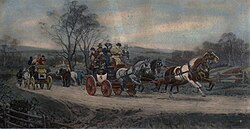
The term "coach" originates from the horse-drawn carriages used by the wealthy as early as 3000 BC. A pivotal development occurred in 15th-century Hungary during the reign of King Matthias Corvinus, where wheelwrights in the town of Kocs created a vehicle with steel-spring suspension. Known as the "cart of Kocs" (kocsi szekér), this design spread across Europe.
By 1650, the imperial post service introduced horse-drawn mail coaches, further cementing the term. In Great Britain, stagecoaches served as the primary intercity transport from approximately 1500 until the rise of the railways.
The Rise of the Motorcoach
The transition to motorized travel began with the charabanc, a vehicle used for short excursions until the early 20th century. Early motor coach operators transitioned from horse-drawn services to motorized fleets; for example, Royal Blue Coach Services purchased its first charabanc in 1913 and expanded to 72 coaches by 1926.
Design and Passenger Features
Because passengers spend extended periods on board, coaches prioritize comfort and utility. While specifications vary—ranging from basic highback seats to luxury configurations—most modern coaches include several standard features.
Interior Amenities
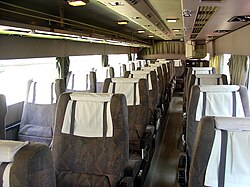
Modern coaches are almost universally equipped with air conditioning and reclining highback seats upholstered in fabric, leatherette, or leather. To enhance the travel experience, many include:
- Storage: Overhead luggage racks for carry-on items and large underfloor compartments for heavier bags.
- Personal Comfort: Individual reading lights, adjustable AC outlets, and curtains or blinds to block sunlight.
- Technology: USB charging ports, Wi-Fi access, and onboard AC power.
- Facilities: Onboard restrooms featuring chemical toilets and hand basins.
- Entertainment: Integrated movie screens and refreshment services provided by vending machines or attendants.
Seating Configurations
Seating layouts are tailored to the service level. The standard configuration is two seats on either side of a central aisle. Premium services, such as those in South Korea, may offer a 2+1 layout. Luxury coaches may feature a 1+1 layout, while some Japanese overnight buses utilize three single seats separated by two narrow aisles.
Manufacturing and Regulation
Production Methods
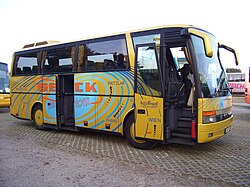
Coaches are produced through three primary methods: fully integrated manufacturing, where one company builds the entire vehicle; chassis-based construction, where a frame (engine and wheels) is delivered to a coachwork factory for the body to be added; or monocoque construction, which uses a single-piece body without a separate chassis frame.
Notable integrated manufacturers include Scania, Fuso, Autosan, and Alexander Dennis. Major coachwork providers include Irizar, Van Hool, Neoplan, Marcopolo, MCI, Prevost, Denning Manufacturing (Australia), and Designline (New Zealand).
Safety and Legal Standards
Regulations vary by region to ensure passenger safety. In Europe, vehicle type certification (M2 or M3) is often regulated by UNECE regulation number 107. In the United States, the Federal Motor Carrier Safety Administration (FMCSA) regulates commercial motorcoach drivers.
Operating a coach requires a commercial driver's license. In the European Union and the United Kingdom, drivers must also obtain a Driver Certificate of Professional Competence (Driver CPC). Additionally, seat belts for all passengers are now a legal requirement in many countries, including the UK.
Coach Specifications Summary
| Feature | Standard Coach | Luxury/Premium Coach | Commuter Coach |
|---|---|---|---|
| Seating Layout | 2+2 Configuration | 2+1 or 1+1 Configuration | Standard Highback |
| Luggage Space | Underfloor + Overhead | Expansive Underfloor | Limited Underfloor |
| Restrooms | Commonly Included | Full Facilities | Occasional/Basic |
| Amenities | AC, Reclining Seats | Wi-Fi, Power, Entertainment | Basic AC, Limited Tech |
Frequently Asked Questions
What is the main difference between a bus and a coach?
The primary difference is the intended journey length and design. Transit buses are for short, urban trips with standing room and multiple doors, while coaches are for long-distance travel, featuring high floors, underfloor luggage storage, and no standing room.
Where does the word "coach" come from?
The term comes from the Hungarian town of Kocs, where wheelwrights in the 15th century developed a horse-drawn vehicle with steel-spring suspension, known as the "cart of Kocs."
What is a charabanc?
A charabanc was an early motorized vehicle used for short excursions and journeys in the late 19th and early 20th centuries, serving as a precursor to the modern motorcoach.
Do coach drivers need special licenses?
Yes, coach drivers must hold a commercial driver's license. Depending on the region, they may also need additional certifications, such as the Driver CPC in the UK and EU.
How are coaches manufactured?
They can be built by integrated manufacturers who handle the entire process, or they can be assembled by adding a body from a coachwork provider to a pre-built chassis consisting of the engine and frame.