Clwyd Administrative History and Local Government Evolution
The administrative landscape of North Wales underwent significant transformation during the mid-to-late 20th century. The creation and eventual dissolution of the county of Clwyd represent a complex period of political negotiation, shifting from traditional boundaries to a two-tier system, and finally to modern unitary authorities.
The Path to Amalgamation
The journey toward a restructured local government began in 1958 with the Local Government Commission for Wales. This commission first recommended the wholesale amalgamation of administrative counties outside of Monmouthshire and Glamorgan. However, Sir Keith Joseph, the Minister of Housing and Local Government, rejected these proposals, citing the unpopularity of similar county mergers in England.
By 1967, a change in government led Secretary of State for Wales Cledwyn Hughes to revive the concept of amalgamation via a white paper. Unlike the previous attempt, this proposal treated existing counties as whole units. It suggested the creation of a single, large county called Gwynedd, which would have incorporated Anglesey, Caernarfonshire, Merionethshire, Denbighshire, and Flintshire. Because the government viewed early action as urgent, the matter was not referred to a Royal Commission.
Due to criticisms that the proposed council was too large, Secretary of State George Thomas announced in November 1968 that Gwynedd would be split into two separate entities. While a March 1970 white paper suggested these should be unitary authorities (single-tier councils with no lower-level districts), the incoming Conservative government in 1971 restored the two-tier system.
The Formation and Structure of Clwyd
The Local Government Act 1972 officially established Clwyd. This new county was formed by merging Flintshire, the majority of Denbighshire, and the Edeyrnion Rural District from Merionethshire. Notably, Clwyd was the only new Welsh county not named after an ancient kingdom; instead, it derived its name from the Clwydian range of hills and the River Clwyd.
For administrative purposes, Clwyd operated under a two-tier system. The upper tier was the Clwyd County Council, while the second tier consisted of six distinct districts.
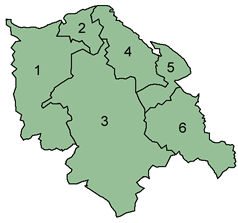
The Six Districts of Clwyd
- Alyn and Deeside
- Colwyn
- Delyn
- Glyndŵr
- Rhuddlan
- Wrexham Maelor
In December 1974, the Clwyd County Council was granted a coat of arms. The design blended elements from the former councils of Denbighshire and Flintshire. It featured a green and white wave symbolizing the Vale of Clwyd and the Clwydian Range, cross and choughs from Flintshire (incorporating the arms of Edwin of Tegeingl), and the black lion of the Princes of Powys Fadog from Denbighshire. The motto, Tarian Cyfiawnder Duw, translates to "The shield of Justice is God."
Transition to Unitary Authorities
The administrative structure changed again with the Local Government (Wales) Act 1994. This legislation abolished both the Clwyd County Council and its six districts, effective midnight on April 1, 1996. Local government responsibilities were transferred to four new principal areas: Flintshire, Wrexham County Borough, Denbighshire, and parts of Conwy, with some smaller communities moving to Powys.
Although the names Flintshire and Denbighshire returned, their new boundaries differed substantially from the historic counties. To manage this transition, records were kept separate: historic Flintshire records remained at the Hawarden branch of the Clwyd Records Office, while historic Denbighshire records stayed at the Ruthin branch.
Preserved Counties
Alongside the creation of principal areas, the 1994 Act established preserved counties. These are similar to English ceremonial counties and are maintained for specific purposes, such as shrievalty and lieutenancy. The Preserved County of Clwyd is nearly identical to the 1974–1996 boundaries, though the communities of Llansilin, Llangedwyn, and Llanrhaeadr-ym-Mochnant were transferred to Powys.
Key Facts
- Established: Created by the Local Government Act 1972.
- Composition: Merged Flintshire, most of Denbighshire, and the Edeyrnion Rural District.
- Naming: Named after the River Clwyd and Clwydian range, not an ancient kingdom.
- Structure: Operated as a two-tier system with one county council and six district councils.
- Abolition: Ceased operations on April 1, 1996, under the Local Government (Wales) Act 1994.
- Successors: Replaced by the principal areas of Flintshire, Wrexham, Denbighshire, and Conwy.
| Period | Administrative Status | Governing Structure |
|---|---|---|
| Pre-1974 | Historic Counties | Flintshire, Denbighshire, Merionethshire |
| 1974–1996 | Administrative County | Two-tier (County Council & 6 Districts) |
| 1996–Present | Preserved County / Principal Areas | Unitary Authorities |
Frequently Asked Questions
Why was Clwyd created?
Clwyd was created as part of a broader effort to modernize and amalgamate local government in Wales, moving away from smaller historic counties to more efficient administrative units under the Local Government Act 1972.
What makes the name "Clwyd" unique among Welsh counties?
Unlike other new Welsh counties created at the time, Clwyd did not take its name from an ancient kingdom; it was named after the River Clwyd and the Clwydian range of hills.
What happened to the Clwyd districts in 1996?
The six districts (Alyn and Deeside, Colwyn, Delyn, Glyndŵr, Rhuddlan, and Wrexham Maelor) were abolished and replaced by unitary authorities, which combined the powers of both the district and county councils.
What is a "preserved county"?
A preserved county is a geographic area maintained for ceremonial purposes, such as lieutenancy and shrievalty, rather than for the delivery of local government services.
How were the historic records of Flintshire and Denbighshire handled?
The records were kept in separate branches of the Clwyd Records Office—Hawarden for historic Flintshire and Ruthin for historic Denbighshire—making it easy to segregate them when the administrative boundaries changed.