Cibona Basketball Club: A Legacy of Croatian Excellence
From its humble beginnings as a sports society for bank workers and craftsmen to becoming a titan of European basketball, Cibona represents the heart of Zagreb's sporting spirit. The club's journey is one of constant evolution, marked by numerous name changes, legendary players, and a trophy cabinet that reflects decades of dominance on both national and continental stages.
Formation and Early Years
The roots of the club trace back to the autumn of 1945 with the founding of Sloboda (Freedom). On April 24, 1946, basketball enthusiast Branimir Volfer, alongside Ljubo Prosen and Joso Miloš, established the basketball section of Sloboda. The team played its inaugural game on May 7, 1946, against local rivals Slavija.
The early years were characterized by frequent organizational shifts and name changes. In November 1946, Sloboda merged with Tekstilac, Amater, and Grafičar to form Sportsko društvo Zagreb. By late 1948, the club was known as Vihor (Vortex), and in 1949, it became Polet (Elan). Finally, in June 1950, the club adopted the name Lokomotiva (Locomotive), a title it would hold for the next 25 years. Lokomotiva became a staple of the Yugoslav top division starting in 1951, with only brief stints in the second division during 1952 and 1960.
The First Trophies and European Breakthrough
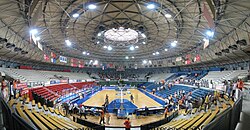
The club's first major success arrived in 1969 when Lokomotiva won the Yugoslav Cup. Led by Hall of Famer Mirko Novosel and a powerhouse trio consisting of Većeslav Kavedžija, Nikola Plećaš, and Milivoj Omašić, the team secured a narrow 78:77 victory over AŠK Olimpija. This historic final was held at the club's new venue, the "Kutija šibica" (Matchbox).
International glory followed in 1972 when Lokomotiva captured the inaugural FIBA Korać Cup. After losing the first leg of the final 83:71 to OKK Beograd, Lokomotiva staged a dramatic comeback in the return match. Nikola Plećaš, known as "Sveti Nikola," scored 40 points to lead his team to a 94–73 victory.
The Golden Era of Cibona
In November 1975, the basketball club separated from the Lokomotiva sports society and came under the administration of Zagreb's municipal authorities. Under the influence of figures like Slavko Šajber, the club secured sponsorship from four state-owned food industry giants: Kraš, Franck, Badel, and Voće. Consequently, the club was renamed Cibona, derived from the Latin cibus bonus, meaning "good food."
The new era began with a Yugoslav Cup victory in 1980, where Andro Knego led the team to a 68:62 win over Bosna. This victory ignited a golden age spanning from 1980 to 1988, driven by the brilliance of Hall of Famers Krešimir Ćosić and Dražen Petrović. During this eight-year stretch, Cibona amassed 14 major trophies.
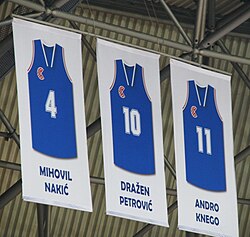
Major Achievements (1980–1988)
- 3 Yugoslav League Championships: 1982, 1984, 1985
- 7 Yugoslav Cups: 1980, 1981, 1982, 1983, 1985, 1986, 1988
- 2 FIBA European Champions Cups: 1985, 1986
- 2 Cup Winners' Cups: 1982, 1987
The onset of the Yugoslav War in 1991 forced the team to emigrate to ensure they could play in FIBA-approved conditions. For the 1991–92 and 1992–93 seasons, the club operated out of Puerto Real (Cádiz), Spain.
Dominance in Independent Croatia
Following Croatian independence, Cibona established itself as the nation's premier powerhouse. Benefiting from strong political and economic backing, as well as the decline of Dalmatian clubs in Split, Zadar, and Šibenik, Cibona won 11 consecutive national titles between 1992 and 2002. The club also remained a fixture in the Euroleague, reaching the quarterfinals in the 1996/97 and 1999/00 seasons.
This streak of dominance was interrupted in 2003 by Split CO, led by coach Petar Skansi and legend Dino Rađa. While Cibona regained the title in 2004, they faced stiff competition from Zadar in subsequent years. In 2001, the club joined the Adriatic League (ABA League), a regional competition. Despite reaching the final in the 2003/04 season, they were defeated on their home court by FMP Reflex.
Recent Challenges and Triumphs
Recent years have seen a fluctuating trajectory for the club. While Cibona won four of five recent national league titles, the rise of the company-backed Cedevita has challenged their supremacy. In Europe, the club faced a setback when it lost its Euroleague license for the 2011/12 season, subsequently competing in the Eurocup without a victory during the 2011/12 and 2012/13 campaigns.
The 2009/10 ABA League season provided one of the most dramatic moments in the club's history. In the final against Partizan at Arena Zagreb, Cibona appeared to have won after Bojan Bogdanović hit a corner three with 0.6 seconds remaining. However, Dušan Kecman scored a half-court buzzer-beater to give Partizan a 75–74 win.
Despite severe financial hardships, Cibona achieved a major milestone in the 2013–14 season by winning the ABA League championship under head coach Slaven Rimac. Due to their financial instability, the club withdrew from the Euroleague spot earned by this victory, allowing Crvena Zvezda to take their place.
Key Facts
- Founded: 1946 (as the basketball section of SD Sloboda).
- Name Evolution: Sloboda → SD Zagreb → Vihor → Polet → Lokomotiva → Cibona.
- Golden Era: 1980–1988, featuring 14 major trophies.
- European Peak: Back-to-back FIBA European Champions Cups in 1985 and 1986.
- National Record: Won 11 consecutive Croatian national titles from 1992 to 2002.
- Notable Legends: Dražen Petrović, Krešimir Ćosić, and Nikola Plećaš.
| Period | Club Name | Key Achievement |
|---|---|---|
| 1946–1950 | Sloboda / Zagreb / Vihor / Polet | Formation and early development |
| 1950–1975 | Lokomotiva | 1969 Yugoslav Cup; 1972 FIBA Korać Cup |
| 1975–1991 | Cibona | 2 European Champions Cups; 7 Yugoslav Cups |
| 1992–2002 | Cibona | 11 consecutive Croatian national titles |
| 2013–2014 | Cibona | ABA League Championship |
Frequently Asked Questions
Why was the club renamed Cibona?
The club was renamed in 1975 after coming under municipal control and receiving sponsorship from four food industry giants. The name comes from the Latin phrase cibus bonus, which means "good food."
Who were the most influential players during Cibona's golden era?
The golden era (1980–1988) was primarily driven by Hall of Famers Dražen Petrović and Krešimir Ćosić, who helped the club win 14 major trophies.
Where did Cibona play during the early 1990s?
Due to the war in the Former Yugoslavia, the team emigrated to Spain for the 1991–92 and 1992–93 seasons, playing their games in Puerto Real (Cádiz).
What happened after Cibona won the 2013–14 ABA League?
Despite winning the championship, the club was facing significant financial problems and withdrew from the Euroleague. Their spot was subsequently taken by Crvena Zvezda.
What is the significance of the "Matchbox" (Kutija šibica)?
The "Matchbox" was the name of Lokomotiva's basketball hall where they won their first major trophy, the Yugoslav Cup, in 1969.