Chugach Mountains: Alaska's Snowiest Peaks
The Chugach Mountains are a breathtaking range in southern Alaska, serving as the northernmost extension of the Pacific Coast Ranges. Stretching across the western edge of North America, this range is renowned for its dramatic landscapes and extreme weather patterns. Spanning approximately 250 miles (402 km) in length and 60 miles (97 km) in width, the Chugach Mountains create a formidable barrier between the coast and the interior.
Geographically, the range extends from the Knik and Turnagain Arms of the Cook Inlet in the west to the Tana River, Tana Glacier, and Bering Glacier in the east. To the north, the range is bounded by the Chitina, Copper, and Matanuska rivers.
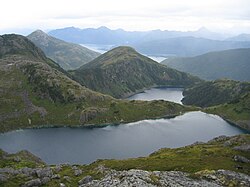
Key Facts
- Highest Point: Mount Marcus Baker, reaching 13,094 feet (3,991 m).
- World Record Snowfall: Due to its position along the Gulf of Alaska, the range receives an annual average of over 1,500 cm (800 in) of snow, the highest in the world.
- Average Elevation: 4,006 feet (1,221 m).
- Protected Areas: Much of the range is preserved within the Chugach State Park and the Chugach National Forest.
- Parent Range: Part of the larger Pacific Coast Ranges.
Geography and Infrastructure
While the range boasts several towering peaks, its average elevation is relatively modest at 4,006 feet (1,221 m). However, the interaction between the mountains and the moist air of the Gulf of Alaska creates a unique climate characterized by immense snowfall.
The region is accessible via several major roadways, including the Glenn, Seward, Richardson, and Portage Glacier highways. A notable engineering feat in the area is the Anton Anderson Memorial Tunnel on the Portage Glacier Highway, which allows both automobiles and railroads to pass beneath Maynard Mountain, connecting Portage Lake to the city of Whittier on Prince William Sound.
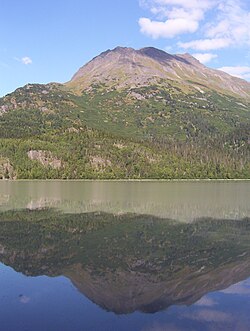
The Mount Gordon Lyon Star
A unique landmark exists on Mount Gordon Lyon at an elevation of approximately 4,000 feet (1,200 m). This 300-foot (91 m) five-pointed star consists of roughly 350 light globes. Facing the city of Anchorage, the star is illuminated from Thanksgiving until Christmas Day, as well as on September 11th. Originally established around 1960 near a former Army Nike missile site, the star is currently maintained by the US Air Force’s Joint Base Elmendorf-Richardson.
History and Etymology
The name "Chugach" is derived from Chugach Sugpiaq Cuungaaciiq, the Alaska Natives who inhabit Prince William Sound and the Kenai Peninsula. These people are part of the Alutiiq (Pacific Eskimo) group and speak the Chugach dialect of the Alutiiq language. The English spelling "Chugatch" was first applied to the mountains in 1898 by US Army Captain William R. Abercrombie.
Prominent Peaks of the Chugach Range
The range features a variety of peaks, from the massive Mount Marcus Baker to the popular Flattop Mountain near Anchorage. The following table highlights the twelve highest summits in the range.
| Rank | Peak Name | Elevation (ft) | Elevation (m) |
|---|---|---|---|
| 1 | Mount Marcus Baker | 13,176 | 4,016 |
| 2 | Mount Thor | 12,251 | 3,734 |
| 3 | Mount Valhalla | 12,135 | 3,699 |
| 4 | Mount Witherspoon | 11,745 | 3,580 |
| 5 | Mount Einstein | 11,401 | 3,475 |
| 6 | Mount Tom White | 11,155 | 3,400 |
| 7 | Icing Peak | 10,955 | 3,339 |
| 8 | Mount Grace | 10,540 | 3,213 |
| 9 | Mount Goode | 10,384 | 3,165 |
| 10 | Mount Steller | 10,082 | 3,073 |
| 11 | Mount Gannett | 9,629 | 2,935 |
| 12 | Mount Gilbert | 9,101 | 2,774 |
Frequently Asked Questions
What is the highest peak in the Chugach Mountains?
The highest point is Mount Marcus Baker, which reaches an elevation of 13,094 feet (3,991 m), though some records list it as high as 13,176 feet (4,016 m).
Why does the Chugach range receive so much snow?
Its geographic position along the Gulf of Alaska ensures that it receives more snowfall than anywhere else in the world, averaging over 1,500 cm (800 in) annually.
Who are the original inhabitants of the Chugach region?
The region is the home of the Chugach Sugpiaq Cuungaaciiq, an Alutiiq (Pacific Eskimo) people who speak the Chugach dialect of the Alutiiq language.
What is the Anton Anderson Memorial Tunnel?
It is a tunnel on the Portage Glacier Highway that provides both automobile and railroad access beneath Maynard Mountain, connecting Portage Lake to Whittier.
What is the significance of the star on Mount Gordon Lyon?
The 300-foot star is a landmark visible from Anchorage. It is illuminated to commemorate Christmas (from Thanksgiving to Christmas Day) and to honor the events of 9/11.