Christchurch Pride: A History of Celebration and Resilience
The journey of Christchurch Pride is a testament to the enduring spirit of the LGBT community in New Zealand. From modest gatherings in the 1970s to a month-long city-wide celebration, the festival has evolved into a vital space for visibility, advocacy, and joy, overcoming significant civic and global challenges along the way.
The Early Roots of Pride in Christchurch
Pride celebrations in the city date back to the 1970s. In June 1974, the city hosted its first Gay Pride Week, featuring a march starting at Plaza Victoria and a celebratory dance held at Hagley Hall.
By 1977, visibility efforts increased. The local newspaper, The Press, announced plans for Gay Pride Week events in Cathedral Square, where supporters were encouraged to wear pink triangles as a symbol of solidarity. This trend of symbolic support continued into 1979, when participants wore pink carnations to mark International Gay Solidarity Day.
The Modern Era and Growth
The festival in its current form was established in 2004. By 2005, the event expanded into a comprehensive week-long calendar. This expanded program included drag shows, dances, a screening of The Rocky Horror Show, and a candlelight vigil dedicated to the victims of the HIV/AIDS pandemic. These early modern events drew approximately 1,000 participants.
Growth continued steadily, with attendance reaching 1,500 people by 2008. A highlight of that year was the premiere of Through Rainbow Coloured Glasses, a production that explored the specific LGBT history of Christchurch.
Overcoming Adversity: Earthquakes and Pandemics
The resilience of the community was tested during the 2010 and 2011 Christchurch and Canterbury earthquakes. The resulting devastation left the festival struggling with a lack of funding and available venues for several years. It was not until 2013 that the first post-earthquake event was successfully held.
More recently, the COVID-19 pandemic disrupted the festival's momentum. While some 2021 activities proceeded—including a closing party attended by 450 people—the 2022 festival had to be postponed from March to June due to ongoing health restrictions.
The Return to Momentum and the Walk for Support
In 2023, the festival returned to its March schedule. The festivities began on 10 March with the third annual Walk for Support, a Pride parade that saw 700 participants march from Ballantynes Department Store along Cashel Street to the Bridge of Remembrance for artistic performances. The festival concluded on 19 March.
By 2024, organizers reported that attendance for the Walk for Support had doubled since its inception. The event also gained significant political visibility, with the attendance of local council members and legislators, including Sara Templeton and Kahurangi Carter.
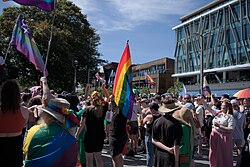
The 2025 celebration marked a historic milestone as the longest event to date, spanning the entire month of March. The opening parade attracted over 1,000 attendees. Despite the presence of protestors from the fundamentalist organization Destiny Church, who directed abusive comments at participants, the community remained undeterred, with the noise of music and speakers largely drowning out the opposition.
Key Facts
- First recorded Pride Week: June 1974.
- Modern incarnation start: 2004.
- Peak early growth: 1,500 attendees by 2008.
- Major disruptions: 2010/2011 earthquakes and the COVID-19 pandemic.
- Signature event: The "Walk for Support" parade.
- 2025 Milestone: Expanded to a full-month celebration in March.
Pride Timeline Summary
| Year/Period | Key Event or Milestone | Notable Detail |
|---|---|---|
| 1974 | First Gay Pride Week | March from Plaza Victoria; dance at Hagley Hall |
| 1977-1979 | Symbolic Support | Use of pink triangles and pink carnations |
| 2004-2005 | Modern Festival Launch | Introduction of week-long calendars and vigils |
| 2008 | Historical Exploration | Premiere of Through Rainbow Coloured Glasses |
| 2013 | Post-Earthquake Recovery | First event held after the 2010/2011 disasters |
| 2023-2024 | Walk for Support Growth | Attendance doubled; presence of local legislators |
| 2025 | Month-long Celebration | First event to span the entire month of March |
Frequently Asked Questions
When did Pride celebrations first begin in Christchurch?
Pride celebrations began in the 1970s, with the first Gay Pride Week taking place in June 1974.
What is the "Walk for Support"?
The Walk for Support is the Pride parade associated with the festival. In recent years, it has followed a route from Ballantynes Department Store along Cashel Street to the Bridge of Remembrance.
How did the Canterbury earthquakes affect the festival?
The 2010 and 2011 earthquakes caused significant struggles regarding funding and the availability of venues, resulting in a gap where the first post-earthquake event did not occur until 2013.
How long is the Christchurch Pride festival in 2025?
The 2025 event is the longest in the festival's history, lasting for the entire month of March.
Who were some of the notable figures attending recent parades?
Recent events have seen the attendance of local council members and legislators, including Sara Templeton and Kahurangi Carter.