Cherokee Nation History: From Ancestral Lands to Sovereignty
The Cherokee people, who call themselves the Aniyunwiya (meaning "leading" or "principal" people), possess a resilient history marked by sophisticated governance, forced migration, and a persistent struggle for sovereignty. Originally inhabiting the southern Appalachia region, the Cherokee evolved from a decentralized society of clans into a constitutional republic, navigating the complex pressures of European colonization and United States expansion.
Early Governance and Social Structure
Before 1794, the Cherokee operated without a centralized national government. Instead, they lived in autonomous towns organized by a matrilineal kinship system, where family lineage was traced through the mother. Leadership was fluid; towns mutually appointed representatives to negotiate with French, British, and American authorities. These leaders were known as the Uku, or "First Beloved Man," a role the English translated as "chief."
Following the Cherokee–American wars in 1794, the nation began to centralize. Little Turkey was recognized as the Principal Chief of the Cherokee Nation by all towns, overseeing lands in present-day North Carolina, South Carolina, Georgia, and eastern Tennessee. During this era, a break-away group known as the Chickamauga (or Lower Cherokee), led by Dragging Canoe, established settlements near present-day Chattanooga and later moved into Alabama. This period of division, termed "The separation," officially ended with the reunification council of 1809.
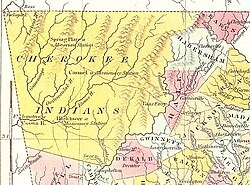
Acculturation and the Rise of Constitutional Government
In the early 19th century, U.S. Indian Agent Benjamin Hawkins promoted programs to "civilize" Native peoples. This shift encouraged the Cherokee to move from communal land tenure to individual subsistence farmsteads. As the deerskin trade declined due to over-harvesting, the Cherokee adopted cattle and pig raising, spinning wheels, and cotton cultivation. While farming had traditionally been the domain of women, men were taught to plow and fence the land.
A group known as the "Cherokee Triumvirate"—James Vann, The Ridge, and Charles R. Hicks—championed formal education and European-American farming methods. They invited Moravian and Congregationalist missionaries to provide religious instruction and run boarding schools, with some students even attending school in Connecticut.
The Path to a Written Constitution
The Cherokee Nation rapidly modernized its political infrastructure to protect its sovereignty. Key milestones included:
- 1817: Establishment of electoral districts.
- 1822: Founding of the Cherokee Supreme Court.
- 1827: Adoption of a written constitution creating three branches of government: legislative, executive, and judicial.
In 1832, the U.S. Supreme Court ruled in Worcester v. Georgia that the Cherokee Nation was a distinct political community and that Georgia's laws had no force within its borders. However, President Andrew Jackson and the state of Georgia ignored the ruling, continuing the pressure for removal.
The Era of Removal and the Trail of Tears
The drive for Cherokee land was fueled by the invention of the cotton gin, which made short-staple cotton highly profitable in the Deep South. In 1815, the U.S. government established a reservation in the Arkansas district of the Missouri Territory. Those who moved voluntarily became known as the "Old Settlers" or Western Cherokee.
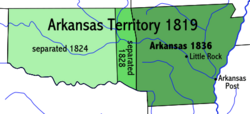
Despite resistance from the majority of the population, the U.S. Congress passed the Indian Removal Act of 1830. This legislation, combined with the Treaty of New Echota (which was ratified in 1836 despite not being approved by the National Council or Principal Chief John Ross), provided the legal pretext for the forced relocation known as the Trail of Tears.
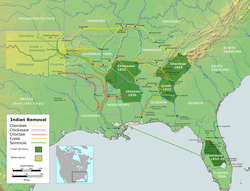
The relocated Cherokee established settlements around their western capital, Tahlontiskee, in present-day Oklahoma. On September 6, 1839, the reunited Cherokee Nation ratified a new constitution at Tahlequah, an event still celebrated today as the Cherokee National Holiday.
Civil War, Reconstruction, and Dissolution
The American Civil War divided the Cherokee Nation. While Principal Chief John Ross favored neutrality, Stand Watie advocated for an alliance with the Confederacy. Eventually, a general consensus shifted toward the Confederacy, with 3,000 of 21,000 citizens serving as soldiers. Stand Watie's 1st Cherokee Mounted Rifles remained active long after other Confederate forces had retreated; Watie became the last Confederate general to surrender on June 23, 1865.

Post-war treaties forced the Five Civilized Tribes to emancipate their slaves and grant them citizenship. Interestingly, a 2020 study noted that former slaves in the Cherokee Nation experienced higher literacy rates and incomes compared to those in the rest of the Confederacy, due to a more successful distribution of free land.
The Curtis Act and Loss of Autonomy
The late 19th century brought further instability. The Curtis Act of 1898 forced the dissolution of tribal lands into individual allotments and terminated tribal courts. Although the Five Civilized Tribes attempted to form the State of Sequoyah in 1905, the proposal failed. By 1907, the Indian Territory was absorbed into the state of Oklahoma, and the Cherokee government was largely curtailed.
Modern Reorganization and Legal Victories
The Oklahoma Indian Welfare Act of 1936 encouraged tribes to re-establish their governments. In 1938, the Cherokee convened to elect a new chief. The Principal Chiefs Act of 1970 finally restored the right to select leaders by popular election. W.W. Keeler won the first such election in 1971, and Wilma Mankiller later became the first woman to serve as Principal Chief, winning her own election in 1987.
Recent legal battles have further shaped the nation's status. In 2020, McGirt v. Oklahoma affirmed that the Muscogee (Creek) Nation's reservation had never been disestablished, a reasoning later applied to the Cherokee Nation. However, the 2022 ruling in Oklahoma v. Castro-Huerta limited this by granting states concurrent criminal jurisdiction over non-Indians on tribal land.
| Period | Governance Structure | Key Event/Legal Milestone |
|---|---|---|
| Pre-1794 | Decentralized clans/towns | Leadership by "First Beloved Man" (Uku) |
| 1827–1839 | Constitutional Republic | Worcester v. Georgia (1832) |
| 1839–1898 | Reunited Nation (Oklahoma) | Trail of Tears / Constitution of 1839 |
| 1898–1936 | Curtailed/Nominal Government | Curtis Act / Oklahoma Statehood (1907) |
| 1938–Present | Reconstituted Sovereign Nation | Principal Chiefs Act (1970) / McGirt v. Oklahoma (2020) |
Key Facts
- Self-Identity: The Cherokee call themselves the Aniyunwiya, meaning "principal people."
- Political Innovation: They adopted a written constitution with three branches of government in 1827.
- Forced Migration: The Indian Removal Act of 1830 led to the Trail of Tears, relocating the nation to present-day Oklahoma.
- Civil War: Stand Watie was the last Confederate general to surrender in 1865.
- Gender Milestones: Wilma Mankiller was the first woman elected as Principal Chief.
- Legal Status: The 2020 McGirt v. Oklahoma ruling reaffirmed the non-disestablishment of tribal reservations.
Frequently Asked Questions
What does the name Aniyunwiya mean?
Aniyunwiya is the name the Cherokee use for themselves, which translates to "leading" or "principal" people in their language.
What was the significance of Worcester v. Georgia?
The 1832 U.S. Supreme Court ruling affirmed that the Cherokee Nation was a sovereign political community and that the laws of Georgia did not apply within its borders, though the ruling was not enforced by the executive branch.
Who were the "Old Settlers"?
The Old Settlers, or Western Cherokee, were those who moved voluntarily to the Cherokee Reservation in the Arkansas district of the Missouri Territory starting around 1815.
How did the Curtis Act affect the Cherokee Nation?
The 1898 Curtis Act forced the dissolution of communal tribal lands into individual allotments, terminated tribal courts, and gave the federal government control over tribal membership.
Who was the first woman to serve as Principal Chief?
Wilma Mankiller became the first woman to serve as Principal Chief of the Cherokee Nation, winning her own election in 1987.