Cheques Around the World: Global Usage, Laws, and Digital Evolution
For centuries, the cheque has served as a cornerstone of global commerce, providing a secure way to transfer funds without the need for physical cash. A cheque is a negotiable instrument that instructs a bank to pay a specific amount of money from a drawer's account to a recipient. While the digital revolution has introduced instant transfers and mobile wallets, the role of the cheque varies significantly across different legal jurisdictions and economies.
From the strict standardization of the United Kingdom to the unique rental customs of Israel, the evolution of the cheque reflects a broader shift toward cheque truncation—the process of replacing physical paper transport with electronic images to speed up clearing times.
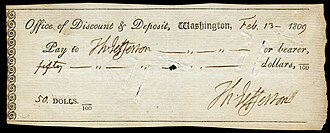
Key Facts
- Digital Shift: Many countries, including New Zealand and Poland, have already phased out or are phasing out cheques in favor of electronic payments.
- Security: In the UK, cheques are sometimes preferred for commercial transactions to avoid phishing fraud associated with online payments.
- Legal Frameworks: Most nations govern cheques through specific legislation, such as India's Negotiable Instruments Act of 1881 or the US Check 21 Act of 2004.
- Technological Standards: Magnetic Ink Character Recognition (MICR) is the global standard for automating the reading of account and routing numbers.
Cheque Systems by Country
Australia
The Australian Cheques Act 1986 governs the issuance of cheques, while the Australian Payments Clearing Association (APCA) manages the practicalities of clearance. In 1999, the adoption of electronic information transmission reduced clearance times from five days to three. However, the Australian government announced in June 2023 that it intends to phase out cheques entirely by 2030.
Canada
Overseen by Payments Canada, Canadian cheques can be legally written in English, French, or Inuktitut. Canada previously utilized "tele-cheques"—items created by a third party on behalf of the payer—but these were prohibited in 2004. The government began phasing out government cheques in April 2016, noting that mailing a cheque is 6.5 times more expensive than direct deposit.
India
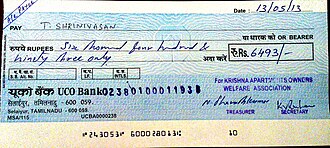
India has a long history with cheques, starting with the Bank of Hindustan in 1770. The Negotiable Instruments Act (NI Act) of 1881 formalized the legal framework for these instruments. To modernize, the Reserve Bank of India (RBI) and the National Payments Corporation of India (NPCI) introduced the Cheque Truncation System (CTS) in 2010. This system uses MICR to capture images of cheques, eliminating the need for physical transport between banks.
Israel
In Israel, cheques remain highly relevant due to laws capping cash payments at 6,000 NIS. They are commonly used for retail, school payments, and utility bills. A unique cultural practice involves tenants providing landlords with twelve post-dated cheques for rent, along with additional open-dated cheques to ensure utility debts are covered.
New Zealand
Governed by the Cheques Act 1960, New Zealand saw a massive decline in cheque usage starting in the mid-1990s. In 1993, cheques averaged 130 per capita; by 2006, this dropped to 41. Major banks, including ANZ, Westpac, BNZ, and ASB, completely phased out cheque acceptance between February 2020 and August 2021.
United Kingdom
The UK maintains rigorous standards for cheques, requiring specific paper weights (CBS1) and accreditation for printers via the Cheque Printer Accreditation Scheme (CPAS). To prevent fraud, "crossed cheques" (marked "account payee only") ensure funds are paid only to the intended beneficiary.
The UK uses a "T+X" clearing cycle (e.g., T+4 for current account withdrawals), providing "certainty of fate" regarding whether a cheque will bounce. While the government attempted to phase out cheques by 2018, public opposition reversed the decision in 2011. Recently, the Image Clearing System has allowed customers to deposit cheques via mobile photos, though overall volume continues to decline.
United States
In the US, terminology varies: "checks" are associated with commercial banks, "share drafts" with credit unions, and "warrants" with government payroll. The Check 21 Act of 2004 legalized the use of substitute electronic cheques to reduce processing costs.
US cheques feature a nine-digit ABA routing transit number at the bottom in MICR format. Historically, cheques remained popular in the US because electronic transfers for very small amounts (under $5) were often prohibitively expensive due to transaction fees, whereas cheques typically incurred zero service charges for both parties.
Global Cheque Comparison Summary
| Country | Primary Governing Law/Body | Current Status | Key Feature/Trend |
|---|---|---|---|
| Australia | Cheques Act 1986 / APCA | Phasing out by 2030 | Electronic transmission since 1999 |
| Canada | Payments Canada | Declining | Trilingual (English, French, Inuktitut) |
| India | NI Act 1881 / RBI | Active / Declining | Cheque Truncation System (CTS) |
| Israel | National Law | Active | Post-dated cheques for rent |
| New Zealand | Cheques Act 1960 | Phased out (2021) | Replaced by EFTPOS and electronic credits |
| UK | Cheques Act 1992 / C&CCC | Active / Declining | Strict paper and printer accreditation |
| USA | Check 21 Act / ANSI X9 | Active / Declining | ABA routing numbers and substitute cheques |
Frequently Asked Questions
What is a Cheque Truncation System (CTS)?
CTS is a process where the physical movement of a paper cheque is stopped. Instead, the bank where the cheque is deposited captures a digital image and uses Magnetic Ink Character Recognition (MICR) to transmit the data electronically to the paying bank.
Why are cheques still used in some commercial transactions?
In some regions, such as the UK, cheques are viewed as a secure alternative to online payments because they can help businesses avoid phishing fraud and other types of authorized payment scams.
What is a "crossed cheque"?
A crossed cheque features two parallel vertical lines in the center, often with the words "account payee only." This prevents the cheque from being cashed over the counter or paid into a third-party account, ensuring the money reaches the intended beneficiary.
How does the US routing number work?
The US uses a nine-digit ABA routing transit number. The first four digits identify the Federal Reserve processing center, digits five through eight identify the specific bank, and the ninth digit is a verification check digit calculated via an algorithm.
Why did Poland withdraw cheques from use?
Poland withdrew cheques in 2006 primarily due to a lack of popularity and the widespread adoption of credit and debit cards, alongside the availability of fast, inexpensive electronic payments within the European Union.