Chemical Abstracts Service: A History of Chemical Information
The landscape of modern chemistry relies heavily on the ability to access, organize, and retrieve vast amounts of research data. At the center of this effort is the Chemical Abstracts Service (CAS), an organization that evolved from a small volunteer effort into the world's most comprehensive repository of chemical research. Associated with the American Chemical Society (ACS) since 1907, CAS has spent over a century refining how scientific knowledge is indexed and shared.
The Foundations of Chemical Abstracting
The origins of CAS can be traced back to 1895, when Arthur Noyes began the Review of American Chemical Research. This abstracting publication—a summary of research papers—served as the forerunner to what would become Chemical Abstracts. In 1907, William A. Noyes expanded the review, and as the need for a dedicated publication grew, he became the first editor of the newly formed Chemical Abstracts.
For several decades, the organization operated out of various locations on the Ohio State University campus in Columbus, Ohio, including Watts Hall and McPherson Laboratory. The early years were characterized by a reliance on volunteer abstractors, a practice that continued until it was phased out in 1994.
Organizational Growth and Leadership
A pivotal shift occurred in 1956 when Chemical Abstracts Service became an official division of the American Chemical Society. E. J. Crane, who had served as the editor since 1915, was appointed as the first Director. His long-term dedication provided the stability necessary for the organization's growth.
Following Crane's retirement in 1958, Dale B. Baker took over as Director. Baker is credited with modernizing the organization and forging international alliances with other information entities. Under his leadership, CAS became an early adopter of computer technology to organize and disseminate scientific data, setting the stage for the digital era of chemistry.
The CAS Registry System and Infrastructure
In 1965, CAS introduced the CAS Chemical Registry System. This system assigns a unique registry number to identify chemical substances, providing a universal language for scientists. Today, this is recognized by the ACS as the largest chemical substance database in the world, and it is utilized globally by local fire departments and agencies like the U.S. Environmental Protection Agency (EPA) for the definite identification of substances.
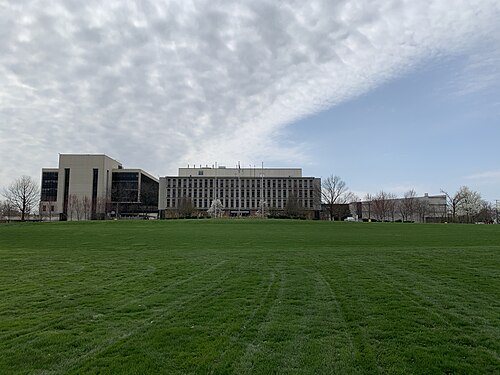
Parallel to these technical advancements, the organization expanded its physical footprint. In 1965, CAS moved to a 50-acre site on the west bank of the Olentangy River, north of the Ohio State campus. To handle the massive volume of 400,000 new research reports printed annually, a 142,000-square-foot, five-story expansion designed by Brubaker/Brandt opened in May 1973.
Modern Evolution and Open Access
The significance of CAS was formally recognized in 2007 when the ACS designated the subdivision as an ACS National Historic Chemical Landmark. This honor highlighted its role as a vital repository for chemistry and related sciences.
In recent years, CAS has adapted to the fast-paced nature of modern science. In 2021, the organization underwent a rebranding, including a new logo and a mission statement focused on dynamic responsiveness to changes within scientific communities. Furthermore, in 2022, CAS expanded its commitment to open data through the Common Chemistry project, releasing nearly half a million CAS registry numbers under an open license.
Key Facts
- Founded: Associated with the ACS since 1907.
- Registry System: Launched in 1965; creates unique identifiers for chemical substances.
- Database Scale: Recognized as the largest chemical substance database globally.
- Historic Status: Named an ACS National Historic Chemical Landmark in 2007.
- Open Data: Released nearly 500,000 registry numbers via Common Chemistry in 2022.
| Year | Event/Milestone |
|---|---|
| 1895 | Arthur Noyes begins Review of American Chemical Research |
| 1907 | William A. Noyes expands the review; Chemical Abstracts is formed |
| 1956 | CAS becomes a division of the American Chemical Society |
| 1965 | Launch of the CAS Chemical Registry System and move to new headquarters |
| 1973 | Opening of the 142,000 sq ft expansion building |
| 1994 | Phase-out of volunteer abstractors |
| 2021 | Rebranding and mission update for dynamic responsiveness |
Frequently Asked Questions
What is a CAS Registry Number?
A CAS Registry Number is a unique identifier assigned to a chemical substance by the CAS Chemical Registry System, used globally by scientists and emergency agencies for definite substance identification.
When did CAS become part of the American Chemical Society?
While associated with the ACS since 1907, it officially became an ACS division in 1956.
Who were the early leaders of CAS?
William A. Noyes was the first editor, E. J. Crane served as the first Director starting in 1956, and Dale B. Baker succeeded him in 1958.
What is the Common Chemistry project?
Announced in 2022, Common Chemistry is an initiative where CAS released nearly half a million registry numbers under an open license to increase accessibility.
Where is the CAS headquarters located?
CAS is located in Columbus, Ohio, on a site on the west bank of the Olentangy River, just north of the Ohio State University campus.