Checkerboards: Design, Variations, and Game Applications
A checkerboard (known as a chequerboard in British English) is a specialized game board featuring a checkered pattern. While most commonly associated with the game of checkers—also referred to as English draughts—this versatile grid serves as the foundation for a wide array of strategic games and mathematical puzzles.
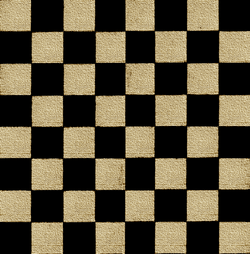
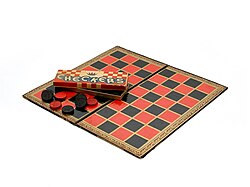
The standard design consists of a square grid with alternating dark and light colors. While black and white are common in printed diagrams, commercial sets often use black and red, and official tournament boards typically utilize green and buff colors.
Key Facts
- The standard checkerboard is an 8×8 grid totaling 64 squares.
- The same 8×8 grid is used for chess, where it is called a chessboard.
- International draughts uses a larger 10×10 grid (100 squares), known in the Netherlands as a dambord.
- Checkerboard patterns are encoded in Unicode for digital representation.
Games and Puzzles
Beyond the classic game of checkers, the alternating square pattern is utilized in numerous other strategic contests. Mathematician Martin Gardner highlighted the puzzle potential of these boards in his 1962 Mathematical Games column for Scientific American.
Games Using Alternating Patterns
Many games rely specifically on the alternating color pattern of the board to function, including:
- Checkers (English draughts)
- Chess and its various variants
- International, Russian, Italian, Czech, and Frisian draughts
- Amazons, Chapayev, Gounki, and Lines of Action
- Fox games and Pool checkers
Games Using the 8×8 Grid
Some games require the 8×8 dimensions but do not necessarily rely on the alternating colors. These are often played on a standard chessboard:
- Arimaa
- Breakthrough
- Crossings
- Mak-yek
- Makruk
- Martian Chess
Technical and Mathematical Specifications
From a mathematical perspective, a checkerboard can be described as a grid of rows and columns where the color of any given square is determined by a function of its coordinates. In this model, the element at the lower left corner is designated as black.
In the digital realm, the Unicode standard provides specific code points to represent checkerboard patterns. These include symbols for delete square and rectangular checkerboard forms (U+2427, U+2428), as well as specific checkerboard and reverse checkerboard characters (U+1F67E, U+1F67F) and fill patterns (U+1FB95, U+1FB96).
Comparison of Board Types
| Board Type | Dimensions | Total Squares | Primary Use |
|---|---|---|---|
| Standard Checkerboard | 8×8 | 64 | English Draughts, Chess |
| Dambord | 10×10 | 100 | International Draughts |
| Rectangular Board | Variable | Variable | Various Puzzles/Games |
Frequently Asked Questions
What is the difference between a checkerboard and a chessboard?
Physically, an 8×8 checkerboard and a chessboard are identical. The term used typically depends on the game being played: "checkerboard" for checkers/draughts and "chessboard" for chess.
How many squares are on a standard checkerboard?
A standard checkerboard consists of 64 squares, arranged in an 8×8 grid of alternating colors.
What is a dambord?
A dambord is a checkerboard used in the Netherlands for International draughts, featuring a larger 10×10 grid with 100 squares.
What colors are used for official tournament boards?
Official tournament boards typically use a combination of green and buff colors.
Are there digital symbols for checkerboards?
Yes, Unicode includes several characters for checkerboards, such as U+1F67E (Checker Board) and U+1F67F (Reverse Checker Board).