Charly García: The Architect of Argentine Rock
Few figures have shaped the sonic landscape of Latin America as profoundly as Charly García. Born Carlos Alberto García in Buenos Aires, Argentina, he emerged in the late 1960s as a precocious talent with absolute hearing—the rare ability to identify or recreate any musical note without a reference tone. Over a career spanning more than five decades, García has evolved from a folk-rock pioneer into a living legend, blending genres from classical and jazz to new wave and experimental rock.
Key Facts
- Full Name: Carlos Alberto García
- Origin: Buenos Aires, Argentina
- Active Years: 1967–present
- Key Bands: Sui Generis, PorSuiGieco, La Máquina de Hacer Pájaros, and Serú Girán
- Instruments: Vocals, piano, keyboards, and bass guitar
- Notable Achievement: Recipient of the Gardel de Oro and declared a Distinguished Citizen of Buenos Aires
The Formative Years and Group Era (1972–1982)
García's ascent began with Sui Generis (1972–1975), a duo with Nito Mestre that captured the youth spirit of the era. Their impact was seismic, marked by albums like Vida and songs such as "Confesiones de invierno" and "Instituciones." The group's initial run culminated in the historic "Adiós Sui Generis" concerts at Luna Park.
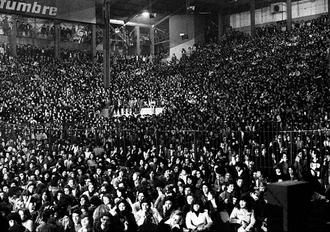
Following Sui Generis, García explored various collaborative formats. He formed PorSuiGieco (1974–1975) and later La Máquina de Hacer Pájaros (1976–1977). However, internal tensions and the oppressive atmosphere of the Argentine military dictatorship led him to seek refuge in Brazil in 1977. Alongside musician David Lebón, he spent time in Búzios, Rio de Janeiro, to escape political repression and be near his girlfriend, Zoca Pederneira.
He returned to the forefront with Serú Girán (1978–1982), a powerhouse ensemble that further cemented his status as a master songwriter and pianist before he transitioned into a full-time solo career.
Solo Career and Artistic Evolution
The transition to democracy in Argentina on December 10, 1983, coincided with a prolific era for García. Between 1982 and 1985, he achieved massive success with works like Terapia intensiva and the 1984 release Piano Bar, which completed what is often referred to as his "golden trilogy." During this time, he also performed with his group "Giovanni y los de Plástico."
Throughout the late 1980s and 1990s, García's work shifted toward the Say No More era, characterized by a more experimental and provocative approach to music and performance. Despite periods of personal excess and professional volatility, his influence remained unmatched in the Spanish-speaking rock world.
The Millennium and Beyond
In December 2000, Sui Generis reunited for a massive show at the Boca Juniors Stadium, performing for 25,000 fans over nearly four hours. This was followed by a solo resurgence in 2002 with the album Influencia, which featured the track "Tu Vicio" and a cover of Todd Rundgren's "Influenza." This record is widely regarded as one of his strongest works since the mid-90s.

Legacy and Recent Years
In his later years, García has been recognized as a global icon. In 2017, he made headlines by accusing Mark Ronson and Bruno Mars of plagiarism, claiming that the hit "Uptown Funk" borrowed the riff and chords from his 1989 song "Fanky." His enduring legacy is further honored by a dedicated street corner in New York City's Times Square.
| Period | Primary Project/Phase | Key Characteristics |
|---|---|---|
| 1972–1975 | Sui Generis | Folk-rock, youth anthems, massive popularity |
| 1976–1977 | La Máquina de Hacer Pájaros | Progressive elements, complex arrangements |
| 1978–1982 | Serú Girán | Jazz fusion, sophisticated songwriting |
| 1982–1989 | Early Solo Career | New wave, pop-rock, "Golden Trilogy" |
| 1994–2000 | Say No More | Experimental, avant-garde, provocative |
| 2009–Present | Living Legend Status | Comeback, honorary titles, global recognition |
Frequently Asked Questions
What is Charly García's musical style?
García is highly versatile, spanning rock, pop, folk, jazz, experimental, new wave, jazz fusion, and classical music.
Which bands was Charly García a member of?
He was a key member of Sui Generis, PorSuiGieco, La Máquina de Hacer Pájaros, and Serú Girán.
Why did Charly García move to Brazil in 1977?
He moved to Búzios, Brazil, to escape the repressive military dictatorship in Argentina and to be with his girlfriend, Zoca Pederneira.
What is the "golden trilogy" in García's career?
The golden trilogy refers to a series of highly successful solo albums from the early 1980s, concluding with the release of Piano Bar in 1984.
Did Charly García ever have a legal dispute over plagiarism?
Yes, in 2017, he accused Bruno Mars and Mark Ronson of plagiarizing the chords and riff of his song "Fanky" for their track "Uptown Funk."