Charles Hodge: The Architect of Princeton Theology
Charles Hodge (1797–1878) was a towering figure in 19th-century American religion, serving as a primary architect of Reformed theology—a tradition emphasizing the sovereignty of God and the authority of Scripture. As the second principal of the Princeton Theological Seminary, Hodge spent decades shaping the intellectual and spiritual landscape of the Presbyterian Church in the United States.
His career was defined by a commitment to orthodoxy, a rigorous approach to biblical languages, and a prolific output of scholarly works that remain in print over a century after his death. From his early days as a student to his tenure as a leading polemicist, Hodge's life mirrored the theological and political tensions of a nation divided by war and scientific revolution.
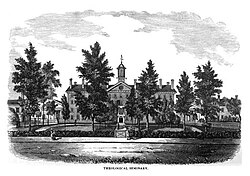
Key Facts
- Role: 2nd Principal of Princeton Theological Seminary (1851–1878).
- Major Work: Systematic Theology (1871–1873), a three-volume magnum opus.
- Theological Stance: Leading proponent of the "Princeton theology" and the Old School Presbyterian branch.
- Academic Focus: Expert in biblical languages, New Testament exegesis, and didactic theology.
- Key Conflict: Opposed Darwinism on the grounds that it was fundamentally atheistic.
Early Life and Education
Born on December 27, 1797, Charles Hodge's early life was marked by tragedy. His father, Hugh Hodge, a graduate of Princeton College and a Revolutionary War surgeon, died of yellow fever complications just seven months after Charles was born. Raised by his mother, Mary Blanchard, and relatives, Charles received a strict Presbyterian education centered on the Westminster Shorter Catechism (a summary of Reformed doctrines used for teaching).
Hodge entered Princeton College in 1812, a period when the Presbyterian Church was establishing the Princeton Theological Seminary as a separate institution to ensure ministers received orthodox training. Under the mentorship of Archibald Alexander, Hodge mastered Greek and developed a passion for the ministry. He enrolled in the seminary in 1816, where he studied 17th-century Reformed scholasticism, specifically the works of Francis Turretin, and practiced reciting scripture in its original languages.
Academic Ascent and Leadership
After graduating in 1819 and pursuing private Hebrew studies, Hodge began his career as a missionary preacher in Philadelphia and New Jersey. His academic aptitude led to a rapid rise; by 1822, he was appointed Professor of Oriental and Biblical Literature. In 1824, he co-founded the Chi Phi Society, and in 1825, he launched the Biblical Repertory (later renamed the Princeton Review) to translate European biblical scholarship for American audiences.
Despite a period of severe illness in 1833 that left him temporarily unable to use his limbs, Hodge remained productive. He transitioned to the role of Professor of Didactic Theology in 1840 while maintaining his duties in New Testament exegesis. He eventually ascended to the position of Principal of the Seminary in 1851, a post he held until his death in 1878.
Summary of Career and Contributions
| Period/Year | Role/Achievement | Key Contribution |
|---|---|---|
| 1822 | Professor of Oriental and Biblical Literature | Academic leadership in biblical languages |
| 1825 | Founder of Biblical Repertory | Introduced European scholarship to the US |
| 1840 | Professor of Didactic Theology | Advanced the study of systematic doctrine |
| 1851–1878 | Principal of Princeton Seminary | Defined the "Princeton theology" era |
| 1871–1873 | Author of Systematic Theology | Produced a 2,260-page definitive theological work |
Theological and Political Battles
Hodge was not merely an academic; he was a fierce polemicist involved in the most contentious debates of his era.
The Old School–New School Controversy
Hodge was a staunch supporter of the Old School faction during the Presbyterian split of 1837. This conflict centered on differences in theology and church governance, with the Old School emphasizing traditional confessional standards over the more revivalist and flexible approach of the New School.
The American Civil War and Secession
A strong nationalist, Hodge viewed secession as unconstitutional. In 1861, he used the Princeton Review to argue against the South's departure from the Union. However, he maintained a distinction between political and ecclesiastical spheres, voting against the "Spring Resolutions" of 1861 because he believed the church should not involve itself in political matters. This tension contributed to the North-South split within the Old School Presbyterian Church.
The Conflict with Darwinism
In his 1874 work, What is Darwinism?, Hodge argued that the theory of evolution was essentially atheistic because it denied the notion of divine design. This created a distinct intellectual divide in Princeton: while Hodge and the Seminary rejected Darwinism, James McCosh, president of the separate Princeton University, sought to reconcile evolutionary science with faith, viewing it as evidence of God's prearrangement of the universe.
Frequently Asked Questions
What was Charles Hodge's most significant written work?
His magnum opus is the Systematic Theology, published between 1871 and 1873. This three-volume work spans 2,260 pages and serves as a comprehensive exposition of Reformed doctrine.
How did Hodge view the theory of evolution?
Hodge believed that Darwinism was contrary to the concept of design in nature and therefore viewed it as a form of atheism. He argued that it was incompatible with the biblical account of creation.
What was the "Old School" position Hodge supported?
The Old School position emphasized a strict adherence to the Westminster Confession of Faith and traditional Presbyterian polity, opposing the more modernizing and revivalist tendencies of the New School.
What was Hodge's stance on the American Civil War?
Politically, Hodge was a staunch Unionist who believed secession was unconstitutional. However, he believed the church should remain separate from political disputes, which led him to oppose official church resolutions regarding the conflict.
Who were the key influences on Hodge's education?
Hodge was deeply influenced by Archibald Alexander, the first president of Princeton Seminary, and Samuel Miller, both of whom instilled in him a combination of rigorous academic scholarship and intense personal piety.