Charadriiformes: The Diverse World of Shorebirds and Seabirds
The Charadriiformes represent a vast and ecologically diverse order of small to medium-large birds found across every corner of the globe. Comprising approximately 390 species, these birds are most commonly known as shorebirds. While many are inextricably linked to aquatic environments, the order is remarkably adaptable; its members range from pelagic seabirds that spend their lives on the open ocean to specialized species inhabiting dense forests and arid deserts.
Most charadriiforms sustain themselves on a diet of invertebrates or other small animals, utilizing a variety of foraging techniques tailored to their specific habitats.
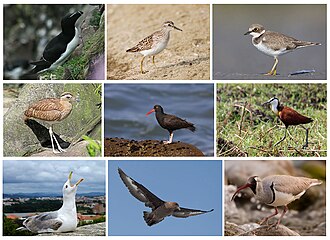
Key Facts
- Species Count: Approximately 390 to 391 species across 19 families.
- Temporal Range: Existed from the Eocene to the Holocene (55–0 Ma), with some fossil evidence dating back to the Late Cretaceous.
- Distribution: Global presence across all continents.
- Primary Habitats: Coastal shores, freshwater wetlands, open oceans, deserts, and forests.
- Taxonomic Structure: Divided into three main suborders: Charadrii, Scolopaci, and Lari.
Taxonomy and Systematics
The classification of Charadriiformes has evolved as scientific methods have improved. While older Sibley-Ahlquist taxonomies grouped them into a larger order called Ciconiiformes based on DNA-DNA hybridization, modern research indicates that Charadriiformes constitute a distinct and single large lineage of modern birds.
The Three Suborders
The order is currently organized into three primary groups based on morphology and behavior:
- Charadrii (The Waders): Typical shorebirds that generally feed by picking items off the surface or probing mud in freshwater and coastal areas.
- Lari (Gulls and Allies): Generally larger birds that primarily hunt fish in the sea. This group includes skuas and gulls, some of which have adapted to inland environments or opportunistic scavenging.
- Scolopaci (The Snipes): Small, gregarious waders, including jacanas and pipers.
Interestingly, auks—which possess a very different physical build due to their adaptation for diving—are now considered more closely related to gulls than to other waders.
Detailed Family Breakdown
The order is structured into 19 families, distributed across the three suborders as follows:
| Suborder | Key Families | Notable Examples | Approx. Species |
|---|---|---|---|
| Charadrii | Charadriidae, Haematopodidae, Recurvirostridae | Plovers, Oystercatchers, Stilts | ~110+ |
| Scolopaci | Scolopacidae, Jacanidae, Rostratulidae | Sandpipers, Snipes, Jacanas | ~110+ |
| Lari | Laridae, Alcidae, Stercorariidae | Gulls, Terns, Auks, Skuas | ~135+ |
Evolutionary History
Charadriiformes are among the most ancient orders of modern birds. Along with Anseriformes, they are the only modern bird orders with an established fossil record in the Late Cretaceous, existing alongside dinosaurs. One notable specimen, VI 9901 from Antarctica's López de Bertodano Formation, is believed to be a basal charadriiform resembling a thick-knee.
While fragmented remains appear early, more complete and undisputed fossils emerge from the mid-Paleogene. Most present-day orders solidified around the Eocene-Oligocene boundary, roughly 30 to 35 million years ago. Historically, a group called the "Graculavidae" (transitional shorebirds) was thought to be the common ancestor of waterfowl and flamingos, but they are now largely viewed as basal taxa of the charadriiforms or other higher waterbirds.
Evolution of Parental Care
Shorebirds are of particular interest to biologists because they exhibit a wider variety of parental care strategies than almost any other avian order. This diversity provides a unique window into how avian social structures evolve.
Research suggests that while the ancestral avian likely utilized a female-led care system, the shorebird ancestor evolved from a bi-parental care system (both parents). However, within the Scolopacidae clade, a transition to a male parental care system occurred. Factors influencing these shifts include:
- Brooding Density: Male care is often correlated with low breeding density, whereas female care is associated with high density.
- Mortality and Maturation: Differing rates of egg death and adult mortality between sexes.
- Sex Ratios: Male-biased adult sex ratios often motivate sex role reversal.
Frequently Asked Questions
What are Charadriiformes?
Charadriiformes is a diverse order of birds that includes shorebirds, gulls, terns, and auks. They are typically small to medium-sized birds found worldwide, mostly inhabiting areas near water.
How do shorebirds differ from seabirds in this order?
While both belong to Charadriiformes, shorebirds (like plovers and sandpipers) typically forage in mud or on beaches, whereas pelagic seabirds (like gulls and auks) are adapted for life on the open ocean and diving.
When did Charadriiformes first appear?
They have an ancient lineage with fossil evidence appearing as early as the Late Cretaceous, though the modern orders we recognize today emerged around 30 to 35 million years ago during the Eocene-Oligocene boundary.
Why is the parental care of shorebirds unique?
They exhibit an unusually high diversity of strategies, ranging from bi-parental care to male-only care, which is rare in birds and often linked to breeding density and adult sex ratios.
Are auks related to gulls?
Yes. Despite their different physical appearance—which is a result of evolutionary adaptation for diving—molecular evidence suggests auks are more closely related to gulls than to other waders.