Cetaceans: The Biology, Evolution, and Conservation of Whales and Dolphins
Cetaceans are a diverse group of aquatic mammals that have fully adapted to life in the world's oceans and rivers. Comprising approximately 94 species, this order includes the massive baleen whales, the intelligent toothed whales, and the agile porpoises. From the depths of the abyss to the estuaries of tropical rivers, these animals exhibit some of the most extreme physiological adaptations in the animal kingdom.
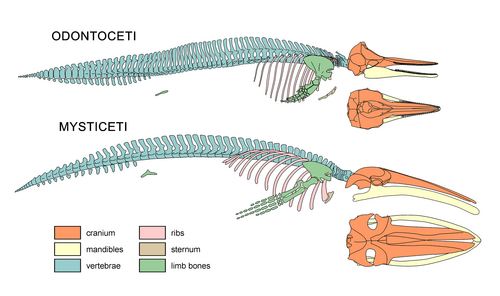
The group is broadly divided into two main suborders: Mysticeti (baleen whales), which filter-feed on small organisms, and Odontoceti (toothed whales), which include dolphins and sperm whales that hunt individual prey.
Key Facts

- Diversity: Approximately 94 extant species across the globe.
- Evolution: Evolved from land-dwelling artiodactyls (even-toed ungulates) starting around 53.5 million years ago.
- Diving Capability: Sperm whales can reach depths of 3,000 meters (9,800 ft).
- Brain Size: The sperm whale possesses the largest brain in the world.
- Conservation: Many species remain threatened due to historical commercial whaling and modern environmental hazards.
Anatomy and Physiology
Skeletal Structure and External Form
Cetaceans have evolved a streamlined body shape, a process known as convergent evolution, mirroring the forms of fish and aquatic reptiles to reduce drag while swimming.
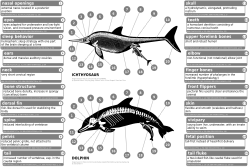
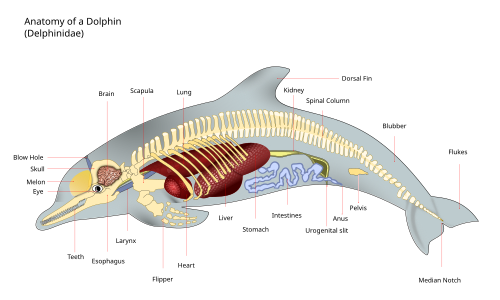
Their anatomy is specialized for an aquatic existence. The forelimbs have become flippers, and the hind limbs have largely disappeared or become vestigial. The tail has evolved into a powerful fluke, which provides the primary propulsion for the animal.
Sensory Systems and the Brain
The brain of a cetacean is highly developed, particularly in species like the sperm whale. Their sensory world is dominated by sound rather than sight. While they possess vision, many toothed whales rely on echolocation (biosonar)—the emission of high-frequency sound pulses that bounce off objects to create a mental map of their surroundings.


Diving and Respiration
To survive extreme depths, cetaceans employ sophisticated physiological mechanisms. During a dive, they reduce oxygen consumption by slowing heart activity and restricting blood circulation to non-essential organs. Diving durations vary significantly by species:
- Rorquals: Up to 40 minutes.
- Sperm Whales: Between 60 and 90 minutes.
- Bottlenose Whales: Up to two hours.
Ecology and Behavior

Hunting and Social Intelligence
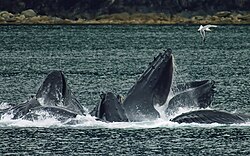
Cetaceans exhibit complex social structures and hunting strategies. Some species, such as humpback whales, utilize bubble net feeding, a cooperative technique where they blow bubbles to corral fish into a tight group before feeding.
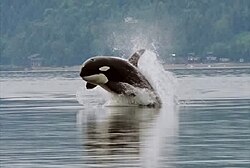
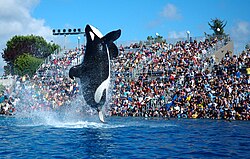
Other behaviors include porpoising—leaping clear of the water while swimming at high speeds—which is frequently observed in killer whales (orcas).
Life History and Reproduction
Most cetaceans reach sexual maturity between seven and ten years of age, though there are notable exceptions. The La Plata dolphin matures at just two years, while the sperm whale may take up to 20 years to reach maturity. Lifespans vary widely; sperm whales can live between 50 and 100 years.
Evolutionary History
The transition from land to sea is one of the most well-documented evolutionary journeys. Cetaceans originated from aquatic artiodactyls during the Eocene epoch. Fossil evidence, such as that of the Maiacetus, shows the gradual transition of these mammals as they moved from terrestrial environments to the open ocean.
![Fossil of a Maiacetus (red, beige skull) with fetus (blue, red teeth) shortly before the end of gestation [89]](/images/ab/f4/abf4d652bbab0130fbc3349da24f2df0ebdf62ea1c70cb3279029244eeb41f0f.jpg)
This evolutionary path led to the emergence of the Pelagiceti clade and eventually the modern Neoceti, splitting into the filter-feeding Mysticeti and the echolocating Odontoceti.
Threats and Conservation

The Impact of Whaling
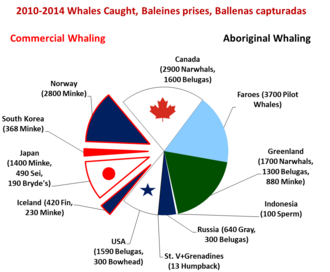
Historically, whales were hunted for meat, oil (used as fuel), and baleen (used in products like dominoes). In the 1930s, roughly 30,000 whales were killed annually, a number that rose to over 40,000 by the 1960s. This led to the collapse of several large baleen whale stocks.


The International Whaling Commission (IWC), established in 1946, eventually prohibited the commercial whaling of 14 large species between 1985 and 2005. Despite this, some populations, such as the North Atlantic right whale, remain critically low, with estimates once falling to between 300 and 600 individuals.
Modern Environmental Hazards
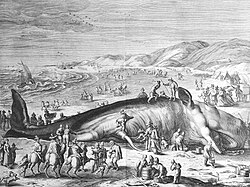
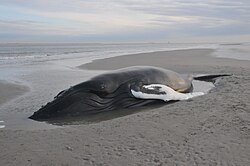
Beyond hunting, cetaceans face threats from noise pollution. Active sonar used by militaries has been linked to mass strandings, particularly among beaked whales, who may be more sensitive to sound. Other causes of beaching include toxic contaminants, parasites, and disturbances in the Earth's magnetic field.
Cetaceans in Human Culture and Captivity
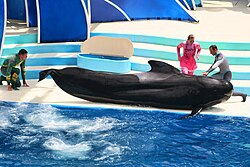
Whales have appeared in human art and mythology for millennia, from ancient Greek coins to the engravings of Gustave Doré. In modern times, the focus has shifted toward captivity. Beluga whales were the first to be kept in aquariums, followed by orcas.


The captivity of orcas has been highly controversial. Critics argue that the limited space of tanks and the requirement to perform tricks cause significant stress for animals that naturally travel up to 160 kilometers a day in the wild.

| Feature | Mysticeti (Baleen Whales) | Odontoceti (Toothed Whales) |
|---|---|---|
| Feeding Mechanism | Baleen plates (filter feeding) | Teeth (predatory hunting) |
| Echolocation | Absent | Present (Biosonar) |
| Examples | Humpback, Blue, Right Whale | Orca, Bottlenose Dolphin, Sperm Whale |
| Primary Diet | Krill, small schooling fish | Fish, squid, other marine mammals |
Frequently Asked Questions
How deep can whales dive?
Diving depths vary by species. While the average is around 100 meters, sperm whales are capable of diving to 3,000 meters (9,800 ft), though they more commonly dive to 1,200 meters.
What is the difference between a whale and a dolphin?
In scientific terms, "whale" and "dolphin" are informal. The primary biological distinction is between Mysticeti (baleen whales) and Odontoceti (toothed whales). Dolphins are a subset of the Odontoceti.
Why do whales beach themselves?
Mass strandings can be caused by various factors, including noise pollution from sonar, infections, parasites, toxic contaminants, or social bonds that lead a pod to follow a stranded leader.
How did whales evolve from land animals?
Whales evolved from land-dwelling artiodactyls (even-toed ungulates) approximately 53.5 million years ago, gradually adapting their limbs into flippers and developing streamlined bodies for aquatic life.
What is bubble net feeding?
Bubble net feeding is a sophisticated cooperative hunting behavior used by some rorquals, such as humpback whales, where they blow a circle of bubbles to trap fish before swimming upward to eat them.