Central Synagogue of Aleppo
The Central Synagogue of Aleppo, also known as the Great Synagogue, Joab's Synagogue, al-Safra, or Al-Bandara Synagogue, stands as a profound testament to the long-standing Jewish presence in Syria. Located in the Al-Farafira district of Aleppo, this historic site served as the primary place of worship for the city's Jewish community for centuries. Its legacy is inextricably linked to the Aleppo Codex, one of the most important manuscripts of the Hebrew Bible, which was housed within its walls for over five hundred years.
From its possible origins in the 5th century CE to its current status as an archaeological site under restoration, the synagogue has survived Mongol invasions, Ottoman transitions, and the turmoil of modern warfare. Today, it remains a symbol of the spiritual and cultural heritage of the Syrian Jewish community.
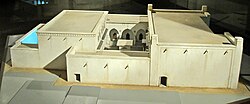
Key Facts
- Location: Aleppo, Syria (Al-Farafira).
- Architectural Style: Byzantine.
- Historical Significance: Former home of the Aleppo Codex.
- Religious Rites: Nusach Sefard and Musta'arabi.
- Current Status: Inactive ruins; currently undergoing restoration by the Sephardic Heritage Museum.
Historical Timeline
Ancient Origins and Medieval Struggles
Local tradition suggests that the foundation of the synagogue was laid by Yoab ben Seruyah, the general of King David, following the conquest of the city (then known as Aram Soba). While traditional, the physical evidence points to the western wing being the oldest section, dating back to the 5th or 6th century CE. The oldest surviving inscription found at the site dates to 834 CE.
The synagogue's history is marked by resilience. During the Mongol invasion of 1260, it was designated as one of six safe havens. However, it was later destroyed during Tamerlane's Mongol invasion in 1400. Rebuilding efforts began in 1405 and were completed by 1418, though the structure was intentionally scaled down during this period to avoid attracting unwanted attention.
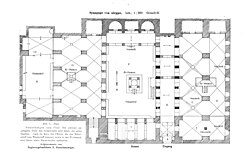
Ottoman Growth and Sephardic Influence
The 1516 transition to Ottoman rule brought economic prosperity and a wave of Spanish Jewish immigrants to Syria. To accommodate these new arrivals and their specific ritual needs, an eastern wing was added to the complex. This expansion allowed the community to integrate the traditions of the Sephardim with the existing Musta'arabi (indigenous Arabic-speaking Jews) customs.
Further renovations in 1855 reflected the community's growth and pride. The layout evolved to include a porticoed courtyard featuring a raised, covered tevah (the platform from which the Torah is read), used primarily during the summer months.
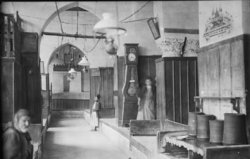
Destruction and Modern Restoration
The synagogue's active life ended abruptly during the 1947 Aleppo pogrom, during which the building was looted and burned. It was during this violent period that the Aleppo Codex was removed and eventually taken to Israel. The site lay in ruins for decades until 1990, when the Syrian Jewish community of New York funded a reconstruction that was completed in 1992.
Despite the reconstruction, the absence of a resident Jewish population in Aleppo meant the building remained abandoned and fell under government jurisdiction. Between 2011 and 2015, the structure suffered further damage during the Syrian Civil War. While the Sephardic Heritage Museum began restoration in 2016, the site was again impacted by the 2023 Turkey–Syria earthquakes. Restoration efforts are currently ongoing.
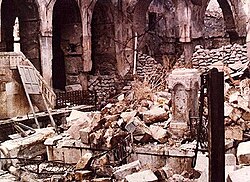
Architecture and Layout
The synagogue was a complex structure divided into three primary sections, each designed for specific liturgical and communal functions.
The Western Prayer Hall
The oldest part of the complex, the western hall, featured three aisles separated by columns. The western wall was characterized by seven windows of varying designs. This section housed the Middle Ark and the Ark of Moses on the southern end, facing Jerusalem. A carved wooden indoor tevah with six steps served as the focal point, while the eastern aisle functioned as an entrance hall and supported a women's gallery.
The Central Courtyard
The courtyard acted as an open-air sanctuary. Its center featured a domed outdoor tevah supported by four columns. Key features included:
- Ark of Tekiah: Located on the western wall, used for sounding the shofar.
- Circumcision Platform: An upper platform accessed by nine steps.
- Summer Ark: Positioned against the southern wall, flanked by semicircular hechalot (Holy Arks).
- Beth Midrash: A study room located on the north side.
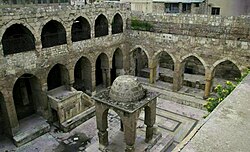
The Eastern Wing
Built specifically for the Sephardic community, the eastern wing contained a prayer space divided into two aisles and its own wooden tevah. This section also housed the Ark of the Sephardic Jews and the Cave of Elijah, a secluded area where the Aleppo Codex was kept.
The entire complex was notable for containing seven hechalot and a genizah (a storage area for worn-out sacred texts) located in one of the smaller chapels.
| Feature | Details |
|---|---|
| Primary Sections | Western Prayer Hall, Central Courtyard, Eastern Wing |
| Key Artifact | Aleppo Codex (formerly housed in the Cave of Elijah) |
| Architectural Style | Byzantine |
| Major Damage Events | 1400 (Mongols), 1947 (Pogrom), 2011-2015 (Civil War), 2023 (Earthquake) |
| Ritual Elements | 7 Hechalot, 3 Tevahs, Genizah, Beth Midrash |
Frequently Asked Questions
What is the Aleppo Codex and why is it significant?
The Aleppo Codex is a critical manuscript of the Hebrew Bible. It was housed in the Central Synagogue of Aleppo for over five hundred years and is considered one of the most accurate versions of the biblical text.
Who was Joab ben Seruyah?
Joab ben Seruyah was a general under King David. According to Jewish tradition, he founded the Great Synagogue after the conquest of the city of Aram Soba (modern-day Aleppo).
What happened to the synagogue in 1947?
During the 1947 Aleppo pogrom, the synagogue was looted and burned, leading to the exodus of the Jewish community from the city and the eventual removal of the Aleppo Codex to Israel.
Is the synagogue still in use today?
No, the synagogue is currently inactive and exists as a ruin/archaeological site. However, the Sephardic Heritage Museum has been working on its reconstruction since 2016.
What are the Musta'arabi and Sephardic rites?
The Musta'arabi were the indigenous Jews of the Middle East, while the Sephardim were Jews who migrated to Syria primarily from Spain starting in the 16th century. The synagogue's architecture evolved to accommodate both groups' unique ritual activities.