Central Corridor Rail: History and Future of the New London to Brattleboro Line
The rail corridor connecting New London, Connecticut, to the borders of Vermont has a storied history of industrial growth, corporate mergers, and shifting passenger needs. Once a vital link for regional travel and freight, the line now stands at the center of modern discussions regarding the restoration of passenger service and the improvement of regional transit infrastructure.
The Early Era of Rail Expansion
The foundation of this network began in September 1850 with the opening of the New London, Willimantic, and Palmer Railroad, which connected New London, CT, to Palmer, MA. By May 1853, the line extended to Amherst via the leased Amherst and Belchertown Railroad. Following a period of reorganization and the failure of several early companies, the New London Northern Railroad acquired these assets by 1864 and further extended the line north to Millers Falls in 1867.
The late 19th century saw a series of leases and acquisitions. In 1870, the Rutland Railroad leased a line from Millers Falls to Brattleboro, Vermont. This segment was eventually absorbed into the Vermont Central Railroad and later the Central Vermont Railway. By 1899, the Central Vermont became part of the Grand Trunk Railway, which was nationalized by the Canadian government in 1922.
Passenger service on this specific route eventually ceased on September 27, 1947. The infrastructure transitioned through several owners in the late 20th century, moving from RailTex in 1995 to RailAmerica in 2000, and finally to the Genesee & Wyoming company in 2012, operating as the New England Central Railroad (NECR).
The Montrealer and the Vermonter
Passenger rail returned to the corridor in 1989 with the overnight Montrealer. This service ran from New London to Brattleboro and beyond, initially stopping only at Amherst before adding a stop at Willimantic in 1991.
Due to fiscal challenges in 1995, the service was rebranded as the Vermonter and shifted to a daytime schedule. The route was altered to run via the Springfield Line and the Boston Subdivision, requiring the train to reverse directions at Palmer to continue north along the Central Vermont tracks.
A significant change occurred on December 29, 2014, when the Vermonter was rerouted onto the Conn River Line between Springfield and Northfield, Massachusetts. While this eliminated the time-consuming reverse move at Palmer and added stops in Holyoke, Northampton, and Greenfield, it resulted in the loss of direct service to Amherst.
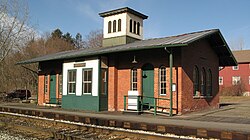
Modern Planning and Future Prospects
Restoring full passenger service to the corridor requires significant infrastructure investment. The tracks currently serve as a vital freight link to New London's deepwater port. While the Vermont section has been upgraded to continuously welded rail (rail joined by welding rather than bolts to provide a smoother ride) via a $50 million ARRA grant, other sections require work.
The New England Central Railroad estimates that upgrading the track from the Massachusetts/Vermont border to New London to support standard 286,000-pound car loads would cost $18 million. A comprehensive project including stations and rolling stock is estimated at $150 million.
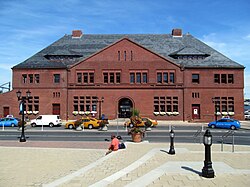
Efforts to revive the line have gained political momentum. In 2012, an excursion train was run to build public support, and officials from New London, Norwich, Windham, and Mansfield signed an agreement to seek funding. Support has also come from Congressman Joe Courtney and State Senator Cathy Osten. In September 2014, a $8.2 million TIGER grant was awarded to upgrade 55 miles of track in Connecticut; while primarily for freight, this is a necessary prerequisite for passenger rail.
More recently, a 2021 study commissioned by Connecticut lawmakers examined expanding Shore Line East service east to Westerly, RI, and north to Norwich, CT. The final report, issued in November 2023, suggested that while Shore Line East expansion could be useful in the long term, expanded bus service would be more effective in the short term due to low population density.
Key Facts
- Original Opening: The New London, Willimantic, and Palmer Railroad opened in September 1850.
- Passenger Gap: Regular passenger service ended in 1947 before being reinstated in 1989.
- Infrastructure Cost: Full passenger restoration is estimated to cost $150 million.
- Recent Upgrades: A $8.2 million TIGER grant was awarded in 2014 for 55 miles of Connecticut track.
- Current Operator: The line is operated by the New England Central Railroad (NECR).
| Era/Service | Key Route/Operator | Notable Change |
|---|---|---|
| Early History | NLW&P / New London Northern | Expansion to Palmer and Millers Falls |
| Late 19th Century | Central Vermont / Grand Trunk | Nationalization by Canadian government (1922) |
| 1989 - 1995 | The Montrealer | Overnight service reinstated |
| 1995 - 2014 | The Vermonter | Shift to daytime schedule; reverse move at Palmer |
| 2014 - Present | The Vermonter (Rerouted) | Moved to Conn River Line; Amherst service ended |
Frequently Asked Questions
Why did the Vermonter stop serving Amherst in 2014?
The train was rerouted onto the Conn River Line between Springfield and Northfield to eliminate a time-consuming reverse move at Palmer, which increased overall speed and added stops in Holyoke, Northampton, and Greenfield.
What is the current status of the tracks in Connecticut?
The tracks are currently used for freight service to New London's deepwater port. Some upgrades have been made via a TIGER grant, but further investment is needed to support full passenger service.
How much would it cost to fully restore passenger service?
The New England Central Railroad estimates the total project cost, including stations and rolling stock, would be approximately $150 million.
What did the 2023 Shore Line East study conclude?
The study found that expanding bus service would be the most effective short-term solution, while rail expansion to Norwich and Westerly might be useful in the long term but is hindered by low population density.
Who currently owns and operates the line?
The line is operated as the New England Central Railroad (NECR), which is owned by the Genesee & Wyoming company.