Cell Nucleus: Structure, Function, and Nuclear Organization
The nucleus serves as the command center of the eukaryotic cell, acting as the repository for genetic information and the coordinator of cellular activities. By sequestering the cell's DNA, the nucleus allows for sophisticated regulation of gene expression and protects the genome from metabolic byproducts in the cytoplasm.
From the complex architecture of the nuclear envelope to the dynamic subnuclear bodies that facilitate RNA processing, the nucleus is far from a static sac of genetic material. It is a highly organized organelle where spatial arrangement directly influences biological function.
Key Facts
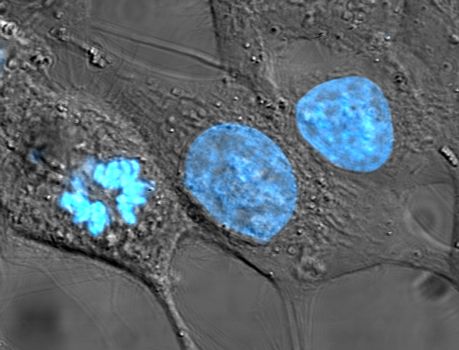
- Genetic Storage: The nucleus houses the majority of a cell's DNA, organized as chromatin.
- Selective Permeability: The nuclear envelope regulates the movement of macromolecules via nuclear pore complexes.
- Ribosome Production: The nucleolus is the specialized region responsible for synthesizing ribosomal components.
- Structural Support: The nuclear lamina provides mechanical stability and organizes chromatin.
- Variability: While most animal cells have one nucleus, some are anucleated (e.g., mature red blood cells) or multinucleated.
Nuclear Architecture and Components
The Nuclear Envelope and Pores
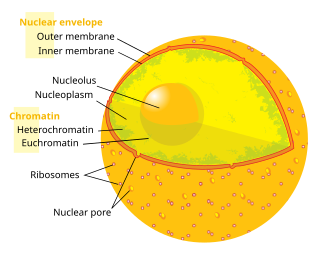
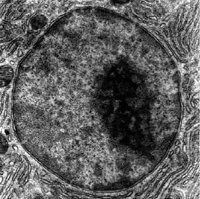
The nucleus is enclosed by the nuclear envelope, a double-membrane system. The outer membrane is continuous with the rough endoplasmic reticulum and is often studded with ribosomes. This envelope is perforated by nuclear pores, complex protein channels that control the traffic of proteins and RNA between the nucleus and the cytosol.
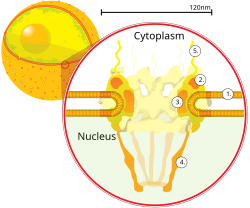
A cross-section of a nuclear pore reveals a sophisticated structure consisting of an outer ring, spokes, a nuclear basket, and cytoplasmic filaments. These components ensure that only specific macromolecules are transported, maintaining the distinct chemical environments of the nucleus and cytoplasm.
The Nuclear Lamina
Just inside the inner nuclear membrane lies the nuclear lamina, a dense fibrillar network of intermediate filaments called lamins. The lamina provides structural support to the nucleus and serves as an anchoring site for chromatin, playing a critical role in organizing the genome and regulating transcription.
The Nucleolus
The nucleolus is the most prominent subnuclear structure. It is not membrane-bound but is a dense aggregate of RNA and proteins. Its primary function is the transcription of ribosomal RNA (rRNA) and the assembly of ribosome subunits.
Chromosomes and Genomic Organization
Inside the nucleus, DNA is complexed with proteins to form chromatin. During interphase, chromatin is relatively loose, but during mitosis, it condenses into distinct chromosomes. Research shows that chromosomes are not randomly tangled; instead, they occupy specific chromosome territories.
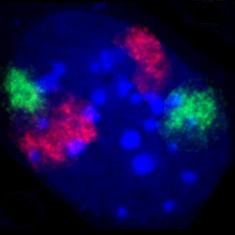
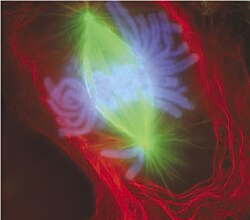
The spatial organization of these territories is functional. Active genes often localize toward the periphery of these territories to facilitate access for transcription machinery. During cell division, the mitotic spindle attaches to condensed chromosomes to ensure equal distribution of genetic material to daughter cells.
Subnuclear Bodies and Functional Domains
The nucleoplasm contains various non-membrane-bound organelles known as nuclear bodies. These structures concentrate specific proteins and RNAs to increase the efficiency of biochemical reactions.
Specialized Nuclear Bodies
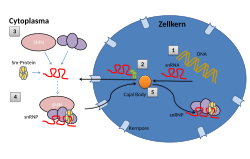
- Cajal Bodies: Involved in the assembly of small nuclear ribonucleoproteins (snRNPs).
- Nuclear Speckles: Regions rich in splicing factors that facilitate the processing of pre-mRNA.
- PML Bodies: Involved in various cellular processes, including apoptosis and genome stability.
- Paraspeckles: Built on long non-coding RNAs and involved in gene regulation.
Transcription Factories
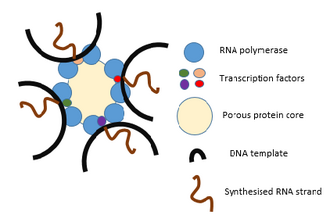
Gene expression occurs in transcription factories—protein-rich cores containing multiple RNA polymerases. This arrangement allows the cell to transcribe multiple genes simultaneously, regardless of their original position on the chromosome.
Nuclear Function and Dynamics
Nuclear Transport
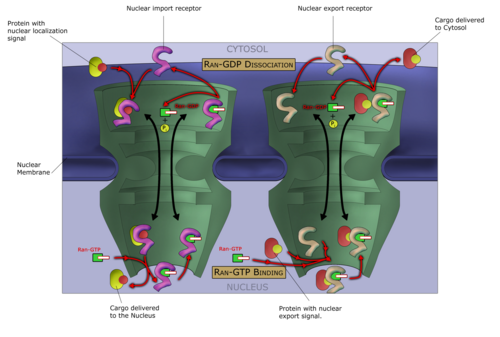
The movement of macromolecules is managed by the Ran-GTP nuclear transport cycle. This active transport mechanism uses Ran-GTP and Ran-GDP gradients to direct proteins (via importins and exportins) into or out of the nucleus.
Cellular Variations
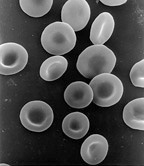
While the nucleus is a hallmark of eukaryotic cells, its presence varies by cell type. For example, human red blood cells undergo a developmental process where they lose their nuclei to maximize space for hemoglobin. Conversely, some cells are multinucleated to support higher metabolic demands or specialized functions.
Historical Context
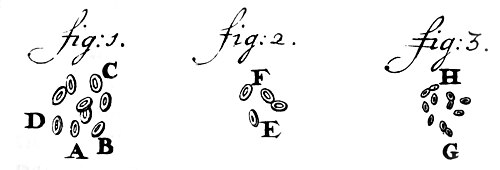
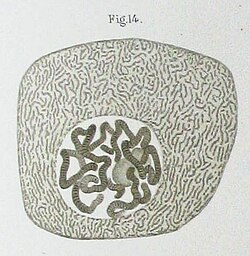
The study of the nucleus has evolved from early observations by Antonie van Leeuwenhoek in 1719 to the detailed chromosomal drawings of Walther Flemming in 1882, who identified polytene chromosomes in salivary gland cells.
Summary of Nuclear Bodies
| Structure Name | Approximate Diameter |
|---|---|
| Cajal bodies | 0.2–2.0 μm |
| PML bodies | 0.2–1.0 μm |
| Paraspeckles | 0.5–1.0 μm |
| Clastosomes | 0.2–0.5 μm |
| PIKA | 5 μm |
| Speckles | 20–25 nm |
Frequently Asked Questions
What is the difference between chromatin and chromosomes?
Chromatin is the relaxed form of DNA and proteins found during interphase, allowing for transcription and replication. Chromosomes are the highly condensed form of chromatin that appears during mitosis to facilitate the movement of DNA during cell division.
How do molecules enter and exit the nucleus?
Molecules move through nuclear pore complexes. Small molecules can diffuse passively, but larger macromolecules require active transport mediated by the Ran-GTP cycle and specific transport proteins called importins and exportins.
Why do some cells lack a nucleus?
Certain cells, such as mature mammalian red blood cells, expel their nuclei during development. This anucleation provides more room for oxygen-carrying hemoglobin and increases the cell's flexibility to move through narrow capillaries.
What is the role of the nucleolus?
The nucleolus is the site of ribosomal RNA (rRNA) synthesis and the assembly of ribosomal subunits, which are then exported to the cytoplasm to form functional ribosomes for protein synthesis.
What are nuclear speckles?
Nuclear speckles are subnuclear domains that store and concentrate pre-mRNA splicing factors, helping to regulate the efficiency and accuracy of mRNA processing.