Cecidomyiidae: The Diverse World of Gall Midges
The Cecidomyiidae, commonly known as gall midges or gall gnats, are a family of small, fragile flies that play a significant role in both agricultural ecosystems and global biodiversity. These insects are most famous for their ability to induce galls—abnormal growths of plant tissue—which serve as protective shelters and food sources for their developing larvae.
While they may appear insignificant due to their size, recent scientific data suggests that Cecidomyiidae might be the most speciose (species-rich) family in the entire animal kingdom. From the Late Jurassic period to the present day, these flies have evolved complex reproductive strategies and specialized relationships with a vast array of plant hosts.
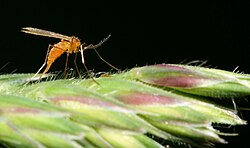
Key Facts
- Extreme Diversity: While over 6,650 species are described, DNA metabarcoding suggests there may be over 1 million species globally.
- Physical Traits: Most adults are tiny (0.5–3.0 mm) with characteristic hairy wings and long antennae.
- Unique Biology: Some species exhibit paedogenesis, where larvae can reproduce without reaching adulthood.
- Chemical Ability: They are among the few animals capable of synthesizing carotenoids, giving them a distinct orange or yellow hue.
- Ecological Roles: They function as both destructive agricultural pests and beneficial predators of other insects.
Physical Characteristics and Anatomy
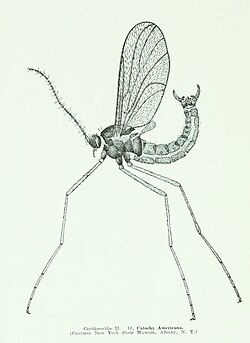
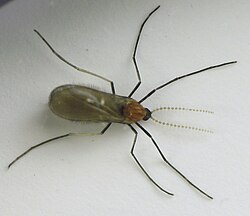
Cecidomyiidae are characterized by their delicate appearance. Most adults range from 0.5 to 3.0 mm, though some rare species can reach 8 mm in length. Their eyes are typically holoptic (meeting at the top of the head), and their mouthparts are significantly reduced.
One of the most distinguishing features of the family is their wings, which bear microtrichia (tiny hair-like structures) often appearing as scales. Their wing venation is reduced compared to other flies in the order Diptera, with only a few longitudinal veins well-developed. Their antennae are notably long, consisting of 12 to 14 segments (and up to 40 in some genera), featuring specialized whorls of hairs and sensory filaments.
Larval and Pupal Development
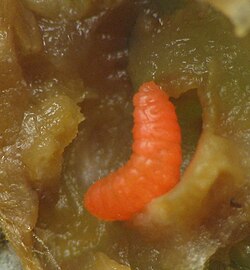
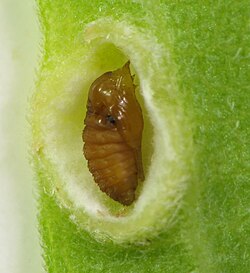
The larvae are peripneustic (having spiracles at both ends of the body) with tiny, cone-shaped heads and reduced mouthparts. A key taxonomic feature is the sternal spatula, a sclerotized structure on the prothorax. The pupae are generally exarate, meaning their appendages are free from the body wall, though in some species, the pupa remains enclosed within the final larval skin.
Reproduction and the Phenomenon of Paedogenesis
The reproductive cycles of Cecidomyiidae can be remarkably strange. While most follow standard insect development, some species engage in paedogenesis. In this process, the larval stage is capable of reproduction without first maturing into an adult. Depending on the species, the resulting daughter larvae may consume the mother, or reproduction may occur during the egg or pupal stages.
Agricultural Impact: Pests and Biological Control
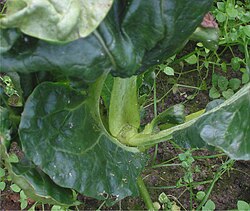
Because many gall midge larvae feed on plant tissues, they can cause severe economic damage to crops. Galls can disrupt plant growth and reduce yields in a variety of essential food sources.
Major Agricultural Pests
- Cereal Crops: The Hessian fly (wheat), wheat blossom midge, and various rice gall midges (Asian and African) cause significant losses.
- Legumes: Pests include the lentil flower midge, lucerne flower midge, and soybean pod gall midge.
- Fruit and Vegetables: The swede midge affects brassicas, while others target pears, raspberries, and tubers like potatoes and ginger.
Beneficial Roles and Biological Control
Not all gall midges are pests. Many species are predatory, with larvae that feed on aphids, spider mites, scale insects, whiteflies, and thrips. Aphidoletes aphidimyza is a prime example, widely used in greenhouse biological control programs in the United States to manage aphid populations.
Additionally, some species are used to control invasive plants. In South Africa, Dasineura rubiformis has been deployed to reduce the seed production of the invasive Australian Acacia mearnsii by inducing galls in its flowers.
Summary of Cecidomyiidae Classification and Impact
| Category | Details |
|---|---|
| Scientific Classification | Order: Diptera; Family: Cecidomyiidae |
| Estimated Diversity | 6,650+ described; potentially over 1 million species |
| Primary Characteristic | Induction of plant galls; hairy wings |
| Key Pests | Hessian fly, Rice gall midge, Swede midge |
| Beneficial Species | Aphidoletes aphidimyza (predatory) |
| Temporal Range | Late Jurassic to Recent |
Frequently Asked Questions
What is a gall and how is it formed?
A gall is an abnormal growth of plant tissue. It is created when the larvae of a gall midge feed within the plant, triggering the plant to grow a specialized structure that provides the insect with both protection and nutrition.
What is paedogenesis in gall midges?
Paedogenesis is a rare reproductive phenomenon where the larval stage of the insect can reproduce without first undergoing the metamorphosis into a mature adult fly.
Why are gall midges often orange or yellow?
Their color comes from carotenoids. Cecidomyiidae are among the very few animals capable of synthesizing these pigments, likely due to horizontal gene transfer from a fungal donor.
Can gall midges be helpful to farmers?
Yes. While some are pests, others are predatory and eat common crop pests like aphids and spider mites. Some are even commercially sold for use in greenhouse biological control.
How many species of gall midges actually exist?
While only about 6,650 species have been formally described, DNA metabarcoding studies suggest the actual number could exceed 1 million, potentially making them the most diverse family in the animal kingdom.