Caribbean Hindustani: The Linguistic Legacy of Indo-Caribbean People
Caribbean Hindustani is a vibrant Indo-Aryan language spoken by Indo-Caribbean communities and their global diaspora. Rather than being a single dialect, it is a koiné—a stable language created from the mixing of several mutually intelligible dialects. It emerged primarily from the Bhojpuri and Awadhi languages spoken by Indian immigrants who arrived in the Caribbean as indentured laborers.
While it shares roots with Fiji Hindi and the Hindustani-Bhojpuri spoken in South Africa and Mauritius, Caribbean Hindustani has evolved into a unique linguistic entity, reflecting the history, struggles, and cultural synthesis of the people who speak it.
Key Facts
- Origins: Primarily based on Bhojpuri and Awadhi, with influences from Magahi and other Eastern Hindi-Bihari dialects.
- Speaker Population: Approximately 299,400 speakers globally (2006–2019), with the largest concentration in Suriname.
- Writing Systems: Historically written in Devanagari, Kaithi, and Perso-Arabic scripts, though the Latin (Roman) script is now most common.
- Cultural Impact: Central to musical genres like Chutney music, Baithak Gana, and various religious songs.
- Regional Variants: Includes Sarnami (Suriname), Guyanese Hindustani, and Trinidadian Hindustani.
Linguistic Evolution and Influences
The foundation of Caribbean Hindustani lies in the regions of Bihar, Jharkhand, and Uttar Pradesh in India. Because the majority of indentured laborers hailed from the Bhojpur and Awadh regions, the language is heavily influenced by Bhojpuri and Awadhi. Over time, it has also been shaped by Standard Hindustani (the combination of Standard Hindi and Standard Urdu), largely due to the popularity of Bollywood films and music.
Beyond its Indian roots, the language has adapted to its new environment by borrowing vocabulary from European colonial languages. In Suriname and Guyana, Dutch and English have left a mark, while in Trinidad and Tobago, English and French influences are present. New words were also created to describe the Caribbean landscape and lifestyle.
For a long time, some viewed Caribbean Hindustani as a "broken" version of Standard Hindi. However, academic research has clarified that it is not a corrupted form of Hindi, but a distinct language deriving from the Magahi and Awadhi dialects, which differ fundamentally from the Khariboli dialect that forms the basis of Standard Hindi and Urdu.
Scripts and Social Usage
The language is used as a vernacular across different religious backgrounds, though vocabulary often varies by faith. Hindu speakers frequently incorporate Sanskrit-derived terms, while Muslim speakers often use words derived from Persian, Arabic, and Turkic sources.
Writing systems have historically mirrored these religious divisions: Hindus typically used the Devanagari script, while Muslims used the Perso-Arabic script in the Nastaliq calligraphic style. The Kaithi script was also used historically. Today, however, the Latin script is the most widely used due to its ease and familiarity.
Regional Dialects
Sarnami Hindustani
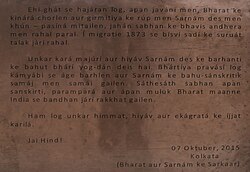
Sarnami (or Sarnami Hindoestani) is the third-most spoken language in Suriname, following Dutch and Sranan Tongo. It is a fusion of Bihari and Eastern Hindi, with Bhojpuri serving as the primary contributor. While used for informal daily communication among the Indo-Surinamese community, Standard Hindi and Urdu remain the prestige literary languages.
Guyanese Hindustani
In Guyana, the language is known by several names, including Guyanese Bhojpuri, Puraniya Hindi, or Aili Gaili. It is spoken primarily by the older generation, imams, and Hindu priests within the Indo-Guyanese community.
Trinidadian Hindustani
Known as Trinidadian Bhojpuri or Gaon ke Bolee ("Village Speech"), this variant was the primary tongue of early immigrants. The arrival of Indian cinema in 1935 introduced Standard Hindustani phrases, which modified the local dialect. However, colonial pressure and a desire for social mobility led many to favor English, causing the language to shift from a first language to a heritage language. Today, it survives largely through music and a "Hinglish" blend of English and Hindustani vocabulary.
Nickerian-Berbician Hindustani
This unique dialect developed in the Nickerie district of Suriname and the Berbice county of Guyana. Because these areas are separated only by the Courantyne River, the communities remained closely linked through intermarriage. While the dialect largely died out in Guyana, it was preserved in Suriname and continues to be spoken by some in Berbice due to the influx of Nickerian migrants.
Summary of Caribbean Hindustani Variants
| Variant | Primary Region | Common Names | Current Status |
|---|---|---|---|
| Sarnami | Suriname | Sarnami Hindustani | Widely spoken informally |
| Guyanese | Guyana | Aili Gaili, Puraniya Hindi | Spoken mainly by elderly/clergy |
| Trinidadian | Trinidad and Tobago | Gaon ke Bolee, Plantation Hindustani | Heritage language; used in music |
| Nickerian-Berbician | Suriname/Guyana Border | Nickerian Sarnami | Preserved in Nickerie; rare in Berbice |
Cultural Expression and Preservation
Caribbean Hindustani remains a cornerstone of Indo-Caribbean cultural identity, particularly through music. Genres such as Chutney music, Chutney soca, and Baithak Gana utilize the language, often blending it with English or Dutch. It is also used in religious songs across Hindu, Muslim, and Indian Christian traditions.
Efforts to preserve the language are ongoing through organizations such as Caribbean Hindustani Inc., Sarnami Bol Inc. in Suriname, and the work of dedicated researchers and linguists across the Caribbean and Canada.
Frequently Asked Questions
Is Caribbean Hindustani a dialect of Standard Hindi?
No. While it is related, it is a distinct language derived from Bhojpuri, Awadhi, and Magahi dialects. It does not descend from the Khariboli dialect that forms the basis of Standard Hindi.
Which script is most commonly used to write Caribbean Hindustani today?
Although Devanagari and Perso-Arabic scripts have historical and religious significance, the Latin (Roman) script is currently the most widely used due to its simplicity and prevalence in the Caribbean.
How did Bollywood influence the language in Trinidad?
Starting in 1935, Indian movies introduced Standard Hindustani (Hindi-Urdu) to Trinidadian audiences, which added new vocabulary and phrases to the local Trinidadian Hindustani and helped revitalize interest in the language.
What is the difference between Sarnami and Guyanese Hindustani?
Sarnami is more widely spoken as a daily informal language in Suriname. Guyanese Hindustani is spoken by a smaller group, primarily the elderly and religious leaders, and has seen a greater decline in favor of Guyanese English Creole.
What is Nickerian-Berbician Hindustani?
It is a specialized dialect that developed in the border regions of Suriname (Nickerie) and Guyana (Berbice), resulting from the close social and marital ties between the Indian indentured laborer communities in those two districts.