Cargo Bike Types: From Traditional Longtails to Electric Freight Trikes
Cargo bikes are specialized bicycles designed to transport goods, people, or equipment. Unlike standard bicycles, these vehicles feature modified frames, extended wheelbases, or additional wheels to increase stability and loading capacity. From low-loading two-wheelers to heavy-duty four-wheelers used in warehouses, the variety of cargo bikes allows them to serve as viable alternatives to cars for urban delivery and family transport.
Many modern models now incorporate electric assist (e-bikes), which utilize an electric motor to supplement human muscle power. This technology makes cargo bikes more practical for longer distances, hilly terrain, and navigating city traffic by providing faster acceleration from a complete stop.
Key Facts
- Long John bikes use linkage steering to place cargo in front of the rider.
- Longtails extend the rear frame to carry passengers or goods.
- Cargo Tricycles can carry between 100 and 300 kg, offering roughly half the capacity of a small panel van.
- Porteur bikes feature a front-mounted rack capable of holding up to 50 kg.
- Bakfiets is the Dutch term for "box bike," traditionally referring to tricycles with two front wheels.
Front-Loading Cargo Bikes
The Long John Bicycle
The Long John is characterized by a cargo area located in front of the rider, connected to the front wheel via linkage steering. These bikes typically feature a smaller front wheel and a rear wheel measuring 58 or 66 cm (23 or 26 in), with a low-slung platform or box spanning 76–102 cm (30–40 in). They generally support a capacity of approximately 100 kg (220 lb).
Originating in Denmark around 1923, the Long John was invented by the Smith & Co. Company and debuted at the 1924 Wembley World Fair. Today, they are popular family car replacements; the cargo box can be fitted with baby car seats, benches with 3- or 5-point harnesses for older children, and protective canopies.
Porteur and Butcher's Bikes
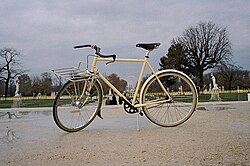
A porteur bicycle utilizes a rack attached directly to the fork, capable of carrying up to 50 kg (110 lb).
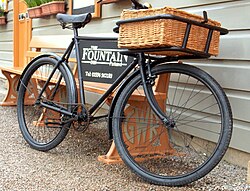
The Butcher's bike (or Baker's bike) was common in the UK during the first half of the 20th century. Unlike the porteur, its storage box or basket was fixed to the main frame rather than the forks. These often featured business advertisements within the frame's main triangle. A similar design, the Cycle Truck (such as the Schwinn model produced 1939–1967), used a smaller front wheel (51 cm / 20 in) and a larger rear wheel (66 cm / 26 in).
Rear-Loading and Specialized Designs
Longtail and Midtail Bicycles
Longtail bicycles feature an extended rear wheelbase, making them ideal for carrying adult passengers or multiple children. Because they lack linkage steering, they handle more like conventional bicycles. In 2008, Xtracycle documented the LongTail as an open-source standard, encouraging custom builds like the Xtravois.
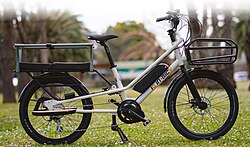
A sub-category known as midtails exists for those needing less length than a full longtail but still requiring space for one or two children, though the distinction between the two categories is often fluid.
Stroller Bikes and Boda-bodas
The stroller bike is a versatile hybrid that converts from a two-wheeled bike (cargo in front) to a three-wheeled stroller, supporting up to 100 lbs (45.4 kg). It received the Gold Award at the 2018 Eurobike exhibition.
In East Africa, the boda-boda serves as a two-wheeled bicycle or motorcycle taxi. The term was later adopted by Yuba Bicycles for a compact cargo bike launched in 2012.
Heavy-Duty and Alternative Cargo Vehicles
Cargo Tricycles and Quadracycles
Tricycles are used for short-range transport of people (cycle rickshaws) or goods. They can be equipped with open platforms for low-value items or lockable aluminum boxes for valuables. With a capacity of 1 to 300 kg and volumes of 1 m³ (35 cu ft) or more, they are highly efficient for urban logistics.
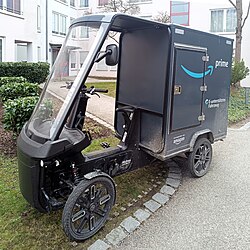
For environments requiring maximum stability and loading capacity over range—such as plants or warehouses—four-wheeled cargo vehicles are occasionally employed.
Wooden Cargo Vehicles
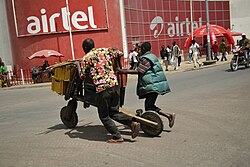
In the east of the Democratic Republic of Congo, the chukudu (or chikudu) is used. This is a two-wheeled wooden vehicle similar to a scooter, specifically designed for transporting cargo.
Cargo Bike Comparison Summary
| Type | Primary Loading Area | Typical Capacity | Key Feature |
|---|---|---|---|
| Long John | Front (Low) | ~100 kg | Linkage steering; family-friendly |
| Longtail | Rear (Extended) | Variable | Handles like a standard bike |
| Porteur | Front (Rack) | Up to 50 kg | Rack attached to fork |
| Tricycle | Front or Rear | 100–300 kg | High stability; high volume |
| Butcher's Bike | Front (Frame-mounted) | Variable | Vintage trade design |
Frequently Asked Questions
What is the difference between a Long John and a Bakfiets?
While "bakfiets" is the general Dutch word for any box bike, it traditionally refers to tricycles with two front wheels. The "Deense bakfiets" (Danish cargo bike) specifically refers to the Long John style, which has two wheels and linkage steering.
Can cargo bikes actually replace a car for families?
Yes, particularly Long John models. They can be equipped with baby car seats, child benches with safety harnesses, and weather-protective canopies, making them suitable for transporting children in urban environments.
How does an e-cargo bike differ from a standard cargo bike?
An e-cargo bike includes an electric motor that provides assistance to the rider. This makes it easier to carry heavy loads, navigate non-flat terrain, and accelerate quickly in city traffic.
What is a "midtail" bicycle?
A midtail is a version of the longtail bicycle with a moderately extended rear frame. It is shorter than a full longtail but still capable of carrying one or two children.
What is the maximum capacity of a cargo tricycle?
Cargo tricycles can typically carry between 100 and 300 kilograms (220–660 lb), depending on the build and the available power (human or electric).