Canadian Provincial Language Policies: English, French, and Minority Languages
Across Canada, provincial laws dictate the official languages used in legislatures and courts. While English is the primary language of governance in many provinces, various jurisdictions have implemented separate policies to support education, bureaucracy, and the preservation of minority languages, particularly French and Gaelic.
Key Facts
- Alberta is unilingual English but allows French in the Legislative Assembly and certain courts.
- Nova Scotia supports linguistic heritage through the Office of Gaelic Affairs and the Office of Acadian Affairs.
- Prince Edward Island established a French Language School Board in 1990 to reverse a decline in French education.
- Saskatchewan has permitted French as an instructional language in public schools since 1968.
- Many provinces provide bilingual web portals to index French-language services.
Alberta: Unilingual Framework with Targeted Services
Alberta inherited its English-only status from the Northwest Territories in 1905. This was later reinforced by the Languages Act (1988), which reaffirmed the province's unilingual English nature while granting the right to use French in the Legislative Assembly and specific courts. While laws may be drafted solely in English without a requirement for translation, French is permitted for oral use in all provincial courts.
Education is a primary area of linguistic support. The Language Policy in Education (1978) allows school boards to create French programs upon request, and the Schools Act recognizes the right to French instruction for the official language minority (1988) and the right of Francophones to manage their own schools (1993). Since 1993, Alberta has maintained separate public Francophone school boards alongside standard public and separate boards that offer French immersion.
Government services generally remain English-only, except in sectors like immigration and tourism or where federal funding is available. Healthcare and social services are not legally required to be provided in French, leaving such initiatives to individual clinics, hospitals, and NGOs. However, the Alberta Bilingual Municipalities Network includes communities such as Beaumont, Legal, Falher, Plamondon, Morinville, St. Albert, St. Paul, Bonnyville, and the Smoky River Municipal District, which provide services in both English and French voluntarily.
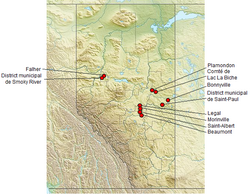
Beyond French, Alberta provides specialized support in other languages. Toll-free lines for gambling and family violence are available in 170 languages. Additionally, the government provides educational curricula for teachers of Cree, Blackfoot, Chinese, German, Italian, Japanese, Latin, Punjabi, Spanish, and Ukrainian. In June 2017, the province introduced a new French Policy to improve services for Franco-Albertans, supported by the partial French website bonjour.alberta.ca.
Nova Scotia: Supporting Gaelic and Acadian Heritage
Since joining Confederation in 1867, Nova Scotia has had no legal requirement to provide services in languages other than English. Despite this, the province actively supports its linguistic minorities through dedicated offices.
The Office of Gaelic Affairs focuses on the renewal of Gaelic language and culture. Simultaneously, the Office of Acadian Affairs provides advice and support to government agencies and Crown corporations to ensure policies and services reflect the needs of the Acadian and francophone community.

To facilitate access for French speakers, the province maintains a dedicated French-language web portal at gov.ns.ca/bonjour.
Prince Edward Island: The Recovery of French Education
The landscape of French education in Prince Edward Island has shifted dramatically over the last century. While the province had 60 French language schools in the first half of the 20th century, school consolidation reduced that number to just one by the late 1970s.
A recovery began in 1980 with the opening of a second school, followed by three more twenty years later. The French Language School Board was created on July 1, 1990, leading to the opening of new schools in Rustico, West Prince, and Summerside-Miscouche (2000), and Souris (2003). The Francophone Affairs Division was also established on April 1, 1989.
While the French Language Services Act (2000) made several commitments to provide services in French, a 2005 government report indicated that many sections had not yet been proclaimed into law as the province continues to build its service capacity.
Saskatchewan: Legislative and Educational Bilingualism
Saskatchewan significantly expanded linguistic access in 1968 when an amendment to the School Act permitted the establishment of designated French schools, ending a period where English was the sole language of instruction.
Under the province's Language Act, all regulations and acts can be enacted and published in English or in both English and French. Both languages are permitted in the Legislative Assembly and the courts, although the rules of court must be available in both languages. In 2010, the government launched a bilingual website (bonjour.gov.sk.ca) to index all available French services.
Provincial Language Policy Summary
| Province | Official Status | French Education Support | Specialized Language Offices |
|---|---|---|---|
| Alberta | Unilingual English | Separate Francophone boards since 1993 | N/A |
| Nova Scotia | English | Supported via Acadian Affairs | Office of Gaelic Affairs; Office of Acadian Affairs |
| Prince Edward Island | English | French Language School Board (1990) | Francophone Affairs Division |
| Saskatchewan | English/French (Legislative) | Designated French schools since 1968 | N/A |
Frequently Asked Questions
Is French an official language in Alberta?
No, Alberta is unilingual English. However, the Languages Act (1988) recognizes the right to use French in the Legislative Assembly and before certain courts.
How does Nova Scotia support the Gaelic language?
Nova Scotia supports the language through the Office of Gaelic Affairs, which works toward the renewal of Gaelic language and culture within the province.
What is the status of French services in Prince Edward Island?
While the French Language Services Act (2000) outlines commitments to provide services in French, some sections remain unproclaimed as the province builds its capacity to deliver these services.
Can French be used in Saskatchewan courts?
Yes, both English and French may be used in Saskatchewan courts, and the rules of court are required to be in both languages.
Which Alberta municipalities provide bilingual services?
The Alberta Bilingual Municipalities Network includes Beaumont, Legal, Falher, Plamondon, Morinville, St. Albert, St. Paul, Bonnyville, and the Smoky River Municipal District.