Canada Post: A Comprehensive History of the Nation's Postal Service
The story of mail delivery in Canada is a reflection of the country's growth, from isolated colonial outposts to a sprawling modern dominion. What began as sporadic letters sent to European monarchs has evolved into a complex logistics network tasked with balancing a legal mandate for universal service with the harsh economic realities of the digital age.
Early Beginnings and Colonial Roots
The first recorded instance of a letter being sent from present-day Canada occurred on August 3, 1527, in St. John's, Newfoundland, when John Rut wrote to King Henry VIII. However, organized internal delivery did not emerge until 1693, when Pedro da Silva was commissioned to carry mail between Quebec City and Montreal.
For over a century, from 1711 to 1851, postal services in British North America operated as extensions of the British Post Office's Royal Mail. This era ended in April 1851, when control was transferred to the Postmaster General for the Province of Canada, with similar transfers occurring in Nova Scotia, New Brunswick, and Prince Edward Island. This pivotal year also saw the introduction of Canada's first postage stamp, designed by Sandford Fleming.

The Establishment of a National Service
With the formation of the dominion of Canada in 1867, the government created the Post Office Department via the Act for the Regulation of the Postal Service. Effective April 1, 1868, this federal department was led by a cabinet minister known as the Postmaster General of Canada, ensuring a uniform service across the land.
The system was modeled after the British service established by Sir Rowland Hill, who pioneered the concept of charging mail by weight rather than destination. Operating under the name The Royal Mail Canada, the service joined the Universal Postal Union in 1878.
Today, several heritage sites commemorate this era, including the first Toronto Post Office, the Vancouver Main Post Office, and the Post Office in Dawson City, Yukon.

Expansion and Innovation in the 20th Century
The early 1900s focused on connecting isolated populations. On October 10, 1908, Canada instituted its first free rural mail delivery service, a landmark achievement that ended the isolation of many Canadians living outside urban centers.
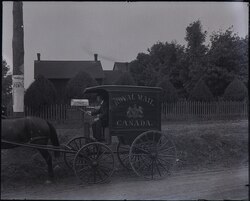
Canada also became an early adopter of airmail. The first flight took place on June 24, 1918, transporting mail from Montreal to Toronto. By 1939, daily airmail service connected Vancouver and Montreal, following the establishment of routes in Manitoba and Quebec during the 1920s and 30s.
Transition to a Crown Corporation
By the 1970s, the Post Office Department faced severe financial instability and labor unrest, with annual deficits reaching $600 million by 1981. To increase commercial viability and compete with private couriers, the Federal Parliament passed the Canada Post Corporation Act on October 16, 1981.
This legislation transformed the department into a Crown corporation (a government-owned enterprise) known as the Canada Post Corporation (CPC). Crucially, the Act legally guaranteed that all Canadians have the right to expect mail delivery regardless of their location.
In the following years, Canada Post sought efficiency by introducing community mailboxes in new subdivisions starting in 1985. While legally upheld by Ontario courts, this shift away from door-to-door delivery remained a point of contention.

Modern Challenges and Digital Transformation
The 21st century brought a drastic shift in mail volume. Between 2006 and 2023, annual letter deliveries plummeted from 5.5 billion to 2 billion. While parcel revenue grew—rising from $1.6 billion in 2015 to $3.4 billion in 2023—Canada Post's market share in parcel delivery dropped from 62% in 2019 to 23% in 2023.

Financial struggles were compounded by labor disputes. The Canadian Union of Postal Workers (CUPW) engaged in several strikes and lockouts, most notably during the "Postal Transformation" modernization effort (2010–2017). This period saw attempts to phase out urban door-to-door delivery, a move that was suspended in 2015 following a federal election promise by Justin Trudeau and officially halted in 2018.

Current Financial State and Future Outlook
Canada Post has faced a severe financial crisis, losing over $3 billion between 2018 and 2024. High labor costs—totaling $4.9 billion in 2023—and the decline of traditional mail have left the corporation with over $1 billion in debt. Unlike other Crown corporations, Canada Post must be self-sustaining through its own revenues.
In September 2025, the Government of Canada provided CA$1 billion and mandated cost-reduction measures. These include phasing out door-to-door service for roughly four million addresses, reducing the speed of non-urgent mail by using surface transport instead of air, and allowing the closure of uneconomic rural post offices. These measures led to further strikes by CUPW, though the government provided an additional loan of over $1 billion in February 2026.
Key Facts
- First Letter: Sent from St. John's, Newfoundland, on August 3, 1527.
- First Stamp: Introduced in 1851, designed by Sandford Fleming.
- Rural Delivery: First free rural mail service began October 10, 1908.
- Airmail: First flight occurred June 24, 1918 (Montreal to Toronto).
- Corporate Status: Became a Crown corporation on October 16, 1981.
- Letter Volume Decline: Dropped from 5.5 billion (2006) to 2 billion (2023).
- Parcel Market Share: Fell from 62% (2019) to 23% (2023).
| Period/Year | Key Event/Metric | Impact/Value |
|---|---|---|
| 1851 | Administrative Shift | Control moved to Province of Canada |
| 1868 | Post Office Act | Uniform federal postal service established |
| 1981 | CPC Act | Transition to Crown corporation |
| 2015-2023 | Parcel Revenue | Increased from $1.6B to $3.4B |
| 2018-2024 | Financial Loss | Over $3 billion |
Frequently Asked Questions
When did Canada start using postage stamps?
Canada's first postage stamps went into circulation in 1851, following the transfer of postal control to local governments. These stamps were designed by Sandford Fleming.
What is the legal guarantee regarding mail delivery in Canada?
The Canada Post Corporation Act of 1981 legally guarantees basic postal service to all Canadians, stipulating that every citizen has the right to expect mail delivery regardless of where they live.
Why has Canada Post struggled financially in recent years?
The corporation has faced a sharp decline in letter mail volume due to digitalization, a loss of parcel market share to competitors, and high labor costs that exceed industry averages.
What are community mailboxes?
Community mailboxes are centralized mail delivery points used instead of individual door-to-door delivery. They were first phased in for new subdivisions in 1985 to increase operational efficiency.
What happened to the Post Office Savings Bank?
The Post Office Savings Bank system, which was created by the Post Office Act of 1868, was phased out between 1968 and 1969.