The Cambridge Rules: How a University Shaped the Modern Game of Football
Long before the global phenomenon of modern soccer—known formally as Association Football—there was a chaotic variety of "football" games played across England. In the 19th century, the University of Cambridge became a critical laboratory for the sport. Through a series of attempts to standardize play, the "Cambridge Rules" emerged, providing the blueprint that would eventually define the laws of the game played by millions today.
The Early Chaos of University Football
Football has a long, often volatile history at Cambridge. As early as 1579, a match between townspeople and students in Chesterton ended in such a violent brawl that the Vice-Chancellor banned "footeball" outside of college grounds. Decades later, in 1631, a student at St John's College suffered a broken collarbone during a game. While the sport saw a decline in the 18th century, it experienced a revival in the early 1800s.
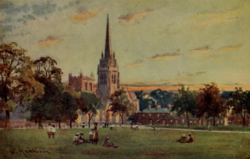
By 1838, observers noted groups of "Gownsmen" (students) playing on Parker's Piece, a common area of land in Cambridge. However, the game was far from uniform. Students arrived from various public schools, each bringing their own set of rules. This created "dire confusion" on the pitch, as players from different schools disagreed on everything from how to handle the ball to what constituted a foul.
The Quest for a Common Code (1838–1848)
To make matches possible, students had to create compromise rules that balanced the different school codes. The first recorded attempt occurred between 1838 and 1842, led by Edgar Montagu and six other representatives who sought to create a system "fair to all the schools." While these rules did not survive, they marked the beginning of a trend toward codification.
In 1846, J. C. Thring and H. de Winton attempted to form a respectable club by combining the traditions of Eton, Winchester, and Shrewsbury. However, they found that the "Rugby game"—which allowed more physical contact and ball-carrying—was a major obstacle to unification.
The 1848 Milestone
A more significant effort took place in 1848. Henry Charles Malden and a committee of fourteen representatives from schools including Harrow, Eton, Rugby, Winchester, and Shrewsbury met to frame a new set of rules. These "Cambridge Rules" were printed and posted on Parker's Piece. Although the physical documents from 1848 have not survived, Malden later claimed they were the direct ancestor of the Association Rules.

The 1856 Laws: The First Surviving Code
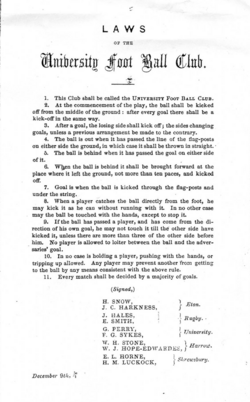
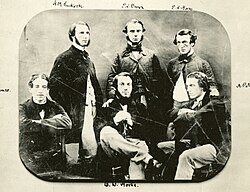
By 1856, the need for order persisted. Frederic G. Sykes described the state of university football at the time as a "general melée" (a confused brawl) with no formal rules. In the Michaelmas Term of 1856, a committee representing five schools and the university drew up a formal set of laws.
Unlike previous attempts, a copy of the 1856 Cambridge Rules survives today. These laws established several key principles:
- Handling: The ball could only be handled to stop it, though a "fair catch" still awarded a free kick.
- Fouls: Holding, pushing, and tripping were strictly forbidden.
- Offside: A player was onside only if four opponents were between them and the goal.
- Scoring: Goals were scored by kicking the ball through flag posts and under a string.
The 1863 Rules and the Birth of the FA
In October 1863, a new committee representing six schools published an updated set of rules for the university. These 1863 rules were more detailed than the 1856 version and introduced a stricter offside law (where any player ahead of the ball was out of play) and replaced the throw-in with a kick-in.
The timing of these rules was pivotal. At the same time, the newly formed Football Association (FA) was embroiled in a bitter dispute over "hacking"—the practice of kicking opponents in the shins. The FA was split between "hackers" (who favored the Rugby style) and "non-hackers."
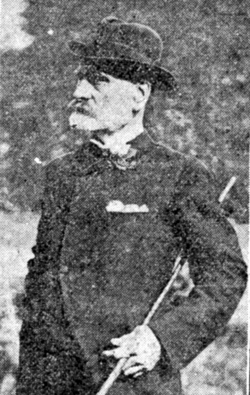
On November 24, 1863, FA secretary Ebenezer Morley brought the Cambridge Rules to the attention of the association. He argued that because these rules were approved by representatives of six major public schools, they deserved immense respect. This intervention provided the "non-hacking" faction with the leverage they needed. Consequently, the FA banned both carrying the ball and hacking, effectively separating Association Football from Rugby.
Key Differences Between the 1863 Cambridge and FA Rules
While the FA adopted the Cambridge offside law almost verbatim, they did not adopt the code entirely. Some differences remained:
- Handling: The FA allowed a free kick for a fair catch; Cambridge banned all handling except to stop the ball.
- Restarts: The FA used throw-ins; Cambridge used kick-ins.
- Ends: The FA changed ends after every goal; Cambridge changed only at half-time.
Later Developments and Lasting Legacy
Cambridge continued to refine its own rules, issuing a revision in 1867 that included a "touch down" (similar to a rugby try) as a tie-breaker. However, the divide between the codes became permanent with the formation of the Rugby Football Union (RFU) in 1871. By 1873, the Cambridge University Football Club officially joined the FA and began playing under FA rules.
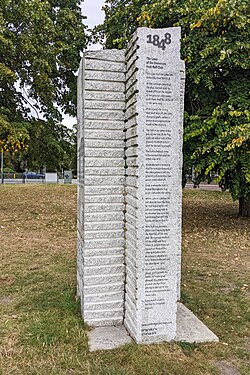
Today, the influence of these students is recognized on Parker's Piece. A plaque installed in 2000 credits the students with emphasizing skill over force, and a 2018 monument features the 1856 rules translated into multiple languages.
Summary of Cambridge Football Codifications
The following table summarizes the various attempts to standardize football at the University of Cambridge during the 19th century.
| Date | Survives? | Schools Involved | Key Notes |
|---|---|---|---|
| c. 1838–1842 | No | Shrewsbury | Intended to be fair to all schools. |
| 1846 | No | Eton, Shrewsbury, Rugby, Winchester | Rugby rules were seen as an obstacle to unity. |
| 1848 | No | Eton, Harrow, Rugby, Shrewsbury, Winchester | Claimed as a primary influence on the FA. |
| 1856 | Yes | Eton, Harrow, Rugby, Shrewsbury | First surviving code; banned hacking and carrying. |
| 1862 | Yes | Eton, Harrow | Created specifically for a match between Old Etonians and Old Harrovians. |
| 1863 | Yes | Eton, Harrow, Marlborough, Rugby, Shrewsbury, Westminster | Directly influenced the first FA Laws of the Game. |
| 1867 | Yes | Various (11 schools) | A revision of the 1863 laws; included a "touch down." |