Calliphoridae: The Biology and Life Cycle of Blowflies
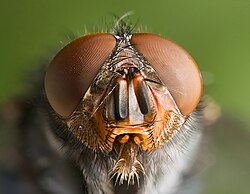
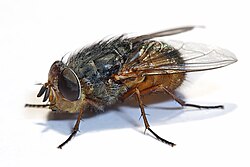
The family Calliphoridae, commonly known as blowflies, represents a diverse group of insects within the order Diptera (true flies). These insects play complex roles in various ecosystems, ranging from nutrient recycling to forensic science. Belonging to the superfamily Oestroidea, Calliphoridae includes numerous subfamilies such as Calliphorinae, Luciliinae, and Chrysomyinae, each contributing to the biological tapestry of their respective habitats.
Key Facts
- Classification: Family Calliphoridae, Order Diptera.
- Reproduction: Females are typically anautogenous, meaning they require protein to develop eggs.
- Egg Characteristics: Small, yellowish or white, measuring approximately 1.5 mm × 0.4 mm.
- Development: Growth is poikilothermic, meaning it is highly dependent on environmental temperature.
- Larval Feeding: Larvae use proteolytic enzymes and mouth hooks to break down organic matter.
Biological Characteristics and Development
The life cycle of a blowfly is a remarkable process of transformation. Most studied species are anautogenous; for instance, a female Phormia regina requires roughly 800 μg of protein per pair of ovaries to produce mature eggs. While it is theorized that females visit carrion to obtain this protein and find suitable sites for egg laying, this remains a subject of ongoing study.
Blowfly eggs are typically white or yellowish and resemble small grains of rice, measuring about 1.5 mm by 0.4 mm. While a single batch may contain 150–200 eggs, a female is iteroparous, meaning she can lay multiple batches throughout her life, often totaling around 2,000 eggs. Most species maintain a 50:50 sex ratio, though certain species in the genus Chrysomya exhibit unique reproductive strategies: C. rufifacies is arrhenogenic (laying only males), while C. albiceps is thelygenic (laying only females).
The Larval Stage
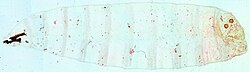
Once hatched, the larvae (often called maggots) begin feeding on livestock or carcasses. They utilize proteolytic enzymes—enzymes that break down proteins—secreted in their excreta, combined with the mechanical grinding action of their mouth hooks, to consume their food source. Because blowflies are poikilothermic, their metabolic rate and development speed are dictated by the surrounding temperature.
At a standard room temperature of 20 °C, the black blowfly Phormia regina can progress from egg to pupa in 150 to 266 hours (roughly 6 to 11 days). Upon completing the third larval stage, the larvae leave the food source and burrow into the soil to undergo pupation. They typically emerge as adults 7 to 14 days later.
Diversity and Genera
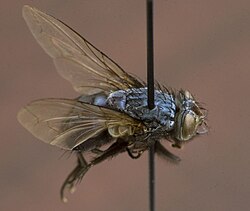
The Calliphoridae family is globally distributed, with significant genera found across the Palearctic, Nearctic, Malaysia, Australasia, and beyond. The diversity within this family is vast, encompassing many specialized genera.
| Genus Group | Example Genera |
|---|---|
| Common Genera | Calliphora, Lucilia, Chrysomya, Phormia |
| Specialized Genera | Cochliomyia, Cordylobia, Melanomya |
| Regional Genera | Abago, Amenia, Cynomya, Eucalliphora |
Frequently Asked Questions
What does it mean that blowflies are poikilothermic?
Being poikilothermic means the insect's internal temperature and metabolic rate change according to the temperature of its environment. This directly affects how quickly they grow and develop.
How do blowfly larvae consume food?
Larvae use a combination of mechanical grinding via their mouth hooks and chemical digestion through proteolytic enzymes found in their excreta to break down proteins.
Are all blowflies the same regarding egg production?
No. While most lay a 50:50 ratio of males to females, some species like Chrysomya rufifacies and Chrysomya albiceps are specialized to lay only one sex.
What is the typical lifespan of egg production for a female?
While a single batch might be 150–200 eggs, a female blowfly is iteroparous and can lay approximately 2,000 eggs over the course of her entire life.
How long does it take for a blowfly to reach the pupa stage?
This varies by species and temperature, but at 20 °C, a species like Phormia regina can transition from egg to pupa in 150 to 266 hours.