Călin Tăriceanu's Premiership (2004–2008)
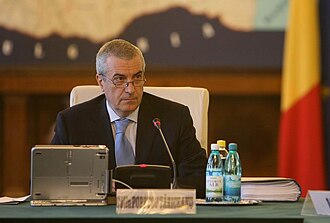
Following the 2004 presidential election victory of Traian Băsescu, Călin Tăriceanu was appointed Prime Minister of Romania. This appointment adhered to a pre-electoral agreement between the two parties of the Justice and Truth Alliance (DA). On December 29, 2004, the new government took office after receiving parliamentary approval with 265 votes in favor and 200 against. This appointment was historic, as Tăriceanu became the first National Liberal prime minister of Romania since 1937.
Key Facts
- Term: 2004–2008.
- Party: National Liberal Party (PNL).
- Major Milestone: Oversaw Romania's accession to the European Union in 2007.
- Economic Reforms: Introduced a flat tax and revalued the leu.
- Military Reform: Abolished conscription and professionalized the Romanian Armed Forces.
- Political Shift: Transitioned from a coalition to a minority government in 2007.
Economic Reforms and Criticisms
The Tăriceanu administration presided over a period of significant economic boom. Key policy achievements included the introduction of a flat tax (a single tax rate applied to all levels of income) and the revaluation of the leu. However, these successes were met with criticism from economists.
Critics pointed to several problematic policies, including the implementation of a "first registration tax" for motor vehicles and the mismanagement of over 2 billion euros resulting from the privatization of BCR. Most notably, the government was criticized for increasing the number of public servants and their salaries, which led to a surge in public spending shortly before the 2008 financial crisis.
Political Turbulence and Conflict with President Băsescu
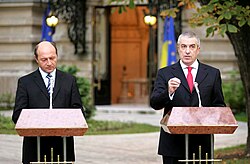
The relationship between Prime Minister Tăriceanu and President Traian Băsescu was marked by increasing tension. On July 7, 2005, Tăriceanu announced his cabinet's resignation to trigger early elections after the Constitutional Court blocked judicial reform laws. However, he reversed this decision on July 19, citing the need for stability during severe floods that killed 66 people and left thousands homeless.
Relations soured further due to several factors:
- Securitate Allegations: Former president Emil Constantinescu suggested tensions rose following allegations regarding Băsescu's past membership in the Securitate (the Communist-era secret police).
- Rompetrol Controversy: In September 2005, reports alleged Tăriceanu used insider information to buy 10 million shares of Rompetrol in April 2004, selling them after becoming prime minister.
- Military Deployment: In June 2006, Tăriceanu and the PNL supported withdrawing Romanian troops from international zones lacking UN, NATO, or EU mandates, specifically targeting troops in Iraq—a move strongly opposed by Băsescu.
Constitutional Conflicts and Government Restructuring
The friction culminated in a jurisdictional conflict in 2007. After President Băsescu refused to accept Adrian Cioroianu as Minister of Foreign Affairs, Tăriceanu assumed the role ad interim (acting). The Constitutional Court eventually ruled that while the President could ask a Prime Minister to reconsider a nominee, he did not have a veto right. Cioroianu was appointed on April 5, 2007.
On April 1, 2007, Tăriceanu dismissed ministers from the pro-Băsescu Democratic Party (PD) and formed a minority government with the Democratic Alliance of Hungarians in Romania (UDMR), supported by the Social Democratic Party (PSD).
Summary of the Tăriceanu Administration
| Category | Details |
|---|---|
| Key Reforms | Flat tax, leu revaluation, professionalization of Armed Forces |
| Major Achievement | EU Accession (2007) |
| Political Alliances | Justice and Truth Alliance $\rightarrow$ Minority Govt (UDMR/PSD support) |
| Legal Outcome | Definitively acquitted of bribery charges on June 2, 2025 |
Frequently Asked Questions
Why did Tăriceanu initially announce his resignation in 2005?
He announced his resignation on July 7, 2005, to trigger early elections after the Constitutional Court blocked laws intended to reform the judicial system.
What were the main economic criticisms of his government?
Economists criticized the "first registration tax" for vehicles, the management of funds from the BCR privatization, and the increase in public servant salaries and numbers prior to the 2008 crisis.
What was the conflict regarding the Ministry of Foreign Affairs?
President Băsescu refused to appoint Adrian Cioroianu, leading Tăriceanu to serve as acting minister until the Constitutional Court ruled that the President did not have the right to veto the Prime Minister's nominee.
How did the government survive the October 2007 no-confidence vote?
Although 220 members of parliament voted in favor of the motion brought by the PSD, it failed because it did not reach the required threshold of 232 votes.
What was the outcome of the bribery case against Tăriceanu?
On June 2, 2025, the High Court of Cassation and Justice definitively acquitted Tăriceanu in a case where he was accused of taking a bribe of 800,000 US dollars.