Caddoan Mississippian Culture and Precontact History
The history of the Caddo people is a testament to cultural continuity and architectural ingenuity. Long before European arrival, the Caddoan Mississippian culture flourished across the American South and Midwest, establishing complex societies characterized by massive earthworks, sophisticated agriculture, and a deep spiritual connection to the land.
Archaeology and the Rise of the Mound Builders
Archaeologists believe the Caddo emerged as an extension of Woodland period peoples, specifically the Fourche Maline and Mossy Grove cultures. Between 200 BCE and 800 CE, these groups inhabited regions that now comprise Arkansas, Louisiana, Oklahoma, and Texas. The Caddo share linguistic and ancestral ties with the Wichita and Pawnee tribes, all of whom historically spoke Caddoan languages.
By 800 CE, these societies coalesced into the Caddoan Mississippian culture. This era saw the rise of ritual centers dominated by platform mounds—large, flat-topped earthworks that served as foundations for temples and the residences of the elite. These mounds were typically arranged around expansive, clean open plazas used for ceremonial gatherings.
By 1000 CE, a distinct "Caddoan" society had emerged, reaching a peak of artistic and architectural achievement during the 12th and 13th centuries. The development of extensive maize agriculture provided a food surplus, allowing for denser settlements and the rise of specialized artisans and craftsmen.
One of the most significant archaeological sites is the Spiro Mounds in southeastern Oklahoma. Located near the Arkansas River, these represent some of the most elaborate mounds in the United States and mark the westernmost extent of the Mississippian culture.
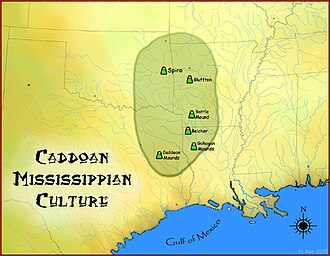
Despite the challenges of the Great Drought (1276–1299 CE), which disrupted many Native American cultures across the continent, the Caddo maintained an unbroken cultural lineage from prehistory to the modern Caddo Nation of Oklahoma.
Key Facts
- Ancestry: Descended from the Fourche Maline and Mossy Grove Woodland cultures.
- Architecture: Known for platform mounds and large ceremonial plazas.
- Geography: Historically centered in the Piney Woods ecoregion.
- Agriculture: Relied heavily on maize, sunflowers, pumpkins, and squash.
- Social Structure: Organized into three primary confederacies: Natchitoches, Hasinai, and Kadohadacho.
- Continuity: Archaeological evidence confirms an unbroken link between prehistoric Mississippian peoples and the modern Caddo Nation.
Religion and Oral Tradition
According to Caddo oral history, the tribe emerged from a cave called Chahkanina ("the place of crying") at the confluence of the Red River of the South and the Mississippi River. Led by a figure named Moon, the people were warned not to look back during their exit; legend says a wolf looked back, causing the exit to close for those remaining.
The Caddoan spiritual world centers on Kadhi háyuh, the "Leader Above" or "Leader in the Sky." Historically, the community was guided by priests, most notably the xinesi (head priest), who acted as a mediator between the people and the spirits residing near the temples.
Religious life was deeply intertwined with the seasons and agriculture. Ceremonies were timed to the cultivation of corn, and tobacco was grown specifically for ceremonial use. Early priests also utilized a purifying sacrament made from wild olive leaves.
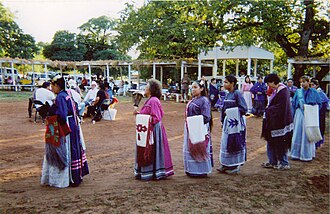
Territory and Regional Influence
The Caddo primarily inhabited the Piney Woods, a region of dense deciduous and pinophytal forests, rolling hills, and bayous (intermittent wetlands) spanning East Texas, southern Arkansas, western Louisiana, and southeastern Oklahoma. They settled predominantly near the Caddo River.
Around 1200 CE, the region saw an influx of Dhegihan Siouan-speaking peoples, including the Osage, Ponca, Omaha, Quapaw, and Kaw. These groups migrated west after conflicts with the Haudenosaunee (Iroquois) in the Ohio River valley. The Osage, in particular, engaged in warfare with the Caddo, eventually becoming the dominant power in parts of Missouri, Arkansas, and eastern Kansas.
At the time of first European and African contact, the Caddo were organized into three main confederacies:
- Natchitoches: Located in northern Louisiana.
- Hasinai: Located in East Texas.
- Kadohadacho: Located near the borders of Texas, Oklahoma, and Arkansas.
Daily Life and Cultural Practices
Caddo society operated on a balanced hunting and gathering dynamic. Men hunted year-round for bison, bears, rabbits, quail, and wild turkeys using handcrafted bows and arrows. Women played a central role in the economy: younger women gathered fruits, seeds, and vegetables, while elderly women managed the planting and cultivation of crops.
Their diet was diverse, consisting of maize, sunflowers, beans, melons, and squash during warm months, supplemented by acorns and roots during the winter.
Craftsmanship was highly revered. Women produced clay pots, utensils, and wooden mortars. These items were so valued that they were often buried with their creators. Body ornamentation was also a significant cultural marker; men used skin painting, jewelry, and hair decorations with feathers or fur, while women frequently used extensive tattooing, including on the face.
| Category | Details |
|---|---|
| Primary Crops | Maize, sunflower, pumpkin, squash, tobacco |
| Key Architecture | Platform mounds and open plazas |
| Confederacies | Natchitoches, Hasinai, Kadohadacho |
| Spiritual Leader | Xinesi (Head Priest) |
| Geographic Hub | Piney Woods (TX, AR, LA, OK) |
Frequently Asked Questions
Who were the Caddoan Mississippians?
They were a complex society of mound builders and farmers who flourished between 800 CE and the time of European contact, serving as the direct ancestors of the modern Caddo Nation, as well as the Wichita and Pawnee peoples.
What was the purpose of the platform mounds?
Platform mounds served as elevated foundations for temples and the homes of the social elite, acting as focal points for ritual and political leadership within the community.
What was the significance of the Piney Woods?
The Piney Woods provided the essential environment for the Caddo, offering a mix of dense forests, river valleys, and bayous that supported both their agricultural needs and their hunting-gathering lifestyle.
How was Caddo society organized before European contact?
The Caddo were organized into three primary confederacies—the Natchitoches, Hasinai, and Kadohadacho—and maintained loose affiliations with other neighboring tribes like the Yowani Choctaw.
What role did women play in Caddo culture?
Women were the primary agriculturalists and artisans. They were responsible for gathering wild foods, planting crops, and crafting the tribe's essential clay and wooden tools.