C-SPAN: The Public Affairs Network Bringing Government to the People
In the heart of Washington, D.C., C-SPAN (Cable-Satellite Public Affairs Network) serves as a critical bridge between the United States government and its citizens. Founded on the principle of transparency, this nonprofit network provides raw, unfiltered access to the proceedings of the U.S. Congress and other public affairs events, allowing viewers to form their own opinions without the lens of traditional news commentary.
Since its inception, C-SPAN has evolved from a single cable channel into a multi-platform media entity, encompassing multiple television channels, radio broadcasts, and an extensive digital archive that documents American political history in real-time.

Key Facts
- Founder: Brian Lamb
- Legal Status: 501(c)(3) nonprofit organization
- Ownership: National Cable Satellite Corporation
- Current CEO: Sam Feist
- Launch Date: March 19, 1979
- Revenue (2023): US$ 46.32 million
- Staff (2023): 198 employees
History and Evolution
C-SPAN was launched on March 19, 1979, by Brian Lamb to provide a direct window into the workings of the federal government. Over the decades, the network expanded its reach to provide more specialized content. C-SPAN2 was introduced on June 2, 1986, followed by C-SPAN3 on January 22, 2001.

The network has consistently pushed for greater transparency, often advocating for increased camera access within the House of Representatives and the Supreme Court. While C-SPAN provides the platform, it is important to note that the network does not control the House TV cameras; those are managed by the House itself.

Programming and Services
C-SPAN's programming is diverse, focusing on the intersection of policy, history, and public discourse. Its core coverage includes the U.S. Senate and the House of Representatives, as well as public affairs events and political campaigns.
Flagship Channels and Content
- C-SPAN: The primary channel focusing on live government proceedings and public affairs.
- C-SPAN2: Home to Book TV, which highlights literary works and authors, and American History TV.
- C-SPAN3: Provides additional coverage of congressional activity and specialized interviews.

Digital Presence and Accessibility
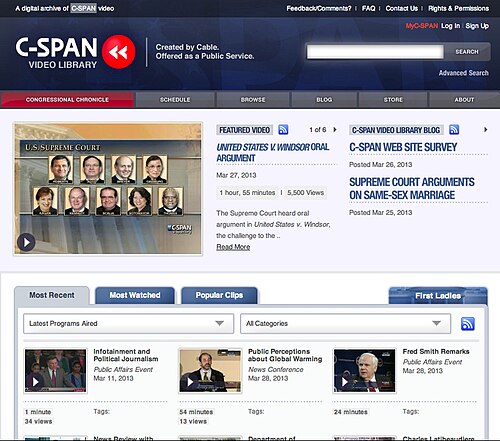
To adapt to the digital age, C-SPAN has expanded its availability. The C-SPAN Video Library serves as a massive digital repository of the network's archives, redefining how social studies and political history are taught. The network is also available via streaming services such as Hulu + Live TV and YouTube TV, as well as through C-SPAN Radio (WCSP-FM/HD in the Washington, D.C./Baltimore area).
Beyond the screen, the network engages the public through the C-SPAN Digital Bus, a mobile educational unit that tours the United States to teach citizens about available C-SPAN resources.

Organizational Overview
Operating as a 501(c)(3) nonprofit, C-SPAN is managed by the National Cable Satellite Corporation. Its mission is strictly public affairs broadcasting, maintaining a neutral stance to ensure the integrity of the government proceedings it airs.
| Feature | Details |
|---|---|
| Headquarters | Washington, D.C., USA |
| Broadcast Area | Worldwide |
| Picture Format | 1080i (HDTV) |
| Sister Channels | C-SPAN2, C-SPAN3, C-SPAN Radio |
| Financials (2023) | $46.32M Revenue / $46.15M Expenses |


Frequently Asked Questions
Who owns C-SPAN?
C-SPAN is owned by the National Cable Satellite Corporation and operates as a 501(c)(3) nonprofit organization.
How can I watch C-SPAN?
C-SPAN is available via cable and satellite providers, streaming services like YouTube TV and Hulu + Live TV, and through their official website at c-span.org.
Does C-SPAN control the cameras in the House of Representatives?
No, C-SPAN does not have control over the U.S. House TV cameras; those are operated by the House of Representatives.
What is the purpose of C-SPAN2?
C-SPAN2 provides specialized programming, including Book TV and American History TV, focusing on literature and historical archives.
Is C-SPAN a news channel?
C-SPAN is a public affairs network. Unlike traditional news channels, it focuses on providing raw, unedited coverage of government proceedings and public events without adding commentary.