C. Bruce Fergusson: A Legacy of Nova Scotian History and Archival Excellence
C. Bruce Fergusson was a pivotal figure in the preservation of Atlantic Canadian heritage. Through his dual roles as a dedicated archivist and an academic, he transformed the way Nova Scotia's historical records were managed, accessed, and studied. His career spanned military service, high-level civil administration, and a prolific output of historical scholarship.
Military Service and Early Career
During the Second World War, Fergusson's professional journey began with a variety of service roles. He was affiliated with the Works Branch of the Royal Canadian Air Force Eastern Air Command and served as a civil service examiner in Ottawa. He further contributed to the war effort by enlisting in the Royal Canadian Navy. Following the conclusion of the war, he returned to his role as a civil service examiner in Ottawa before transitioning into the field of history and archives.
Transforming the Public Archives of Nova Scotia
Fergusson joined the Public Archives of Nova Scotia as the Assistant Provincial Archivist in 1946, eventually ascending to the position of Provincial Archivist in 1956, a role he held until his retirement in 1977. His tenure was marked by a commitment to modernization and accessibility.
One of his primary achievements was the implementation of a comprehensive microfilming program—the process of photographing documents to create small film copies for preservation and easy retrieval—which resulted in over 10,000 reels of microfilm. To ensure that history was accessible to all, Fergusson introduced a policy that kept the archives open seven days a week until 10:00 PM, providing full service to researchers.
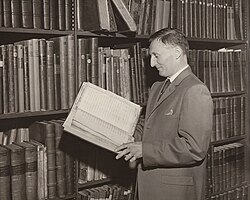
Under his leadership, the archives experienced significant growth. By aggressively acquiring municipal, county, court, and school records, Fergusson doubled the holdings of books and pamphlets. This expansion, combined with improved access, led to a fivefold increase in visitors, peaking at 13,000 researchers in 1977 alone.
Academic Contributions and Advocacy
Beyond the archives, Fergusson was a dedicated educator. He taught contemporary history at the Nova Scotia Technical College from 1946 to 1950 and served as an associate professor of history at Dalhousie University starting in 1957. His leadership extended to national boards, where he served as Chairman of the Historic Sites and Monuments Board of Canada from 1963 to 1965.
In 1975, Fergusson was elected National President of the Canadian Authors Association. In this capacity, he became a vocal advocate for domestic literature. In 1976, he criticized the "book-dumping" practices of American publishers, who sold leftover inventory in Canada at prices that undercut local production. He urged the federal government to implement measures that supported Canadian authors rather than penalizing foreign publishers.
Published Works and Scholarship
Fergusson was a prolific writer and editor, producing nearly 100 books, articles, and pamphlets. Much of his work focused on the regional history of Nova Scotia and was published through the Public Archives. His most notable works include:
- Place-Names and Places of Nova Scotia (1967)
- Members of the Legislative Assembly of Nova Scotia, 1758-1958 (1958)
- The edited diary of Simeon Perkins
Key Facts
- Tenure: Served as Provincial Archivist of Nova Scotia from 1956 to 1977.
- Archival Growth: Doubled the holdings of books and pamphlets and produced 10,000+ microfilm reels.
- Public Access: Increased visitor numbers fivefold, reaching 13,000 researchers by 1977.
- Literary Output: Authored or edited nearly 100 historical publications.
- Honors: Awarded the Order of Canada in 1978.
| Period/Year | Role/Achievement | Organization |
|---|---|---|
| WWII Era | Civil Service Examiner / Navy Enlistment | RCAF / Royal Canadian Navy |
| 1946-1950 | Teacher of Contemporary History | Nova Scotia Technical College |
| 1956-1977 | Provincial Archivist | Public Archives of Nova Scotia |
| 1957 | Associate Professor of History | Dalhousie University |
| 1963-1965 | Chairman | Historic Sites and Monuments Board of Canada |
| 1975 | National President | Canadian Authors Association |
Death and Legacy
C. Bruce Fergusson passed away in Halifax on September 20, 1978. He was awarded the Order of Canada on July 4, 1978, and was invested posthumously on April 25, 1979. To ensure his passion for regional history continues, Dalhousie University established the C. Bruce Fergusson Prize. This award is given to the top Honours student in the history department who proceeds to a Masters program focusing on Nova Scotian history.
Frequently Asked Questions
How did C. Bruce Fergusson improve access to the Nova Scotia archives?
He implemented a policy of keeping the archives open seven days a week until 10:00 PM and developed a microfilming program that created over 10,000 reels of microfilm for researchers.
What was Fergusson's stance on the Canadian publishing industry?
He opposed the practice of American publishers "dumping" leftover inventory into the Canadian market at low prices, arguing that this undercut Canadian book production and that the government should support local authors.
Which of his publications are the most well-known?
His most prominent works are "Place-Names and Places of Nova Scotia" (1967) and "Members of the Legislative Assembly of Nova Scotia, 1758-1958" (1958).
What is the C. Bruce Fergusson Prize?
It is an award established by Dalhousie University for the top history Honours student who enrolls in a Masters program specializing in the study of Nova Scotian history.
What military roles did he hold during World War II?
He worked with the Works Branch of the Royal Canadian Air Force Eastern Air Command, served as a civil service examiner in Ottawa, and enlisted in the Royal Canadian Navy.