C-40 Clipper: The Versatile Backbone of US Military Airlift
The C-40 Clipper represents a sophisticated marriage of commercial efficiency and military necessity. Based on the Boeing 737-700, this aircraft serves as a critical logistics and transport asset for the United States Armed Forces, providing a bridge between high-capacity cargo hauling and executive transport.
To achieve its specialized performance, the C-40 utilizes a unique hybrid design. It combines the fuselage of a Boeing 737-700 with the reinforced wings and landing gear of the larger 737-800. This structural enhancement, paired with auxiliary fuel tanks, significantly extends its operational reach. While a standard 737-700 has a range of 3,010 nautical miles (nmi), the C-40 can fly up to 5,000 nmi (9,300 km) without refueling.
Key Facts
- Base Model: Boeing 737-700 with 737-800 wings and landing gear.
- Maximum Range: 5,000 nautical miles (9,300 km).
- C-40A Capacity: Up to 121 passengers or a "combi" mix of 70 passengers and three cargo pallets.
- C-40B Purpose: High-security "office in the sky" for senior military and government leaders.
- C-40C Purpose: VIP transport for Cabinet and Congress members with flexible seating (42 to 111 passengers).
The C-40A: Logistics and Combi Capabilities
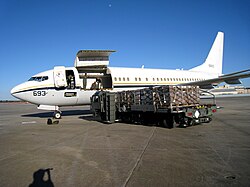
The C-40A was developed as a combi aircraft—a versatile platform capable of transporting both cargo and passengers simultaneously. First flying in April 2000 and entering service in April 2001, it was acquired by the U.S. Navy Reserve to replace the aging C-9B Skytrain II fleet.
The C-40A brought significant improvements over its predecessor, including better fuel efficiency, increased payload capacity, and compliance with international noise and environmental standards. The Navy Reserve utilizes these aircraft to provide all of the Navy's medium and heavy airlift capabilities.
Deployment of the C-40A began with Fleet Logistics Support Squadron Five Nine (VR-59) in Texas, followed by VR-58 in Florida and VR-57 in California. Additionally, the U.S. Marine Corps sought to integrate the C-40A into its fleet to replace its own Skytrain aircraft, with personnel from Marine Transport Squadron One operating Navy Clippers during the transition.
The C-40B: The Executive Command Center
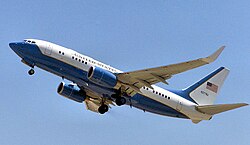
While the C-40A focuses on logistics, the C-40B is a military version of the Boeing Business Jet. Selected by the U.S. Air Force in August 2000 to replace the C-137, the C-40B is specifically designed to transport U.S. combatant commanders.
Often described as an "office in the sky," the C-40B is equipped for high-level governance and command. The interior features a distinguished visitor compartment with sleeping accommodations, a crew rest area, two galleys, and business-class seating with worktables. To maintain seamless command and control, it includes secure two-way broadband data communications, satellite links, telephones, and a computer-based passenger data system.
These aircraft are operated by the 89th Airlift Wing at Andrews Air Force Base, the 15th Airlift Wing at Hickam AFB for U.S. Pacific Command, and the 86th Airlift Wing at Ramstein AB for U.S. Air Forces in Europe.
The C-40C: Flexible VIP Transport
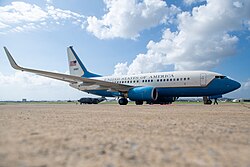
The C-40C serves as a VIP transport for members of the U.S. Congress and the Cabinet, replacing the Boeing C-22 (a militarized Boeing 727). Notably, the C-40C was the first military aircraft acquired by the Department of Defense as an "off-the-shelf" commercial product.
While similar in build to the C-40B, the C-40C lacks the advanced secure communications suite. Its primary advantage is flexibility; the cabin configuration can be adjusted to accommodate anywhere from 42 to 111 passengers. These aircraft are operated by the 201st Airlift Squadron of the District of Columbia Air National Guard and the Air Force Reserve's 932d Airlift Wing.
C-40 Variant Comparison
The following table summarizes the primary differences between the three main variants of the C-40 Clipper.
| Feature | C-40A | C-40B | C-40C |
|---|---|---|---|
| Primary User | U.S. Navy Reserve / USMC | U.S. Air Force | Air National Guard / AF Reserve |
| Primary Role | Logistics / Combi | Command / Executive | VIP Transport |
| Key Capability | Cargo pallets + Passengers | Secure Broadband Comms | Flexible Seating (42-111) |
| Replaced Aircraft | C-9B Skytrain II | C-137 | C-22 |
Frequently Asked Questions
What makes the C-40 different from a standard Boeing 737-700?
The C-40 features strengthened wings and landing gear from the larger 737-800 and includes auxiliary fuel tanks that increase its unrefueled range to 5,000 nautical miles, compared to 3,010 nmi for the standard 737-700.
What is a "combi" configuration in the C-40A?
A "combi" configuration allows the aircraft to simultaneously transport both cargo and passengers. Specifically, the C-40A can accommodate up to three cargo pallets and 70 passengers on the main deck.
How does the C-40B support military leadership?
The C-40B acts as a mobile office, providing senior leaders with secure voice and data communications, internet access, satellite links, and dedicated sleeping and work areas.
What is the passenger capacity of the C-40C?
The C-40C is highly flexible and can be configured to carry between 42 and 111 passengers depending on the mission requirements.
Which aircraft did the C-40A replace for the U.S. Navy?
The C-40A replaced the fleet of aging C-9B Skytrain IIs, offering superior fuel efficiency, range, and payload capabilities.