Bundesautobahn 8: A Comprehensive Overview of Southern Germany's Major Transit Route
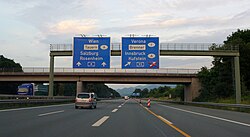
The Bundesautobahn 8 (BAB 8 or A 8) is a critical east-west artery in southern Germany. Stretching 497 km (309 mi), it connects the Luxembourg A13 motorway at Schengen to the Austrian West Autobahn near Salzburg. This highway serves as a vital link across several German states, including Saarland, Rhineland-Palatinate, Baden-Württemberg, and Bavaria.
The route passes through several major urban centers, including Neunkirchen, Pirmasens, Karlsruhe, Pforzheim, Stuttgart, Ulm, Augsburg, and Munich, making it one of the most heavily utilized transit corridors in the region.
Key Facts
- Total Length: 497 km (309 mi).
- Route: From Schengen (Luxembourg border) to the Austrian border near Salzburg.
- States Covered: Saarland, Rhineland-Palatinate, Baden-Württemberg, and Bavaria.
- Historical Origin: Construction began in March 1934 as a Reichsautobahn.
- Current Status: A mix of modern six-lane sections and original 1930s configurations.
Infrastructure and Road Conditions
The A8 is characterized by a stark contrast between modern engineering and historical remnants. While much of the route has been updated, significant portions still reflect the original 1930s design. These older sections often feature a 2+2 lane configuration without emergency lanes, steep inclines, and tight curves.
Due to the combination of outdated infrastructure and high traffic volumes, the A8 is considered one of Germany's most crowded and dangerous autobahns. Bottlenecks are particularly frequent during winter in the Black Forest, the Swabian Alb near Aichelberg, and the Irschenberg, where heavy trucks often struggle with uphill climbs.
Lane Expansion and Modernization
As of 2016, several key sections have been expanded to three lanes in each direction to alleviate congestion:
- Karlsruhe to Pforzheim-North
- Pforzheim-South to Stuttgart and Mühlhausen
- AK Ulm/Elchingen to Augsburg and Munich-Eschenried
- AK Munich-South to AD Inntal
Further modernization is ongoing. In 2021, work began to widen the Enz crossing east of Pforzheim from four to six lanes. This project, estimated to cost over 100 million euros, involves the construction of a new green bridge for wildlife and the replacement of seven bridges, with completion expected by 2026.
Remaining Gaps and Incomplete Sections
Despite ongoing efforts, some sections do not yet meet modern standards or remain incomplete. These include areas near Merzig, the stretch between AK Neunkirchen and Zweibrücken (lacking emergency lanes), and planned works at the Alb crossing (Mühlhausen to Hohenstadt) and the AD Inntal to Salzburg section.
Notably, a gap exists within Munich; the section from Augsburg ends at Munich-Obermenzing, while the section from Salzburg ends at Munich-Ramersdorf. Transit traffic must navigate this gap via the A99 north, the A995 west, or the "Mittlerer Ring" (central urban ring road).
Unique Route Features
The A8 features several architectural and operational anomalies that distinguish it from other German motorways:
- The Winzeln Left Slip Road: At Pirmasens-Winzeln, one of only four such exits in Germany, the left lane serves as the exit to Winzeln while the right lane continues on the A8.
- Faraday Cage: Near Heusweiler, wire netting was previously installed to protect vehicle electronics from a high-powered radio transmitter. These wires were removed in 2020 after the transmitter ceased operations.
- Feng Shui Design: The motorway services at Gruibingen were constructed following feng shui philosophy.
- Divided Routes: At Drakensteiner Hang, the northbound and southbound routes are physically separated on opposite sides of the peak.
- Motorway Church: Near Adelsried, the "Maria, Schutz der Reisenden" church was built in 1956, marking the first of 42 such churches in Germany.
Route Summary Table
| Feature | Details |
|---|---|
| West End | Luxembourg A13 motorway (Schengen) |
| East End | Austrian West Autobahn (near Salzburg) |
| Total Distance | 497 km |
| Key Cities | Karlsruhe, Stuttgart, Ulm, Augsburg, Munich |
| Funding Model | Operator model used for Ulm/Elchingen to Munich (consortia funded work for 30-year toll rights) |
Frequently Asked Questions
Why is the A8 considered dangerous in some sections?
Certain parts of the A8 still use the original 1930s configuration, which lacks emergency lanes and features steep hills and tight curves. When combined with modern high traffic volumes, these sections become hazardous, especially in winter.
How do drivers navigate the gap in the A8 in Munich?
Transit traffic is officially signposted to use the A99 orbital motorway (north/east) at the Eschenried and Munich-South interchanges. Some drivers use the A99 west and Mittlerer Ring for a shorter but often more congested route through the city.
What is unique about the Pirmasens-Winzeln exit?
It is one of only four "left slip roads" in Germany, meaning the exit to Winzeln is located in the left lane for traffic coming from Zweibrücken, while the right lane continues straight.
Why do some drivers exit the A8 before reaching the Austrian border?
Because Austria charges tolls for its autobahns, some drivers exit at Bad Reichenhall or Schwarzbach to avoid the toll, which frequently leads to traffic congestion on local country roads.
What was the "operator model" used for funding?
For the expansion between Ulm/Elchingen, Augsburg, and Munich, construction consortia funded the work themselves. In exchange, they were granted the right to collect lorry road charges and manage maintenance for a period of 30 years.