Bullwheels: The Engineering Behind Ropeways and Early Farm Machinery
In the world of mechanical engineering, the bullwheel serves as a critical component for transferring motion and maintaining tension. While most commonly associated today with the sweeping vistas of ski resorts and mountain transport, the bullwheel has a rich history that stretches back to the dawn of mechanized agriculture.
Bullwheels in Modern Ropeway Systems
In contemporary ropeway applications, such as chairlifts and gondolas, a bullwheel is a large wheel designed to guide a rope or cable as it loops through the system. These systems typically rely on two primary wheels to keep the cable in motion.
The wheel connected to the prime mover—the motor that provides the power—is known as the drive bullwheel. Conversely, the wheel at the opposite end of the line is called the return bullwheel.
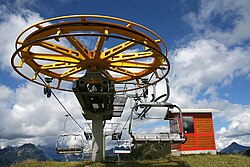
To ensure the cable remains taut and safe, one of these wheels is typically integrated with a cable tensioning system. These systems generally utilize either hydraulic mechanisms or fixed counterweights to maintain constant pressure on the line.
Advanced Configurations
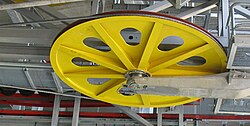
Depending on the complexity of the lift, engineers may employ a double-grooved bullwheel. This design allows two separate cables traveling at the same speed, or a single cable looping around the wheel twice, to be managed by a single component.
The Agricultural Origins of the Bullwheel
Long before they powered mountain lifts, bullwheels were essential to farm implements, specifically the reaper (a machine used for harvesting grain). In this context, the bullwheel referred to the traction, drive, or traveling wheel of the harvester.
The bullwheel functioned by utilizing its outer surface to create traction against the ground. As draft animals or tractors pulled the implement forward, the rotation of the bullwheel powered all the machine's moving parts, including the reel, rake, self-binder, and reciprocating knives.
Cyrus McCormick famously utilized the bullwheel to power his 1834 reaper. This mechanical arrangement remained the industry standard until the early 1920s, when small internal combustion gasoline engines, such as those produced by the Cushman Motor, became the preferred power source.
Key Facts
- Primary Function: Acts as a large wheel for rope rotation in ropeways and as a traction wheel in early farm machinery.
- Ropeway Types: Includes the drive bullwheel (powered) and the return bullwheel.
- Tensioning: Maintained via hydraulic systems or fixed counterweights.
- Agricultural History: Used by Cyrus McCormick in his 1834 reaper to power harvesting components.
- Obsolescence in Farming: Replaced in the early 1920s by internal combustion engines.
| Feature | Ropeway Application | Agricultural Application (Reaper) |
|---|---|---|
| Primary Role | Cable guidance and propulsion | Ground traction and power transfer |
| Power Source | Prime mover (Motor) | Draft animals or tractors |
| Key Components | Drive/Return wheels, Tensioning systems | Reciprocating knives, reel, rake |
| Era of Prominence | Modern Era | 1834 to early 1920s |
Frequently Asked Questions
What is the difference between a drive bullwheel and a return bullwheel?
The drive bullwheel is attached to the prime mover and provides the force to move the cable, while the return bullwheel simply guides the cable back to the start of the loop.
How is cable tension maintained in a ropeway?
Tension is typically managed by attaching one of the bullwheels to a tensioning system, which uses either hydraulic pressure or fixed counterweights.
What is a double-grooved bullwheel?
It is a specialized wheel with two grooves that allows either two separate cables or a single cable looping twice to travel at the same speed.
How did the bullwheel work on early reapers?
The bullwheel used friction against the ground to rotate as the machine was pulled forward, which in turn powered the mechanical parts of the harvester like the knives and rake.
Who was a pioneer in using bullwheels for farming?
Cyrus McCormick used the bullwheel to power his reaper in 1834.
Why did bullwheels stop being used in farm machinery?
By the early 1920s, they were largely replaced by small internal combustion gasoline engines, such as the Cushman Motor.