Budva Cityscape: From Ancient Old Town to Modern Urban Expansion
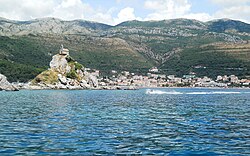
Budva is a city of striking contrasts, where the timeless allure of a medieval fortress meets the rapid growth of a modern tourist hub. Situated on a rocky peninsula at the southern end of the Budva field, the city serves as a living museum of Adriatic history, evolving from an early Illyrian settlement into a bustling Mediterranean destination.
The Historic Old Town
The Old Town of Budva is a fortified enclave that reflects centuries of shifting power. While archaeological evidence points to an Illyrian presence before Greek colonization, the city was permanently settled during the Roman era. Much of the current architectural character, including the city walls and various buildings, was established during the period of Venetian rule.
The town is entirely encircled by defensive stone walls, featuring classic Medieval Adriatic fortifications such as towers, embrasures, fortified gates, and a central citadel. While the city originally had gates on all four sides, the sea-facing entrances were closed over time. Today, the primary entrance is the Porta di Terra Ferma, which leads visitors from the west into Njegoševa Street, the town's main thoroughfare.
Other notable access points include four gates on the north wall facing the marina (Porta Pizana, Porta Pizana 1 and 2, and Porta Pizanella) and a small gate leading to the Ričardova glava beach in the southwest. The interior follows a roughly orthogonal layout, though many narrow streets deviate from the grid to connect various piazzas. To preserve its atmosphere, the entire area within the walls is now pedestrian-only.
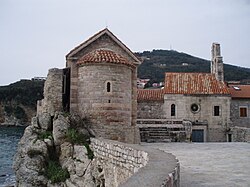
The Citadel and Religious Heritage
At the southern tip of the city lies the citadel, originally known as the Castle of St Mary. This fortification was expanded throughout the Middle Ages and reached its final form under Austro-Hungarian rule. Its 160-meter-long sea-facing ramparts are integrated into the city walls, with Austrian stone barracks serving as a prominent internal structure. The ruins of the Santa Maria de Castello church remain within the complex.
To the north of the citadel is a large public square that serves as the spiritual heart of the Old Town. This area houses several historic churches:
- Santa Maria in Punta Church (840 AD)
- St Sava Orthodox Church (12th century)
- St. Ivan Church (17th century)
- The Holy Trinity Orthodox Church (1804)
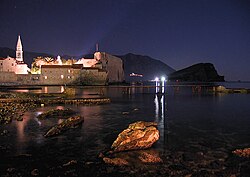
Despite suffering extensive damage during a 1979 earthquake, the Old Town underwent an eight-year reconstruction process ending in 1987. Today, the damage is barely visible, and the cobbled streets are vibrant centers of tourism, filled with cafes, restaurants, and shops.
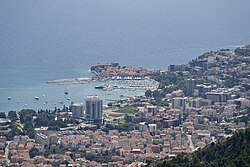
Expansion Beyond the Walls
For most of its history, Budva remained confined to its walls. However, the 20th century brought significant expansion into the Budva field, driven by the rise of the tourism industry. This growth began with the development of hotels along the 1,600-meter Slovenska beach, including the Avala hotel (1939), the Mogren hotel, and the Slovenska plaža hotel complex (1984).
Early development during the SFRY (Socialist Federal Republic of Yugoslavia) era was largely planned and sustainable, particularly south of the Adriatic Highway (E65 / E80). The western part of the Budva field also followed urban planning principles, housing the civic center—which includes government offices, schools, and health services—as well as the Rozino, Dubovica, and Golubovina neighborhoods.
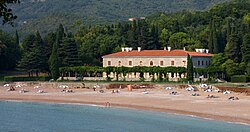
The Phenomenon of "Budvanization"
In contrast to the planned areas, the eastern Budva field and surrounding hills experienced chaotic urban sprawl starting in the late 1980s and early 1990s. This spontaneous growth coincided with the breakup of Yugoslavia and a lack of state enforcement of urban planning. Following Montenegrin independence in the 2000s, an influx of foreign capital, particularly from Russia, caused real estate prices to skyrocket.
This period of unregulated development led to the term Budvanizacija ("Budvanization"), a regional expression describing massive, chaotic urban growth that prioritizes individual developer profit over environmental sustainability. This has resulted in an irregular grid of narrow streets, inadequate infrastructure, and a chronic shortage of parking spaces, leading to severe summer traffic jams.
The impact of this sprawl is evident in the city bypass (Obilaznica). Once a crescent road circling the northern end of the Budva field, it has been swallowed by the expanding city and now functions as a busy urban street rather than a bypass.
Key Facts
- Historical Roots: Originally an Illyrian settlement, later colonized by Greeks and permanently settled in the Roman era.
- Architecture: Most remaining walls and buildings date back to Venetian rule.
- Main Gate: Porta di Terra Ferma is the primary western entrance.
- Oldest Church: Santa Maria in Punta, dating back to 840 AD.
- Resilience: The Old Town was fully restored by 1987 following a devastating earthquake in 1979.
- Urban Terminology: "Budvanization" refers to the region's unplanned and unsustainable urban sprawl.
| Area/Period | Characteristics | Key Features |
|---|---|---|
| Old Town | Fortified, Pedestrian-only | Venetian walls, Citadel, Historic Churches |
| Planned Expansion | Sustainable, Resort-style | Slovenska beach, Avala Hotel, Civic Center |
| Unplanned Sprawl | Chaotic, High-density | High-rises, Infrastructure gaps, "Budvanizacija" |
Frequently Asked Questions
What is the significance of the Porta di Terra Ferma?
It is the main city gate of the Old Town, serving as the grand entry from the west and the starting point of Njegoševa Street, the city's primary thoroughfare.
How did the 1979 earthquake affect the city?
The Old Town suffered extensive damage, but a comprehensive repair and reconstruction effort took place between 1979 and 1987, leaving very few visible traces of the disaster today.
What does the term "Budvanization" mean?
Budvanizacija refers to a form of chaotic and massive urban growth tailored to the needs of developers and landowners without regard for the environment or sustainable urban planning.
Which churches are located in the Old Town's public square?
The square contains the Santa Maria in Punta Church (840 AD), St Sava Orthodox Church (12th century), St. Ivan Church (17th century), and The Holy Trinity Orthodox church (1804).
What is the current state of the city bypass?
Although named the Obilaznica (bypass), it has been absorbed by the city's urban expansion and now functions as a busy urban street.