British Football Club Tours in South America (1904–1929)
Between 1904 and 1929, a series of exhibition tours by British football clubs played a pivotal role in the spread and development of association football across South America. These tours, featuring 12 British clubs and various South American sides, served as a bridge between the birthplace of the sport and a region where the game was rapidly gaining popularity.
The era began with a period of absolute British dominance, but as the decades passed, the tide shifted. While early visitors often secured landslide victories, later tours revealed a South American style of play that had evolved into a sophisticated, tactical force, eventually challenging the technical superiority of the British teams.
Key Facts
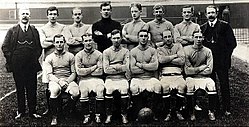
- Duration: The tours spanned 25 years, from 1904 to 1929.
- First and Last: Southampton F.C. was the first club to tour (1904), and Chelsea F.C. was the last (1929).
- Regional Impact: Tours contributed to the founding of major clubs, such as S.C. Corinthians in Brazil.
- Performance Shift: Southampton won all matches in 1904; by 1929, Chelsea suffered eight defeats in 16 games.
- Pioneering Matches: Exeter City played in the first-ever match involving the Brazil national team in 1914.
The Roots of South American Football
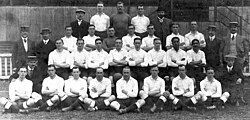
Football and other British sports, including rugby union, found fertile ground in Argentina and Uruguay during the late 19th century. Argentina established the Buenos Aires Football Club in 1867—the first in South America—and launched the Argentine Primera División in 1891, the first football league outside the British Isles. Uruguay followed shortly after, introducing the sport in 1870 and starting its own championship in 1900.
To further encourage the sport, local associations invited foreign teams to compete. These matches were massive draws; for instance, a 1905 game between Nottingham Forest and Alumni in Buenos Aires attracted 10,000 spectators, highlighting the local appetite for testing themselves against the technically superior British sides.
Early Dominance and the First Breakthroughs
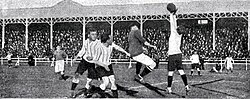
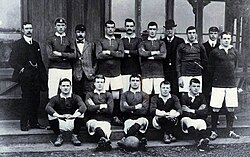
The initial tours were characterized by overwhelming British success. Southampton F.C. dominated their 1904 trip, scoring 40 goals and winning every match.
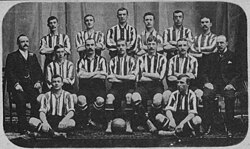
Nottingham Forest followed in 1905, continuing the trend of high-scoring victories.
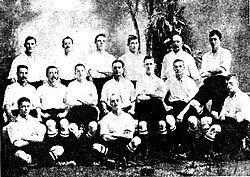
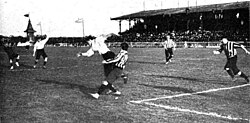
The first significant shift occurred in 1906 when the Argentine club Alumni defeated the South Africa team (composed largely of British-origin players) 1–0. This victory was hailed by local media as a "great triumph" and a stimulus for the future of Argentine football.
Expanding the Reach: Brazil and Beyond
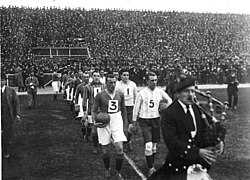
While early tours focused on the Rio de la Plata region, the reach eventually expanded. In 1910, Corinthian F.C. of London became the first British club to tour Brazil. Their influence was profound; a group of railway workers was so inspired by the team that they founded S.C. Corinthians in September 1910.
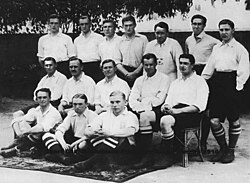
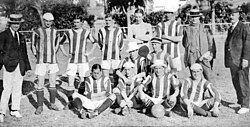
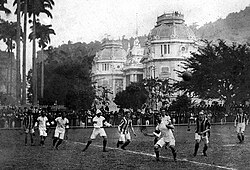
Corinthian F.C. remains the only British team to have toured South America twice, returning in 1913. Later, in 1914, Exeter City pushed the boundaries further by playing a series of friendlies in Rio de Janeiro, culminating in a match against the first-ever Brazil national team scratch side.
The Closing Era and Tactical Evolution
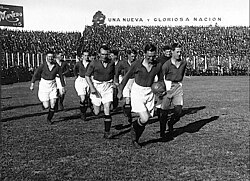
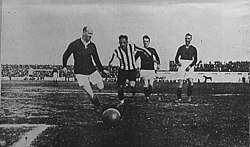
By the 1920s, the gap in quality had closed. Plymouth Argyle's 1924 tour provided a glimpse of this volatility; they thrashed the Uruguay national team 4–0—a team that would win the first World Cup six years later—but also faced intense atmospheres. One match against Boca Juniors was abandoned after a pitch invasion sparked by a controversial penalty goal scored by Plymouth's Russell.
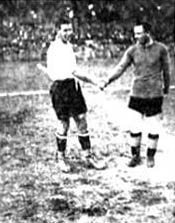
The final tour of the era was conducted by Chelsea F.C. in 1929. The results were a stark contrast to those of 1904. Chelsea won only five of their 16 matches, losing eight. Chelsea chairman Kirby noted that the South American players had become "true masters in tactical play," praising their ball control and facilities.
![The Chelsea F.C. team that toured on South America, photographed in Argentina in 1929 [46]](/images/a1/8f/a18f664bb645c77d3e8d2d0013dca53b8511f45464d6135ee7b577fa89d33a51.jpg)
Summary of British Club Tours (1904–1929)
| Club | Year | Argentina | Uruguay | Brazil |
|---|---|---|---|---|
| Southampton | 1904 | Yes | Yes | No |
| Nottingham Forest | 1905 | Yes | Yes | No |
| South Africa F.A. | 1906 | Yes | Yes | Yes |
| Everton | 1909 | Yes | Yes | No |
| Tottenham Hotspur | 1909 | Yes | Yes | No |
| Corinthian | 1910, 1913 | No | No | Yes |
| Swindon Town | 1912 | Yes | Yes | No |
| Exeter City | 1914 | Yes | No | Yes |
| Third Lanark | 1923 | Yes | Yes | No |
| Plymouth Argyle | 1924 | Yes | Yes | No |
| Motherwell | 1928 | Yes | Yes | Yes |
| Chelsea | 1929 | Yes | No | Yes |
Legacy and Coaching Influence
Beyond the match results, these tours left a lasting professional legacy. Several British players transitioned into coaching roles in South America. Notable examples include Walter Bull (Tottenham Hotspur) in Argentina, John Harley in Uruguay, and John Hamilton, who went to Brazil in 1907 to become the country's first professional coach.
Frequently Asked Questions
Which British club was the first to tour South America?
Southampton F.C. was the first British club to tour the region in 1904, winning all of its matches.
How did the results of the tours change over time?
Initially, British teams were dominant, often winning by large margins. However, by the 1929 Chelsea tour, South American teams had improved their tactical play and ball control, leading to more defeats for the visiting British sides.
Which South American club was inspired by a British touring team?
S.C. Corinthians in Brazil was founded in September 1910 by railway workers who were inspired by the visit of Corinthian F.C. of London.
What was the significance of Exeter City's 1914 tour?
Exeter City was the first British team to play beyond Argentina and Uruguay, and they played in the first-ever match involving the Brazil national team.
Who was the first professional football coach in Brazil?
John Hamilton, who visited Brazil in 1907, became the first professional coach in the country.