Brazilian Americans
Brazilian Americans (Portuguese: brasilo-americanos or americanos de origem brasileira) are individuals in the United States of full or partial Brazilian ancestry. According to estimates from the Brazilian Ministry of Foreign Affairs, this community totals approximately 1,775,000 people, making it the largest of any Brazilian diaspora globally. Representing about 0.5% of the total American population, this vibrant community blends Brazilian heritage with American life, contributing significantly to the nation's cultural and economic landscape.
Key Facts
- Total Population: Estimated at 1,775,000 (including foreign-born and those by ancestry).
- Primary Languages: Portuguese, English, and Porglish (a hybrid of Portuguese and English).
- Major Hubs: New York City, Boston, and Miami are the top three metropolitan areas.
- Migration Driver: A significant wave occurred in the late 1980s and early 1990s due to hyperinflation in Brazil.
- Economic Impact: The U.S. is a major source of remittances, providing roughly 26% of Brazil's total remittances in 2012.
History and Migration Patterns
The presence of Brazilians in North America dates back further than many realize. In the 17th century, individuals from João Pessoa and Recife—then under Dutch control in Northeast Brazil (Paraíba and Pernambuco states)—were recorded among the settlers and refugees arriving in New Netherland, the area that is now New York City.
However, formal records of Brazilian emigres only began to appear in the 1940s. Prior to this, Brazilians were generally categorized under the broader umbrella of South Americans. Between 1820 and 1960, approximately 234,761 South American emigres arrived in the U.S., including a number of Brazilians. By the 1960 census, 27,885 Americans of Brazilian ancestry were officially recorded.
The most substantial increase in migration occurred during the late 1980s and early 1990s, triggered by severe economic instability and hyperinflation in Brazil. Even after the 1994 stabilization of the Brazilian economy, immigration persisted as individuals sought higher wages in the United States.
Demographics and Distribution
Brazilian immigration patterns show a distinct gender trend; the 1990 and 2000 U.S. censuses indicated that women immigrated from Brazil in higher numbers than men, with females outnumbering males by ten percent. While many arrived legally, a significant portion of the population since the 1980s has remained undocumented.
Geographically, the population is concentrated in the Northeast and Florida. Massachusetts and Florida host the largest populations, with Middlesex County, MA, and Broward County, FL, ranking as top hubs for Brazilian immigrants.
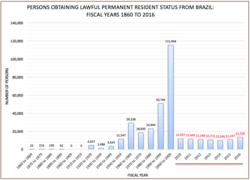
The distribution of Lawful Permanent Resident (LPR) status—the official designation for green card holders—shows a historical trend of growth, though the rate of increase has slowed compared to the surge seen between 1990 and 2009.
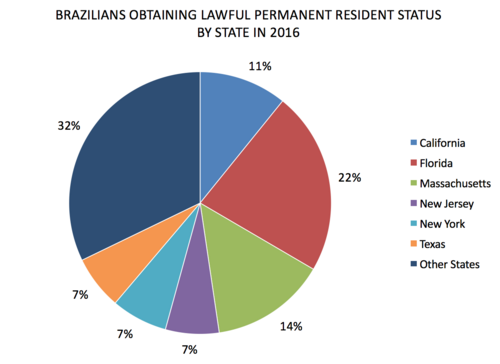
Population by State (2024 Estimates)
| State/Territory | Population Estimate | Percentage of State Pop. |
|---|---|---|
| Massachusetts | 137,449 | 2.0% |
| Florida | 134,807 | 0.6% |
| California | 64,122 | 0.1% |
| New Jersey | 56,188 | 0.6% |
| New York | 36,024 | 0.2% |
| Connecticut | 30,065 | 0.8% |
| Texas | 29,745 | 0.1% |
Cultural and Social Influence
The Brazilian American community is predominantly Christian, with smaller minorities practicing Judaism and Mormonism. Linguistically, the community is diverse, utilizing Portuguese and English, and in some cases, Porglish—a linguistic blend of the two languages.
The influence of the diaspora is highly visible in the arts, sports, and business. From world-renowned models and actors to elite athletes and academic pioneers, Brazilian Americans have left a mark across various sectors of American society.
Notable Figures in Arts and Entertainment
The community has produced numerous talents in cinema and music, including actress Alice Braga, singer Bebel Gilberto, and model Gisele Bündchen. Other prominent figures include actress Camilla Belle and singer Sky Ferreira.



Achievements in Sports and Academia
In sports, the legacy is headlined by soccer legend Pelé, as well as MMA stars like Anderson Silva and Wanderlei Silva. In the academic and business realms, notable figures include Harvard Law professor Roberto Mangabeira Unger and JetBlue founder David Neeleman.
Frequently Asked Questions
Why did so many Brazilians move to the U.S. in the 1980s?
The primary driver was the worsening economic conditions in Brazil, specifically the period of hyperinflation that occurred in the late 1980s and early 1990s.
Which U.S. cities have the largest Brazilian populations?
The top three metropolitan areas are New York City, Boston, and Miami.
What is "Porglish"?
Porglish is a hybrid language used by some members of the Brazilian American community, blending elements of Portuguese and English.
How does the Brazilian diaspora impact Brazil's economy?
The diaspora is a significant source of remittances. In 2012, the U.S. accounted for approximately 26% of the $4.9 billion in remittances received by Brazil.
Are there more Brazilian American men or women?
Census data from 1990 and 2000 indicates that women have immigrated from Brazil to the U.S. in higher numbers, with females outnumbering males by ten percent.