boxingpugilismboxing stylesMarquess of Queensberry rulesboxing techniques

Boxing: History, Techniques, and the Science of the Sweet Science

Boxing: History, Techniques, and the Science of the Sweet Science Boxing, often referred to as pugilism or the "Sweet Science," is a combat sport centered on the art of punching and strik...

Boxing: History, Techniques, and the Science of the Sweet Science

Boxing, often referred to as pugilism or the "Sweet Science," is a combat sport centered on the art of punching and striking. From its prehistoric roots to the highly regulated professional bouts of today, boxing has evolved from a raw test of strength into a sophisticated discipline of strategy, footwork, and physical endurance.

Key Facts

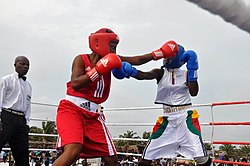
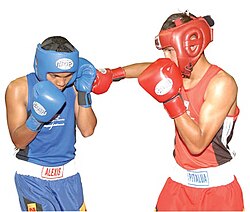
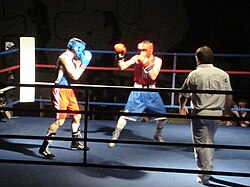
A woman's boxing match in Uruguay in 2008
  • Origins: Visual evidence dates back to the third millennium BC in Egypt and Sumer.
  • Olympic History: Featured in ancient Greece (688 BC) and reintroduced in the modern era in 1904.
  • Governing Bodies: Major sanctioning bodies include the WBA, WBC, IBF, and WBO.
  • Core Focus: The sport focuses exclusively on striking with the fists.
  • Safety: Head injuries are the most common risk, leading to calls for bans by several medical associations.

The Evolution of Boxing
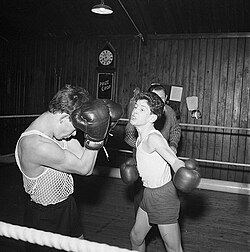
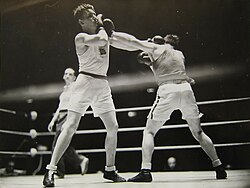
Amateur Boxing Club, Wales, 1963

Ancient History

The earliest records of boxing appear in Sumer and Egypt during the third millennium BC. A relief sculpture from Thebes (c. 1350 BC) depicts both fighters and spectators. In these early contests, participants fought bare-fisted or used simple wrist bands for support. The first documented use of boxing gloves appeared in Minoan Crete around 1500–1400 BC.
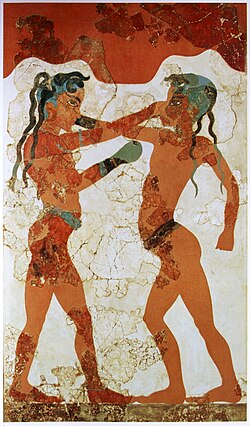
An Akrotiri fresco painting of Minoan youths boxing, the earliest documented use of boxing gloves, c. 1650 BC

Boxing became a cornerstone of Greek athletics, appearing in the Olympic Games in 688 BC. This tradition continued into the Roman era, where it remained a popular spectacle.
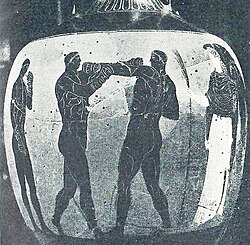
A boxing scene depicted on a Panathenaic amphora in Ancient Greece, c. 336 BC, now housed at the British Museum

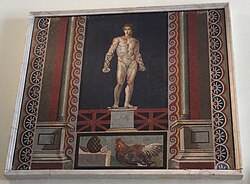
A boxer and a rooster in a Roman mosaic of first century AD at the National Archaeological Museum, Naples

The Path to Modern Rules

The sport transitioned from the raw "prize ring" era to a regulated sport with the introduction of the Marquess of Queensberry rules in 1867. These rules standardized the use of gloves and established round durations, moving the sport away from the endurance-based bare-knuckle fights of the early 19th century.
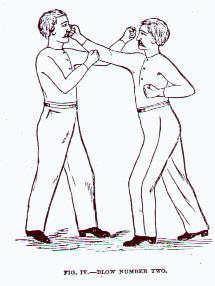
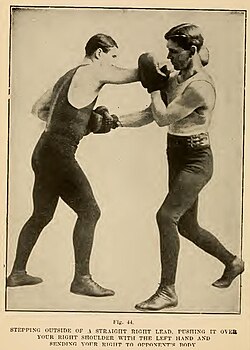
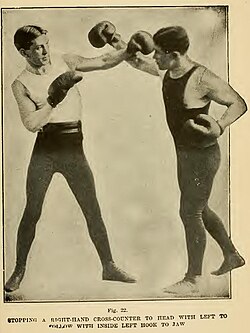
A straight right demonstrated in Edmund Price's The Science of Defence: A Treatise on Sparring and Wrestling, published in 1867

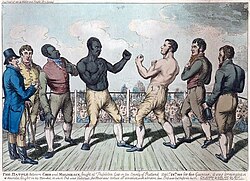
Tom Molineaux (left) vs. Tom Cribb in a rematch for the heavyweight championship of England in 1811

Boxing Styles and Strategies

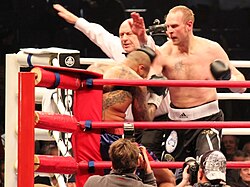
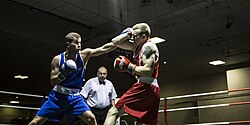
Robert Helenius (right) vs. Attila Levin (left) at Hartwall Arena in Helsinki, Finland, on 27 November 2010

A boxer's style is defined by how they utilize their reach, movement, and power. Most fighters fall into one of several primary categories:

  • Boxer/Out-fighter: Uses superior reach and footwork to stay outside the opponent's range, landing points while avoiding damage.
  • Boxer-puncher: A hybrid style combining the technical skill of an out-fighter with the power to end a fight.
  • Brawler/Slugger: Relies on raw power and heavy hits, often engaging in trades of punches.
  • Swarmer/In-fighter: Uses aggressive, non-stop pressure to get inside the opponent's reach.
  • Counter puncher: Focuses on exploiting openings in the opponent's guard and reacting to their attacks.
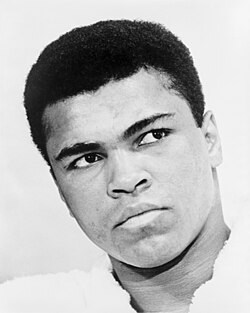
Heavyweight champion Muhammad Ali in 1967, a typical example of an out-fighter

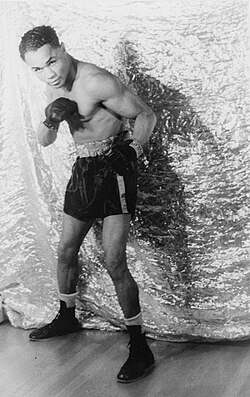
Henry Armstrong, known for his aggressive, non-stop assault style of fighting

Canelo Álvarez is known as an excellent counterpuncher and being able to exploit openings in his opponents' guards while avoiding punches with head and body movement. He is also known as a formidable body puncher.[89][90]

Technical Fundamentals

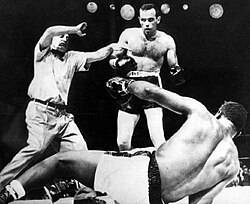
Ingemar Johansson of Sweden knocks out heavyweight champion Floyd Patterson on 26 June 1959

Stance and Footwork

The foundation of boxing is the stance, which provides balance and mobility. Common stances include the upright stance, the semi-crouch, and the full crouch. Footwork allows a boxer to maintain the correct distance and create angles for attack.

Offensive Punches

Boxing utilizes a variety of punches, including the jab, the cross (a powerful counter-punch), hooks, and uppercuts.
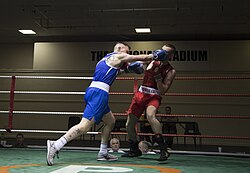
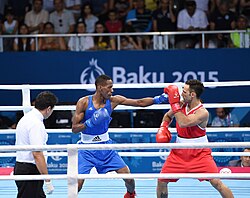
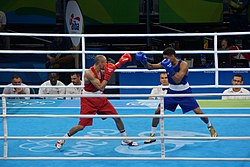
Boxer (left) using a Cross

Ricardo Dominguez (left) throws an uppercut on Rafael Ortiz (right)[92]

Defensive Maneuvers

Defense is critical for longevity in the ring. Techniques include evading (pulling away), blocking (using forearms to stop body shots), and covering (using gloves to protect the head).
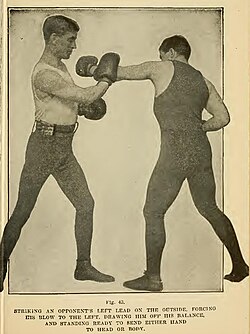
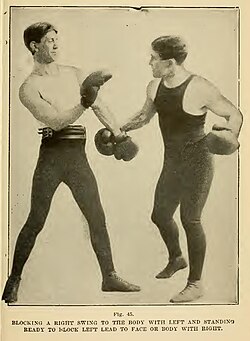
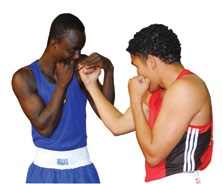
Boxer (left) parrying opponent's jab from closed stance.

Boxer (left) using a low parry.

Boxer (left) using cross block

Guards and Positioning

Boxers employ different guards to protect themselves. These range from the traditional guard and high guard to more specialized positions like the cross-armed guard or the Michigan Defense.
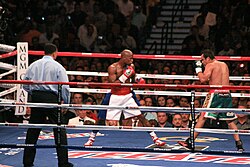
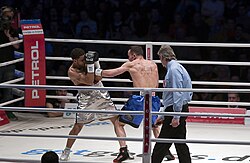
Floyd Mayweather Jr. (left) using Michigan Defense against Juan Manuel Márquez

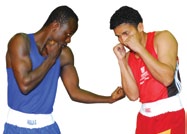
Boxer (left) using a high guard

Equipment and Professional Structure
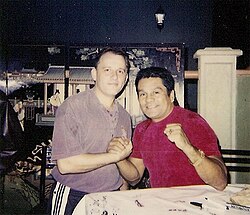
Roberto Durán (right), who held world championships in four weight classes: lightweight, welterweight, light middleweight and middleweight

Modern boxing requires specific gear to ensure safety and performance, including hand wraps, boxing gloves, and specialized footwear. In the corner, a trainer and a cutman (a specialist who treats wounds between rounds) provide essential support.

Boxer Tina Rupprecht receiving instructions from her trainer while being treated by her cutman in the ring corner between rounds

The sport is divided into amateur and professional ranks. Professional boxing is overseen by various sanctioning bodies that award world titles across different weight classes.

Major Boxing Sanctioning Bodies
Level Organization Acronym
Major World Boxing Association WBA
Major World Boxing Council WBC
Major International Boxing Federation IBF
Major World Boxing Organization WBO
Intermediate International Boxing Organization IBO
Amateur/Pro International Boxing Association IBA

Health and Safety Concerns

Women's Amateur Boxing

Despite its popularity, boxing carries significant physical risks. Head injuries are the most frequent, and fatalities do occur. A study from 1890 to 2011 estimated an average of 13 deaths per year. Neurosurgeons have used CT scans to track cognitive decline in boxers, and medical associations in the UK, Canada, and Australia have called for bans on the sport due to these risks.

Frequently Asked Questions
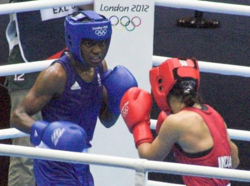
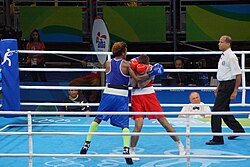
Nicola Adams (left), the first female boxer to win an Olympic gold medal, with Mary Kom of India
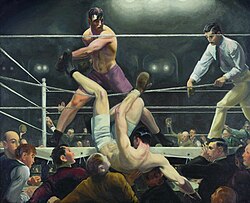
Luis Ángel Firpo sending Jack Dempsey outside the ring illustrated in a June 1924 painting by George Bellows
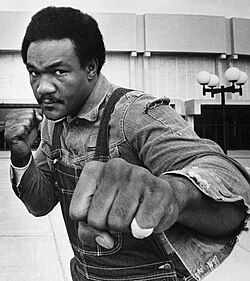
George Foreman, a two-time heavyweight champion and former Olympic gold medalist, in 2009
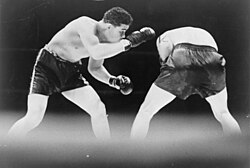
Louis vs. Schmeling in 1936
Boxer (right) parrying opponent's jab from open stance.
Boxer (right) using a punch catch
Boxer (right) using uppercut catch from open stance
Boxer (left) using a wedge block
Fighter (right) using forearm block against uppercut to the body
Fighter (left) using reverse elbow block
Boxer (left) using hook cover
Boxer (right) using a Helmet cover
Boxer (left) using Arm-in hug against boxer (right) using High Guard
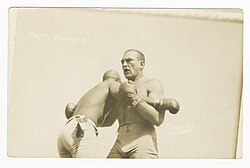
James J. Jeffries (right) using underhooks against Jack Johnson
Boxer (left) using collar tie against boxer (right) using cross collar tie
Boxer (right) using front headlock
Boxer (right) using framing against boxer (left) using High Guard
Boxer (right) using cross-armed guard
Boxers using classic long guard
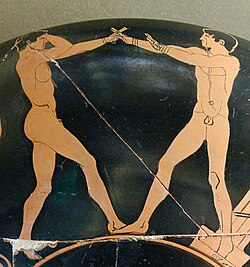
Boxer (left) using Dracula guard and boxer (right) using mummy guard on pottery dated to 470 BC
Boxer (right) using a traditional guard
Boxer using a conventional guard
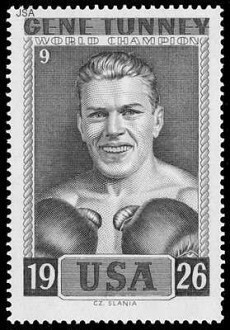
A stamp honoring heavyweight champion Gene Tunney
Former WBA, IBF, WBO and IBO heavyweight champion, Ukrainian Wladimir Klitschko in December 2008

What are the Marquess of Queensberry rules?

Introduced in 1867, these rules modernized boxing by requiring the use of gloves and establishing timed rounds, replacing the earlier bare-knuckle prize fighting style.

What is the difference between an out-fighter and a swarmer?

An out-fighter uses reach and movement to keep their distance and score points from afar, while a swarmer uses aggressive pressure to get close and overwhelm their opponent.

Which organizations sanction professional boxing?

The primary major sanctioning bodies are the WBA, WBC, IBF, and WBO, with the IBO serving as an intermediate body.

Is boxing considered a martial art?

Yes, boxing is recognized as a martial art focused on the science of striking and punching.

What are the primary health risks associated with boxing?

The most significant risks are head injuries and cognitive degeneration, which have led some medical organizations to advocate for the sport to be banned.