Boston Herald: A History of New England Journalism
The story of the Boston Herald is a complex tapestry of mergers, media empires, and survival. Its lineage is not a single line, but rather two distinct paths—the Daily Advertiser and the original Boston Herald—that eventually converged through the influence of global media moguls William Randolph Hearst and Rupert Murdoch.
The Founding and Early Years
The original Boston Herald was established in 1846 by a collective of printers operating as John A. French & Company. Launched as a single two-sided sheet priced at one cent, the paper was led by 22-year-old editor William O. Eaton. Eaton envisioned a publication that remained independent in religion and politics while remaining critically engaged with literacy, drama, and global news analysis. The paper expanded quickly, absorbing the Boston American Eagle in 1847.
Parallel to the Herald, other publications were shaping the Boston landscape. The American Traveler began in 1825 as a stagecoach listing bulletin, eventually evolving into the Boston Evening Traveler by 1845. Meanwhile, the Boston Daily Advertiser, founded in 1813 by Nathan Hale, became a dominant force in the 19th century by absorbing the Boston Patriot (1832) and the Boston Gazette (1840).
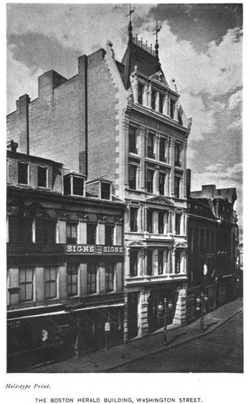
Consolidation and the Hearst Era
The early 20th century was marked by aggressive acquisitions. In 1912, the Herald acquired the Traveler, maintaining both titles. By October 1917, publisher John H. Higgins purchased the neighboring Boston Journal, creating the Boston Herald and Boston Journal.
During this same period, William Randolph Hearst entered the market. Hearst purchased the Daily Advertiser in 1917. Through a series of rebrands and mergers involving the Boston Record and The American, Hearst's holdings evolved. By 1961, the Evening American and Daily Record merged to form the Record American. Eventually, in 1972, these Hearst properties merged with the Boston Herald Traveler.
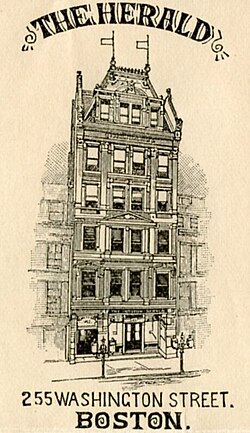
The WHDH-TV Controversy and Financial Decline
In 1946, the Herald-Traveler Corporation diversified into broadcasting by acquiring radio station WHDH, followed by WHDH-FM and WHDH-TV (Channel 5) in 1957. For years, the television station's revenue effectively subsidized the newspaper's operations.
However, the corporation faced a legal battle with the Federal Communications Commission (FCC) regarding the licensing process and alleged improper meetings between the company's CEO and FCC Chairman John C. Doerfer. In 1969, the FCC granted a permit to Boston Broadcasters, Inc. to replace WHDH-TV. After losing its final appeal, the Herald-Traveler Corporation was forced to surrender Channel 5 to WCVB-TV on March 19, 1972.
The Murdoch Rescue and Independent Ownership
The loss of television revenue crippled the newspaper, leading to its sale to the Hearst Corporation and the creation of the Boston Herald American. By 1982, Hearst announced the paper would close on December 3, which would have left Boston as a one-newspaper town. In a dramatic turn, Rupert Murdoch negotiated a purchase of the paper, closing the deal just hours after termination notices had been sent to staff. The paper famously announced its survival with the headline: "You Bet We're Alive!"
Murdoch restored the name to the Boston Herald. In 1994, due to legislation championed by Senator Ted Kennedy preventing a single company from owning both a newspaper and a television station in the same market, Murdoch's News Corporation sold the paper to publisher Patrick J. Purcell. Purcell operated the Herald as an independent entity and expanded into suburban markets by acquiring the Community Newspaper Company.
Modern Era: Bankruptcy and Digital First Media
The 21st century brought industry-wide challenges. After selling its suburban chain to Liberty Group Publishing (later GateHouse Media) in 2006 for $225 million, the Herald continued to struggle. In December 2017, the company filed for Chapter 11 bankruptcy protection.
In February 2018, Digital First Media (DFM) acquired the Herald for nearly $12 million. This transition was marked by significant cost-cutting, including the termination of a printing contract with The Boston Globe and the relocation of offices from the Seaport District to Braintree, Massachusetts.
Key Facts
- Founded: 1846 by John A. French & Company.
- Original Price: One cent per two-sided sheet.
- Major Owners: William Randolph Hearst, Rupert Murdoch, Patrick J. Purcell, and Digital First Media.
- Broadcasting Link: Formerly owned WHDH-TV (Channel 5) until 1972.
- Recent Acquisition: Purchased by Digital First Media in 2018 for approximately $12 million.
| Era/Entity | Key Event | Outcome |
|---|---|---|
| Original Herald (1846) | Founded by printers | Established independent news voice |
| Hearst Era (1917-1972) | Mergers of Advertiser/American | Created Record American |
| Murdoch Era (1982-1994) | Acquisition from Hearst | Saved paper from closure |
| Purcell Era (1994-2017) | Independent ownership | Expanded into suburban markets |
| DFM Era (2018-Present) | Bankruptcy acquisition | Shift to Braintree and digital focus |
Frequently Asked Questions
Why did Rupert Murdoch buy the Boston Herald in 1982?
Murdoch purchased the paper after the Hearst Corporation announced it would close the Herald American on December 3, 1982, which would have left Boston with only one newspaper.
What caused the loss of WHDH-TV Channel 5?
The FCC ordered comparative hearings following controversies regarding the licensing process and meetings between the newspaper's CEO and the FCC chairman. The license was eventually granted to Boston Broadcasters, Inc. (WCVB-TV).
Why was News Corporation forced to sell the paper in 1994?
Senator Ted Kennedy included language in an appropriations bill that barred a single company from owning both a newspaper and a television station in the same market, preventing the purchase of WFXT (Channel 25).
Who currently owns the Boston Herald?
The Boston Herald was acquired by Digital First Media (DFM) in March 2018 following a bankruptcy court approval.
What is Boston Herald Radio?
Launched on August 5, 2013, it is an internet radio station featuring Herald staff, with morning programming simulcast on 830 AM WCRN.