Books: The Evolution of Written Knowledge from Clay to Digital
A book is a written work of substantial length created by one or more authors. While we often think of them as physical objects, books are essentially vessels for information that can be distributed in various forms, including printed pages, audio recordings, and electronic files. Broadly, books are classified into fiction, which features invented narratives, and non-fiction, which is intended to present factual truth.
From the earliest etchings on stone to the seamless interface of a tablet, the medium of the book has evolved to meet the needs of human communication and preservation. Modern books typically follow the codex format—a series of pages bound together and protected by a cover—but this design is the result of millennia of experimentation.

Key Facts

- Diversity of Form: Books exist as printed hardbacks, paperbacks, ebooks, and audiobooks.
- Historical Scale: Google Books estimated in 2010 that approximately 130 million unique books have been published.
- Core Formats: The transition of writing media moved from tablets and scrolls to the codex and eventually to digital screens.
- Accessibility: Modern publishing includes specialized formats like braille and large-print editions for those with print disabilities.
The History of Writing Media

Ancient Tablets and Proto-Writing
Long before paper, humans used durable materials to record information. Some of the earliest precursors to books were cuneiform clay tablets used by the Sumerians around 4000 B.C. in Mesopotamia. Even earlier, proto-writing—symbols that precede full writing systems—can be seen in artifacts like the Jiahu symbols on tortoise shells.
![Jiahu symbols written on tortoise shells, such as the eye symbol in the bottom-right, are regarded as a form of proto-writing[11]](/images/20/47/20478d8cd2d66260a45f8ca1f2e8215c3097bd6d17aba9574b047cb486a90114.jpg)

Scrolls and Papyrus
As civilizations advanced, more flexible materials emerged. The ancient Egyptians utilized papyrus, a material made from the pith of the papyrus plant, to create scrolls. These long sheets of material were rolled for storage and transport, though they were less efficient for quick referencing than later formats.


The Rise of the Codex and Manuscripts
The codex (plural: codices) replaced the scroll by binding pages together. This allowed readers to flip directly to a specific section and write on both sides of the page. Before the invention of the printing press, these were manuscripts—books written entirely by hand by scribes.


The Printing Revolution

Woodblock and Movable Type
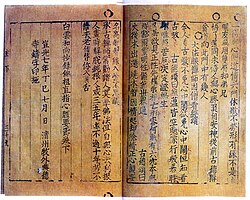
The transition from handwritten to printed text began with woodblock printing, where text was carved into wooden blocks. This evolved into movable type, which allowed individual characters to be rearranged and reused. Korea produced the earliest known book printed with movable metal type in 1377, while the Gutenberg Bible in the mid-15th century marked a turning point for printing in the West.


Modern Manufacturing
Industrialization introduced mass production, leading to the distinction between hardback (sturdy covers) and paperback (flexible, cheaper covers) editions. The publishing process now involves a complex chain of creation and dissemination, often managed by commercial publishing companies.

The Digital Age and Accessibility

Ebooks and Audiobooks
The late 20th and early 21st centuries saw the rise of ebooks (electronic books) and audiobooks (recorded readings). These formats have fundamentally changed how content is consumed, allowing for instant distribution and portability across various devices.


Inclusive Publishing
Technological advancements have also improved accessibility. Braille printing and large-print editions ensure that individuals with visual impairments or print disabilities can access the same knowledge as sighted readers.
Book Classification and Preservation

Organization and Libraries
To manage the vast number of published works, libraries use sophisticated classification systems and call numbers to organize books on shelves. This allows researchers and the public to locate specific titles among millions of volumes.


Conservation and Ethics
Conservation involves the scientific preservation of old books to prevent decay. However, the history of the book is also marked by conflict; book censorship and book burning have been used throughout history to suppress ideas and control information.


| Era/Format | Primary Material | Key Characteristic |
|---|---|---|
| Ancient Tablets | Clay/Stone | Durable, etched symbols |
| Scrolls | Papyrus/Parchment | Rolled sheets, linear reading |
| Codex | Paper/Vellum | Bound pages, random access |
| Printed Book | Paper/Ink | Mass production via press |
| Digital Book | Electronic Screens | Instant distribution, searchable |
Frequently Asked Questions



What is the difference between a manuscript and a printed book?
A manuscript is a work written by hand, whereas a printed book is produced using a printing press or digital printer, allowing for multiple identical copies to be created quickly.
What is a codex?
A codex is the ancestor of the modern book, consisting of separate pages bound together on one side, which replaced the earlier scroll format.
How are fiction and non-fiction books distinguished?
Fiction contains narratives that are imagined or invented by the author, while non-fiction is intended to provide factual information and truth.
What are the benefits of accessible publishing formats?
Formats such as braille and large-print editions allow people with print disabilities to read and access information that would otherwise be unavailable in standard print.
What is the role of a conservation technician in libraries?
Conservation technicians use scientific methods and tools, such as microscopes, to examine and repair old or damaged books to ensure they are preserved for future generations.