Bombay Engineer Group: The Legacy of the Bombay Sappers
The Bombay Engineer Group, widely known by the informal title Bombay Sappers, is a distinguished regiment of the Corps of Engineers of the Indian Army. With a history spanning over two centuries, the group serves as a vital combat support element, specializing in combat engineering to ensure the mobility and success of army operations.
Based at their headquarters in Khadki, Pune, Maharashtra, the Bombay Sappers have evolved from a small colonial force into a modern military powerhouse. Their motto, "Sarvatra!" (meaning "Everywhere"), reflects their versatility and readiness to deploy in any environment, from high-altitude borders to disaster-stricken civilian areas.
Key Facts
- Active Period: 1780 to present.
- Role: Combat Engineers providing combat support.
- Headquarters: Khadki, Pune, Maharashtra.
- Motto: Sarvatra!
- Unique Capability: The only engineer group with a Parachute Field Company (411 Independent Parachute Field Company).
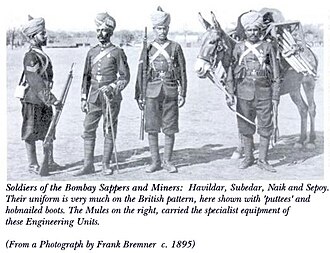
- Highest Honors: Recipients of the Param Vir Chakra and Ashok Chakra (Post-Independence) and the Victoria Cross (Pre-Independence).
Historical Evolution
Origins and the Pioneer Lascars
The lineage of the Bombay Sappers began in the late 18th century during the British Raj. In 1777, Major Lawrence Nilson, the first Chief Engineer of the Bombay Presidency, formed a company of 100 Pioneer Lascars (native soldiers tasked with construction and clearing). By 1781, they were recognized as a Pioneer Corps, playing a critical role in the Second and Third Mysore Wars against Tipu Sultan.
Throughout the early 1800s, the corps expanded and contracted based on military needs. They provided essential road construction and surveying in Malabar and Kanara and were instrumental during the Second Maratha War under Sir Arthur Wellesley (the future Duke of Wellington), where they maintained vital communication lines and transported heavy artillery.
The Rise of the Sappers and Miners
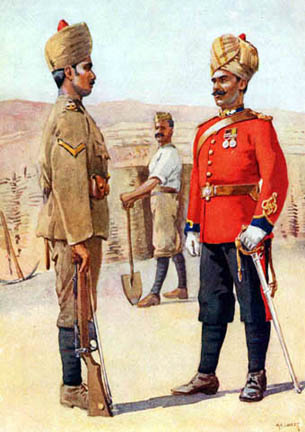
While the Pioneers focused on construction, a separate company of Engineer Lascars—specialists in technical engineering—was raised in 1820 as the "Sappers and Miners Company." This unit became the first to operate abroad in 1821, fighting pirates on the Arabian coast and earning the corps' first battle honour, Beni Boo Alli.
By 1840, the various pioneer and sapper units were amalgamated into the Bombay Sappers & Miners. This unified force spent the 19th century operating across the globe, including campaigns in Persia, Abyssinia, China, and Somaliland, as well as internal conflicts during the Anglo-Sikh Wars and the aftermath of the 1857 Mutiny.
The World Wars and Transition to Independence
During World War I, the regiment expanded massively to support the British Empire, fighting in Europe, Palestine, Mesopotamia, and East Africa. In recognition of their extraordinary service, the title "Royal" was bestowed upon them in 1921, renaming them the Royal Bombay Sappers and Miners.
World War II saw further expansion, with the group deploying to Malaya, Singapore, Burma, North Africa, Italy, and Greece to fight Axis forces. Following India's independence, the group integrated into the Corps of Engineers of the independent Indian Army.
Regimental Composition and Modern Role
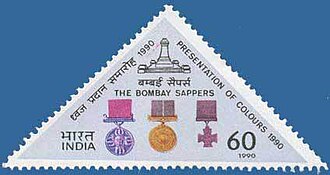
Today, the Bombay Engineer Group maintains a diverse class composition to reflect the inclusive nature of the Indian Army:
- Marathas: 40%
- Mazhabi and Ramdasia Sikhs: 40%
- Hindustani Mussalmans: 10%
- Other Indian Castes: 10%
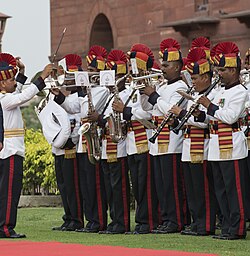
Beyond combat, the group is renowned for its contributions to peacetime activities, including prestigious construction projects, disaster relief operations, and aid to civil authorities. Their specialized 411 (Independent) Parachute Field Company, based in Agra, provides elite airborne engineering capabilities.
Summary of Regimental Details
| Category | Details |
|---|---|
| Branch | Corps of Engineers, Indian Army |
| Training Centre | Khadki, Pune |
| Pre-Independence Awards | 3 Victoria Crosses, 3 Medaille Militare |
| Post-Independence Awards | 1 Param Vir Chakra, 1 Ashok Chakra |
| Key Historical Units | Pioneer Lascars, Pontoon Train |
Frequently Asked Questions
What is the difference between a Sapper and a Pioneer?
Historically, Pioneers were primarily responsible for heavy construction, road building, and clearing paths, while Sappers and Miners focused on more technical engineering tasks, such as fortifications, demolition, and bridging.
Where is the Bombay Engineer Group headquartered?
The group's training centre and headquarters, the Bombay Engineer Group and Centre, are located in Khadki, near Pune, in the state of Maharashtra.
What is the significance of the motto "Sarvatra!"?
The motto "Sarvatra!" translates to "Everywhere," symbolizing the regiment's ability to operate in any terrain or condition, whether in war or during peacetime disaster relief.
Which elite unit is unique to the Bombay Engineers?
The Bombay Engineers are the only engineer group to possess a Parachute Field Company, specifically the 411 (Independent) Parachute Field Company of the 50th (Independent) Parachute Brigade in Agra.
What are some of the most prestigious awards won by the group?
The group has earned the highest military honors of both the British and Indian eras, including three Victoria Crosses before independence and the Param Vir Chakra and Ashok Chakra after independence.